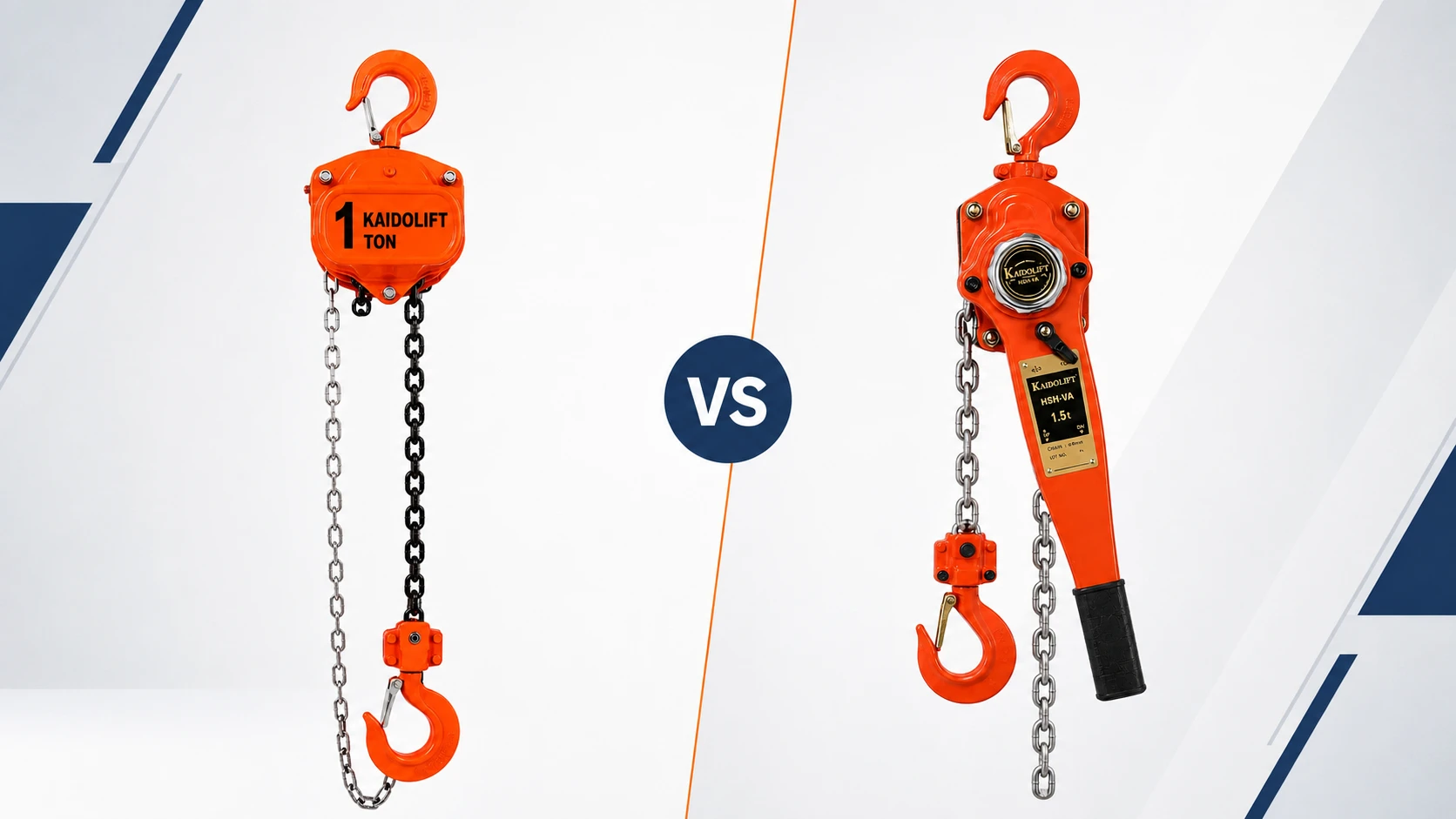
Manual Chain Hoist vs Lever Hoist: Key Differences and How to Choose
Manual chain hoists and lever hoists both use mechanical advantage to move loads without electricity, but they are not interchangeable. The correct choice depends on what the load must do, where the operator can stand, how the hoist will be supported, how much travel is required and whether the job involves lifting, pulling or tensioning.
Choosing by capacity alone can create an awkward or unsafe arrangement. A chain block may have the required rated capacity but be difficult to operate in a horizontal position. A lever hoist may be compact enough for the work area but require more handle movement than the available space permits. The supporting beam, trolley, anchor point, slings and attachments must also suit the complete load path.
In this guide, manual chain hoist means a hand-chain-operated hoist, commonly called a chain block. A lever hoist is also manually operated, but it is controlled by a ratcheting lever rather than a separate hand-chain loop.
Quick answer: Choose a manual chain hoist for controlled vertical lifting from an overhead suspension point, especially at a fixed workstation or where a longer lift is required. Choose a lever hoist for short-travel lifting, controlled pulling, load positioning or tensioning when the specific model is approved for that use. Always verify rated capacity, load direction, lift or reach, headroom, handle clearance, support structure, environment and applicable documentation before use.
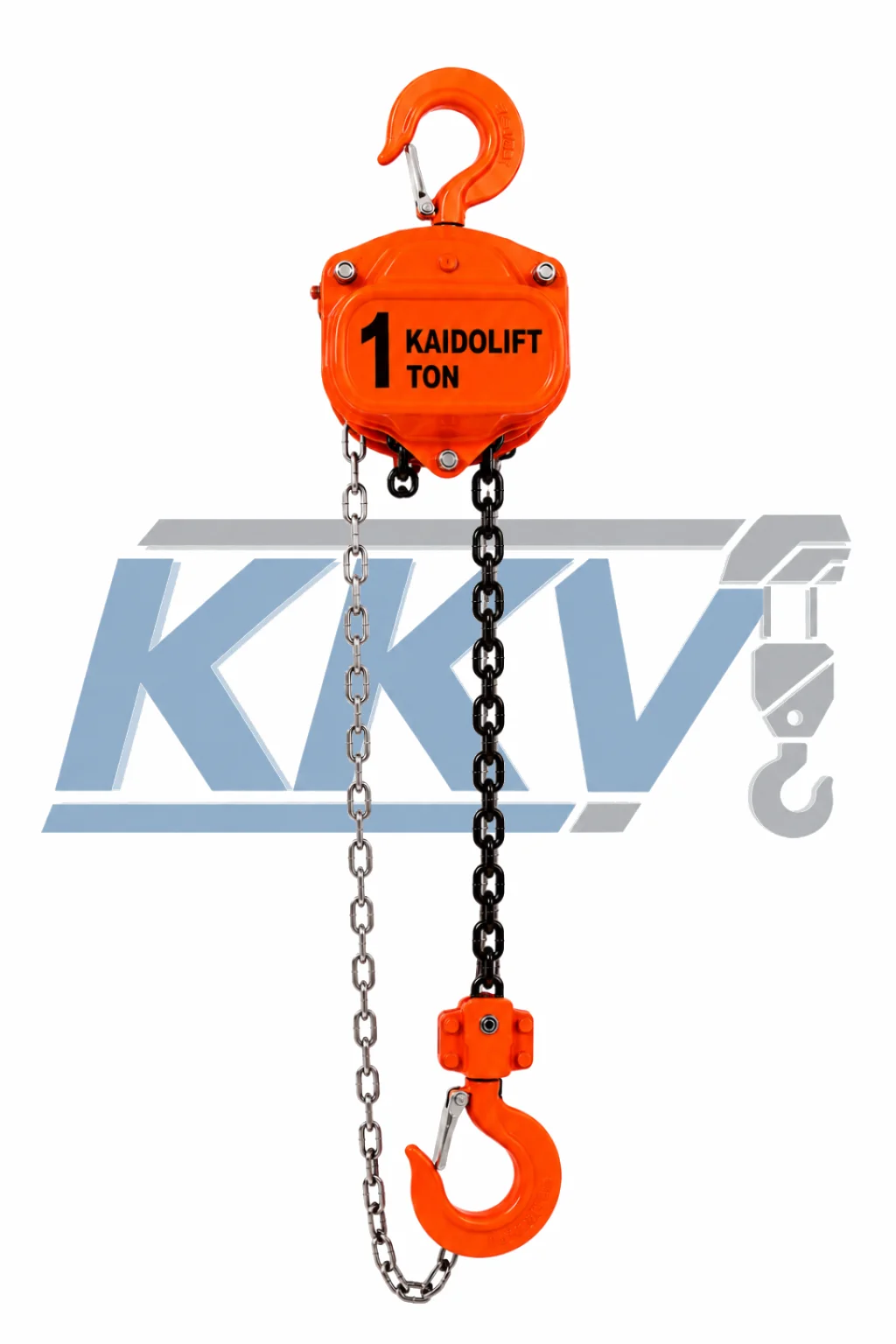
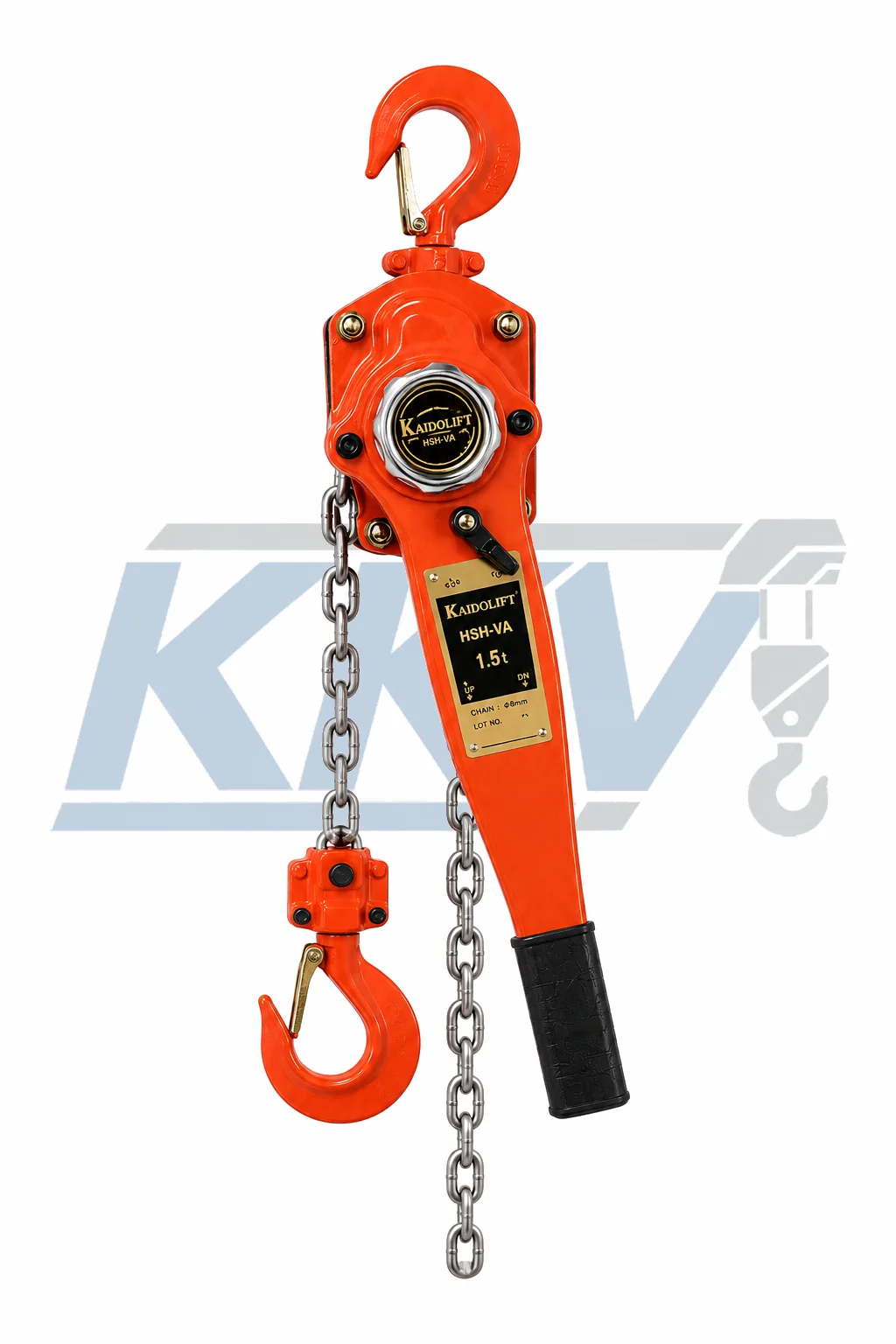
Table of contents
- Manual chain hoist vs lever hoist at a glance
- What is a manual chain hoist?
- What is a lever hoist?
- Seven key differences
- Which hoist fits each application?
- A six-question selection process
- Worked selection examples
- KKV product starting points
- Information to include in an RFQ
- Common selection and operating mistakes
- Safety and pre-use checks
- Frequently asked questions
Manual Chain Hoist vs Lever Hoist at a Glance
| Selection point | Manual chain hoist | Lever hoist |
|---|---|---|
| Common names | Chain block, hand chain hoist, chain fall | Lever block, ratchet lever hoist, chain puller; sometimes called a come-along |
| Operator input | The operator pulls an endless hand-chain loop | The operator moves a handle back and forth |
| Primary task | Raising and lowering a freely suspended load from an overhead point | Lifting, pulling, tensioning and short-travel positioning when the model permits |
| Typical load path | Straight vertical lifting | Vertical, horizontal or angled line of pull, subject to the manufacturer’s instructions |
| Best operating position | Fixed or trolley-mounted overhead lifting point | Close to the load and attachment points |
| Travel | Often practical for longer vertical lift | Often practical for shorter, incremental movement |
| Space to verify | Headroom plus hanging hand-chain clearance | Headroom plus room to sweep the operating handle |
| Portability | Portable models are available, but often installed at a lifting point | Frequently selected for mobile maintenance and field rigging |
| Horizontal movement | Use a suitable trolley if the suspended load must travel along a beam | Can pull or position a load along the permitted line of pull; it does not replace a beam trolley |
| Standards commonly referenced in the United States | ASME B30.16 for applicable overhead underhung and stationary hoists | ASME B30.21 for applicable lever hoists |
This table is a starting point, not permission to use every lever hoist in every orientation. Product design and instructions differ. The nameplate, operating manual and documentation for the exact model always control.
What Is a Manual Chain Hoist?
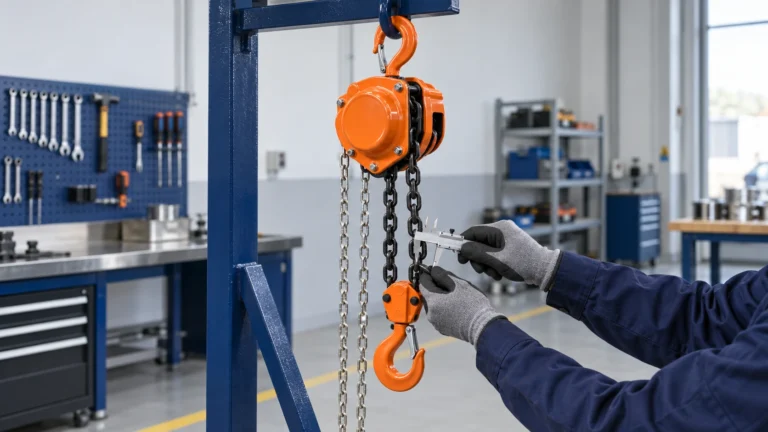
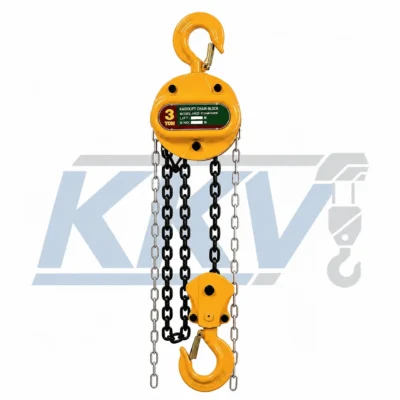
A manual chain hoist is a hand-operated device used to raise, lower and hold a freely suspended load. It is commonly called a chain block, hand chain hoist or chain fall.
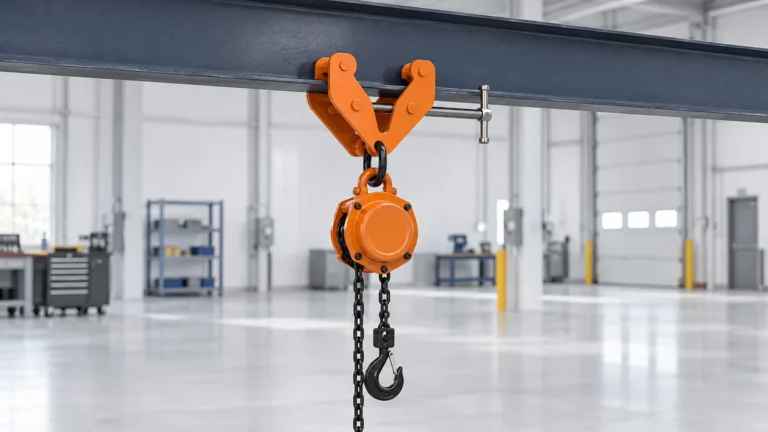
The operator pulls an endless hand chain. This turns a hand wheel and internal gears, which drive the load chain over a load sheave. The gear reduction multiplies the operator’s input, while the braking mechanism controls and holds the load. The upper hook or suspension fitting connects the hoist to a suitable overhead support, and the lower hook connects to properly selected rigging or an approved attachment on the load.
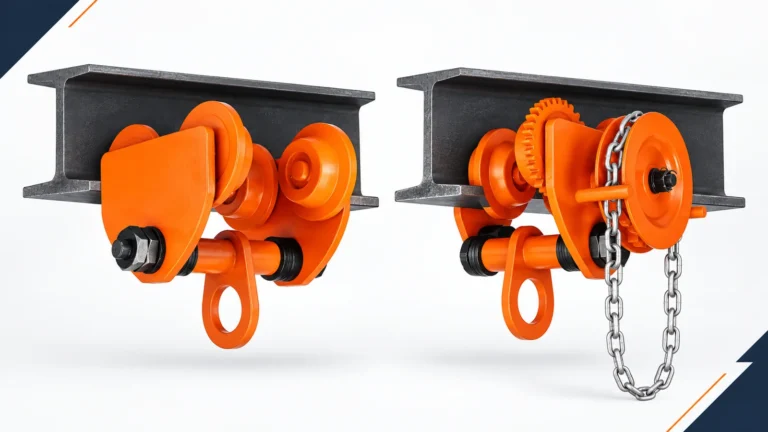
Manual chain hoists are commonly used at workshop lifting points, maintenance stations, warehouses, fabrication areas, construction sites and temporary installations where electrical or pneumatic power is unavailable or unnecessary. A suitable push or geared trolley can add controlled travel along a compatible beam.
The important limitation is the load path. A conventional hand chain hoist is primarily intended for straight lifting and lowering with the hoist, load chain and hooks correctly aligned. If the suspended load must travel horizontally, move the suspension with a suitable trolley rather than dragging the load sideways with the load chain.
For a more detailed capacity, lift and headroom checklist, see How to Choose a Manual Chain Hoist.
What Is a Lever Hoist?
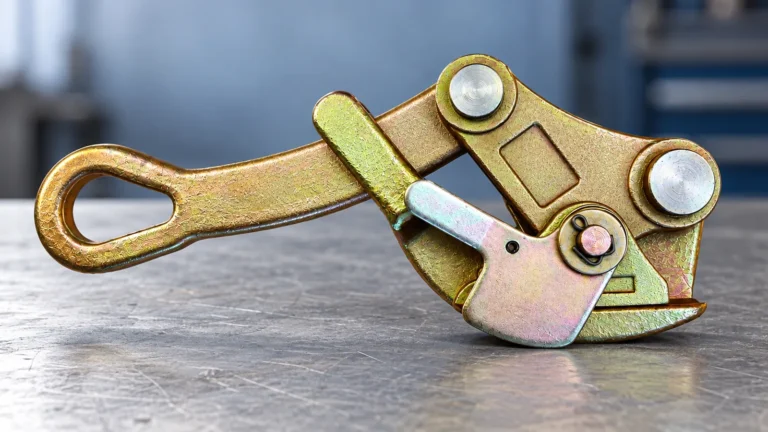
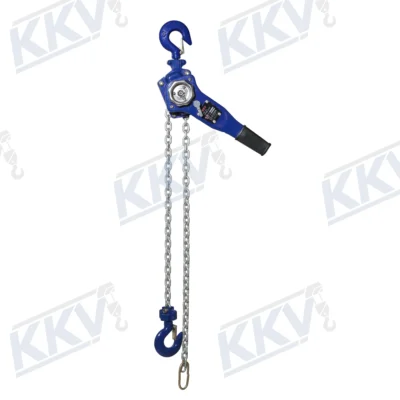
A lever hoist is a compact manually operated device that moves a load by means of a reciprocating handle, ratchet or gear mechanism, load chain and hooks. It may also be called a lever block, ratchet lever hoist or chain puller. The term come-along is used inconsistently and can also describe a wire-rope pulling device, so purchase specifications should identify the actual mechanism and rated function.
The operator selects the permitted direction and moves the handle through repeated strokes. Each stroke advances the load chain in small increments. Many models include a free-chaining function that allows rapid unloaded chain adjustment, but that function must only be used in the condition described by the manufacturer. It is not a way to release or move a suspended load.
Lever hoists are often selected for machinery positioning, steel erection, pipe alignment, construction, maintenance, shipyard work and other tasks requiring a portable tool and controlled short movement. Depending on the exact model, they may be rated for lifting, pulling and tensioning in more than one orientation.
That capability does not eliminate alignment requirements. The upper and lower hooks, attachment points and hoist body must be loaded in the intended line. Do not side-load a hook, support a load on a hook latch, twist the chain or allow the body to bind against a structure.
Seven Key Differences Between a Chain Block and a Lever Hoist
1. Hand Chain Operation vs Ratcheting Handle
A chain block uses two chains for different purposes. The hand chain is the control the operator pulls; the load chain carries the load through the hoist mechanism. Continuous hand-chain pulling raises or lowers the hook.
A lever hoist has no separate operating hand-chain loop. The operator moves a handle back and forth, and a direction selector controls raising or lowering. This can be convenient close to the work, but the lever needs a clear arc. A very confined location may fit the hoist body while still leaving too little room to operate the handle.
Do not compare the two tools only by the physical effort felt during one demonstration. Full-load hand-chain pull, lever pull, handle length, gear ratio and the number of load-chain falls vary by model and capacity. Compare the technical data for the exact configuration.
2. Vertical Lifting vs Lifting, Pulling and Tensioning
The clearest functional difference is the intended task.
A manual chain hoist is normally selected to lift and lower a freely suspended load vertically from an overhead point. In the United States, the published scope of ASME B30.16 includes applicable hand-chain-operated overhead underhung and stationary hoists used for vertical lifting and lowering.
ASME B30.21 covers applicable lever hoists used for lifting, pulling and tensioning. This broader scope explains why a lever hoist is commonly selected for horizontal or angled positioning work.
However, the standard category is not a substitute for the product manual. Before using a lever hoist horizontally or at an angle, verify that the manufacturer permits the intended orientation, that the support and attachment points are rated, and that the chain and hooks remain correctly aligned with the load path.
3. Longer Lift vs Short Incremental Positioning
For a load that must rise several metres from a fixed overhead point, a hand chain hoist is often the more practical manual option. The operator can continue pulling the hand chain while the lifting mechanism remains overhead. The hand-chain length can be specified to suit the operating level.
A lever hoist advances the chain through repeated handle strokes. It excels at controlled, incremental movement, but a long travel distance can require many strokes and repeated repositioning by the operator. Exact lift, reach and chain length still need to be specified; neither product should be operated beyond its travel limit.
Do not confuse lift with headroom. Lift is the available hook travel. Headroom is the hook-to-hook distance consumed by the hoist when the lower hook is at its highest permitted position.
4. Operator Location and Required Clearance
With a chain block mounted overhead, the operator usually works below and to the side of the hoist using the hanging hand chain. This can be useful when the suspension point is well above normal reach, provided the operator remains clear of the load and the hand-chain length is correct.
A lever hoist normally places the operator closer to the hoist body and load path. This can improve access for alignment work but also means the operator needs secure footing, a usable handle position and enough clearance to complete each stroke without contacting nearby steelwork, machinery or rigging.
For both types, measure the actual work envelope rather than checking only whether the body fits. Include hooks, load block, chain bag if fitted, hand-chain loop, handle movement, slings and the path of the load.
5. Fixed Installation vs Mobile Rigging
Manual chain hoists are frequently left at a fixed lifting point or paired with a trolley on a workshop beam. They can also be moved between points, but the hand chain and longer chain lengths may be less convenient to transport and manage.
Lever hoists are commonly selected for mobile maintenance, erection and rigging because the control is integrated into the body and compact versions are easy to carry. This is a typical tendency, not a universal rule. Compare the net weight and dimensions of the exact capacity; a higher-capacity lever hoist may be heavier than a smaller chain block.
Whichever tool is moved between locations, every new suspension or anchor point must be verified. A rated hoist does not make an unknown beam, clamp, pad eye or structure suitable.
6. Repeated Lifting and Productivity
For intermittent lifting, both devices can be economical because they need no external power. Task frequency changes the decision.
A hand chain hoist may suit repeated vertical lifts at a fixed workstation when the speed and operator effort are acceptable. A lever hoist may be more efficient for short positioning corrections, alignment and tensioning. For frequent production lifting, long travel, high cycle counts or a job where manual effort becomes excessive, an electric hoist may be more appropriate.
Do not assume that one manual type is always faster. Operating speed depends on the exact gear ratio, load, travel, operator position and procedure. The purchasing question is whether the tool can complete the required work consistently without encouraging rushed or improper operation.
7. Applicable Standards and Documentation
The two product categories may fall under different standards and inspection requirements. For example:
- ASME B30.16 covers applicable overhead underhung and stationary hoists, including hand-chain-operated hoists.
- ASME B30.21 covers applicable ratchet-and-pawl and friction-brake lever hoists used for lifting, pulling and tensioning.
Other countries, industries and sites may require different standards, inspection intervals, certificates or markings. State the destination country, workplace rules and tender requirements in the RFQ. Ask for documentation for the exact model, capacity, lift and configuration instead of assuming that a certificate for one series covers every variation.
Which Hoist Fits Each Application?
| Application | Usually the better starting point | Why | What must still be checked |
|---|---|---|---|
| Raising machinery from a workshop floor | Manual chain hoist | Controlled vertical lifting from an overhead point | Total load, lift, headroom, beam and rigging |
| Moving a suspended load along an I-beam | Manual chain hoist with a suitable trolley | The trolley provides controlled beam travel | Beam profile, flange width, trolley capacity and end stops |
| Aligning machinery during installation | Lever hoist | Short, precise positioning between suitable attachment points | Permitted direction, anchors, handle clearance and load path |
| Pulling structural members into position | Lever hoist, if approved for the task | Ratcheting control suits incremental pulling | Rated pull, attachment points, hook alignment and stored energy |
| Applying controlled tension | Lever hoist, if the model permits tensioning | Compact tool can hold and adjust line tension | Required tension, measurement method and site procedure |
| Long vertical lift without power | Manual chain hoist | Continuous hand-chain operation is often more practical | Lift length, hand-chain length, chain falls and operating effort |
| Temporary field maintenance | Lever hoist or compact chain block | Choice depends on movement direction and available support | Tool mass, capacity, environment, access and travel |
| Repeated production lifting | Electric hoist may be preferable | Reduces repetitive manual operation and can improve cycle time | Duty, speed, controls, power, headroom and maintenance |
The phrase “usually the better starting point” is deliberate. Site conditions and manufacturer instructions can change the answer.
A Six-Question Selection Process
1. What Must the Load Do?
Write the required movement in plain language: raise four metres, lower into a pit, pull 500 millimetres for alignment, hold while bolts are fitted, or apply controlled tension. Do not use the vague description “move a load.”
If the task is a straight vertical lift from an overhead point, begin with a manual chain hoist. If it is short-travel positioning, pulling or tensioning, begin with a lever hoist whose instructions allow the task.
2. What Is the Maximum Load Applied to the Hook?
Include the payload plus slings, shackles, lifting beams, spreaders and other below-the-hook equipment. Select a rated capacity that is at least equal to the maximum total load and meets the applicable lifting plan and site rules.
Never use proof-test load, brake setting or a load-limiter threshold as working capacity. If the load weight is unknown, determine it using a reliable method before selecting or operating the hoist.
3. How Much Lift or Reach Is Required?
For a vertical lift, measure the required hook travel between the lowest pickup and highest landing positions. For pulling or positioning, measure the distance between attachment points, the required movement and the chain take-up needed to connect the hoist.
Allow for rigging length and final hook positions. Do not plan to splice, weld or improvise an extension to the load chain.
4. How Much Space Is Available?
For a chain block, check minimum hook-to-hook distance at the upper position, clearance for the hand chain and access for the operator. For a lever hoist, also check the length and sweep of the handle through its complete operating arc.
If the load must finish close to a beam or ceiling, compare capacity-specific headroom dimensions. A compact-looking housing does not by itself guarantee the best headroom.
5. What Supports the Hoist?
Identify the beam, trolley, clamp, pad eye, lifting point or other structure. Record dimensions and rated capacity where applicable. The support and every connector in the load path must be suitable for the forces and direction involved.
For pulling or angled work, consider how the force acts on both anchors. A point designed only for a vertical load may not be suitable for a lateral or angled force.
6. What Operating Conditions and Documents Apply?
State whether the work is indoors or outdoors and whether moisture, salt, dust, chemicals, heat, cold or an explosive atmosphere may be present. Standard products are not automatically suitable for corrosive, marine, food-grade, spark-sensitive or other special environments.
Also specify operating frequency, destination, required language, inspection documentation, test certificate, declaration and any applicable standard. The supplier can only confirm the correct configuration when the application is described completely.
Worked Selection Examples
Example 1: Removing a Motor at a Fixed Workshop Bay
The motor and all rigging will be lifted vertically from a beam. The job requires controlled raising and lowering, and the hoist will remain at the workstation.
Starting choice: a manual chain hoist. If the motor must move along the beam after lifting, add a compatible trolley rather than pulling the suspended motor sideways.
Confirm: maximum total load, lift, headroom, beam and trolley data, hand-chain length, operating effort, environment and documents.
Example 2: Aligning Steelwork Before Bolting
Two structural members need a short controlled movement between engineered attachment points. The tool must be carried around the site and used close to the work.
Starting choice: a lever hoist approved for the intended pulling and positioning direction.
Confirm: maximum line load, both attachment points, hook seating, chain alignment, available handle sweep, travel and a procedure for controlling stored energy and completing the connection.
Example 3: Repeated Lifting on a Production Line
A load must be raised many times per shift over the same vertical path. Manual operation is possible, but cycle time and operator effort are becoming significant.
Starting choice: compare an electric hoist with a manual chain hoist instead of assuming that either manual product is the economical answer.
Confirm: duty, starts per hour, average and maximum load, lift speed, controls, power, headroom, trolley travel, maintenance and emergency procedures.
KKV Manual Chain Hoist and Lever Hoist Starting Points
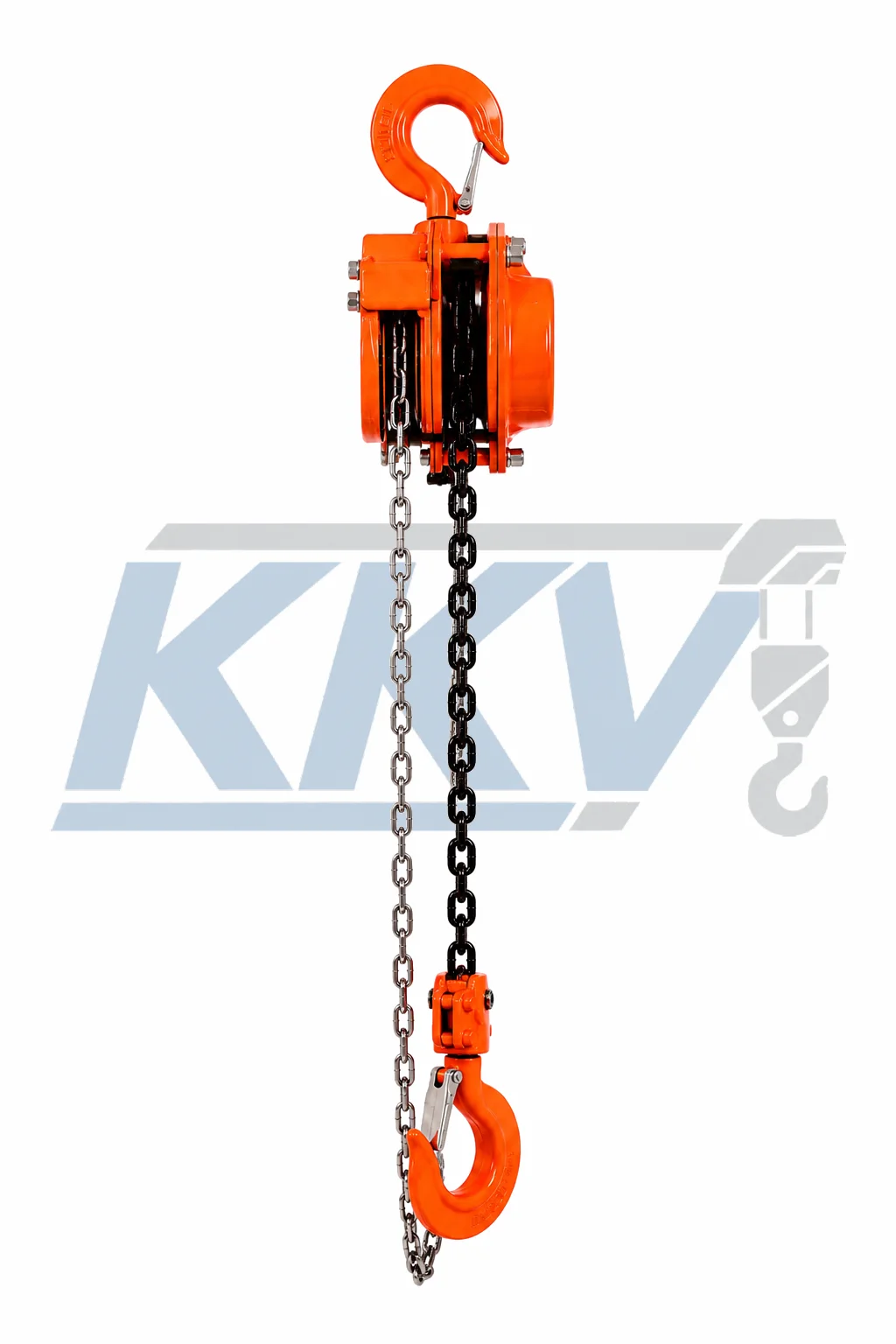
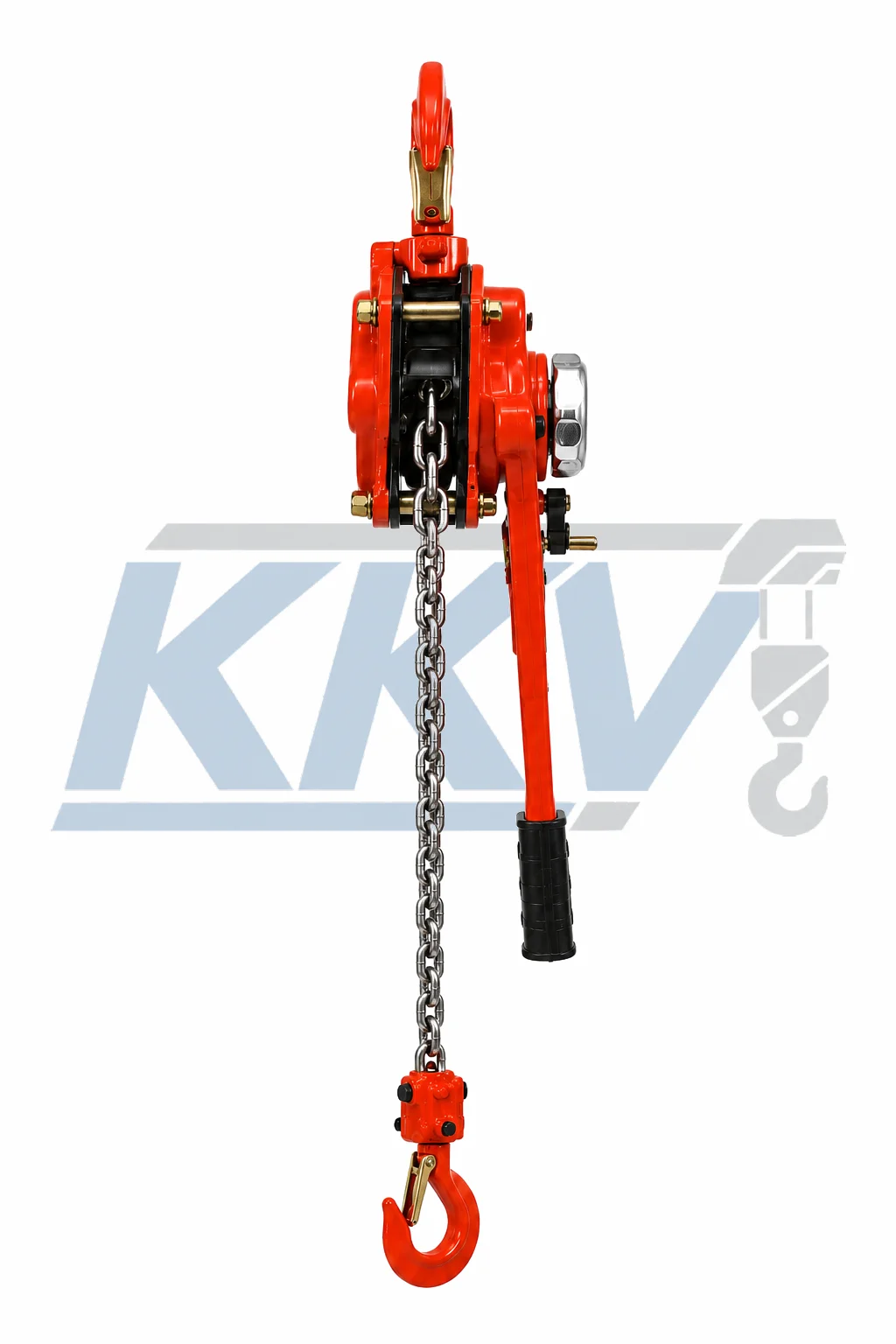
KKV currently lists both product types. For overhead vertical lifting, begin with the HS-VL Manual Chain Hoist or HSZ-T Manual Chain Hoist and then compare the capacity-specific lift, headroom and operating data.
For lifting, pulling, tensioning or positioning work, review the HSH-VA Heavy-Duty Lever Hoist or HSH-VL Lever Hoist, subject to the instructions and permitted uses of the exact model.
These links are product starting points, not a complete selection. Do not compare only the largest capacity shown on each page. Match the required function first, then verify the technical row and documentation for the exact capacity, lift and configuration being ordered.
Information to Include in Your RFQ
| RFQ item | Information to provide |
|---|---|
| Required function | Vertical lifting, lowering, pulling, tensioning or positioning |
| Maximum total load | Payload plus all rigging and below-the-hook equipment |
| Rated capacity requested | Capacity selected from verified load and project requirements |
| Lift or reach | Required hook travel or attachment-point distance |
| Headroom | Available hook-to-hook space at the highest position |
| Suspension or anchors | Hook, trolley, clamp, beam, pad eye or engineered points |
| Beam details | Profile, flange width and other trolley-fit dimensions, if applicable |
| Operator access | Hand-chain drop or available lever-handle sweep |
| Frequency | Occasional, daily, lifts per hour and typical load spectrum |
| Environment | Indoor, outdoor, wet, marine, dusty, corrosive or special atmosphere |
| Options | Load limiter, chain bag, special hooks, corrosion protection or trolley |
| Documentation | Manual, test certificate, declaration, inspection record and required standard |
| Destination | Country, port, language and delivery terms |
Browse KKV’s manual chain hoists and lever hoists to identify a starting series, then send the complete application rather than only a tonnage request.
Common Selection and Operating Mistakes
Treating “Any Angle” as Permission to Side-Load the Hoist
Multi-directional operation does not mean that the hoist can be twisted against a structure or that a hook can be loaded sideways. The body, load chain, hooks and attachment points must remain aligned with the permitted direction of force.
Extending a Lever Handle with a Pipe
Never use a pipe, cheater bar or other extension on a lever-hoist handle. Operate the hoist only with the manual power and number of operators permitted by the manufacturer. If abnormal force is required, stop and check for overload, misalignment, an obstruction or equipment damage.
Using Free-Chaining While the Hoist Is Loaded
If a lever hoist has a free-chaining function, use it only when no load is applied and only as described in the manual. Before loading, disengage free-chain mode and confirm that the direction selector and brake are correctly engaged.
Assuming Two Hoists Automatically Share the Load Equally
Two hoists used together do not automatically carry equal loads. Geometry, rigging elasticity and movement can concentrate force on one unit. Multi-hoist lifting requires a qualified plan, verified load distribution and coordinated operation.
Using a Lever Hoist as a Transport Load Binder Without Approval
Do not use a lever hoist to secure cargo during transport unless the product is specifically approved for that application and all applicable transport requirements are satisfied. Lifting, pulling and transport restraint are different design and regulatory tasks.
Safety and Pre-Use Checks for Both Hoist Types
Selection is only part of the job. A trained or authorized person should inspect, install and operate the equipment according to the manufacturer’s instructions, the lifting plan and applicable workplace requirements.
Before each use, verify at least the following:
- the hoist identity and rated-capacity marking are legible;
- the exact model is approved for the intended lifting, pulling or tensioning task;
- the supporting structure, anchors, trolley, clamps and rigging are suitable;
- the load chain is correctly seated and is not twisted, kinked, stretched, corroded or visibly damaged;
- hooks are not distorted or side-loaded, and the load is seated in the hook saddle rather than on the tip or latch;
- controls, direction selector and brake operate correctly during an unloaded check and a controlled initial tensioning check;
- on a multi-fall unit, the lower hook block has not capsized and every chain fall is correctly routed;
- the load path is clear and all people remain clear of the suspended load and potential line of pull;
- the operator has secure footing and sufficient hand-chain or handle clearance;
- warning labels and required inspection status are present and legible.
Do not exceed rated capacity, use the load chain as a sling, wrap it around the load, lengthen or repair it by welding, use a damaged hoist, lift people, lift over people, or leave a suspended load unattended unless an approved procedure and specific precautions allow it. Remove a hoist from service if it malfunctions or behaves unusually.
Frequently Asked Questions
Is a lever hoist the same as a chain hoist?
Both may use a load chain and mechanical brake, but the operating controls and intended applications differ. A manual chain hoist uses a hanging hand-chain loop and is primarily selected for overhead vertical lifting. A lever hoist uses a ratcheting handle and may be selected for lifting, pulling or tensioning when approved by the manufacturer.
Is a chain block the same as a manual chain hoist?
In common industry usage, chain block, hand chain hoist and manual chain hoist often refer to the same hand-chain-operated lifting device. Product specifications should still state the required capacity, lift, suspension and standard rather than relying on the name alone.
Is a lever hoist the same as a come-along?
The term come-along is often used for a lever-operated puller, but it can describe either a chain lever hoist or a wire-rope pulling tool. Check the mechanism, nameplate and manual. Do not assume that every product sold under that name is rated for overhead lifting.
Can a lever hoist be used horizontally?
Many lever hoists are designed for pulling and positioning as well as lifting, and ASME B30.21 includes lever hoists used for lifting, pulling and tensioning. The exact model must still permit the intended orientation. Keep the hoist, hooks and chain aligned with the load path and verify both attachment points.
Can a manual chain hoist be used horizontally?
A conventional hand chain hoist is primarily selected for straight vertical lifting. Horizontal operation can make the hand chain difficult to control and may fall outside the intended application. Use a lever hoist or another purpose-rated pulling device unless the chain-hoist manufacturer specifically authorizes the arrangement.
Which type is better in a confined space?
A lever hoist is often more compact, but its handle needs room to move. A chain block needs headroom and clearance for the hanging hand chain. Compare the complete work envelope for the exact capacity; do not decide from body dimensions alone.
Which type is better for a long lift?
A manual chain hoist is often more practical for a longer vertical lift because the operator can continue pulling the hand chain from below. Confirm available lift, hand-chain length, headroom, chain falls and full-load operating force for the exact model.
Can either hoist hold a load while work is performed?
A correctly selected hoist may hold a load as part of an approved procedure, but a suspended load should not be treated as a permanent support or left unattended without specific precautions. Follow the manufacturer, lifting plan and workplace rules, and use engineered blocking or supports where the task requires them.
Should I choose the same capacity as the payload weight?
Not automatically. The lower hook also carries slings, shackles, beams and other below-the-hook equipment. Calculate the maximum total load and select a rated capacity that meets or exceeds it, subject to the lifting plan and local requirements.
When should I choose an electric hoist instead?
Consider powered equipment when the task involves frequent cycles, long travel, higher productivity requirements or excessive repetitive manual effort. Compare duty, speed, controls, power supply, headroom and maintenance rather than purchase price alone.
Choose by the Required Movement, Not by the Product Name
The practical choice begins with one question: what must the load do?
Choose a manual chain hoist when the job is primarily a controlled vertical lift from a suitable overhead suspension point. Choose a lever hoist when the job requires portable, short-travel lifting, pulling, tensioning or positioning and the exact model is approved for that application.
In both cases, confirm the maximum total load, required travel, available space, suspension or anchor points, environment, operating frequency and documentation. Neither tool can compensate for an unsuitable support, an unknown load or an improvised lifting method.
For a quotation, send KKV the load weight, required movement, lift or reach, headroom, attachment details, working environment, frequency and destination. The more complete the application data, the more accurately the hoist and configuration can be selected.
Need help comparing a manual chain hoist and a lever hoist? Email sales@kkvhoist.com with your application details and required quantity.
Safety note: This article is general product-selection guidance, not a lifting plan or a substitute for the manufacturer’s instructions, site risk assessment, qualified engineering review, operator training, inspection requirements or applicable law. Never stand under a suspended load and never use a material hoist to lift people unless the complete system is specifically designed and approved for personnel lifting.