Grade 80 Chain Sling Inspection Checklist: Links, Hooks, Master Links, Tags and Removal Criteria
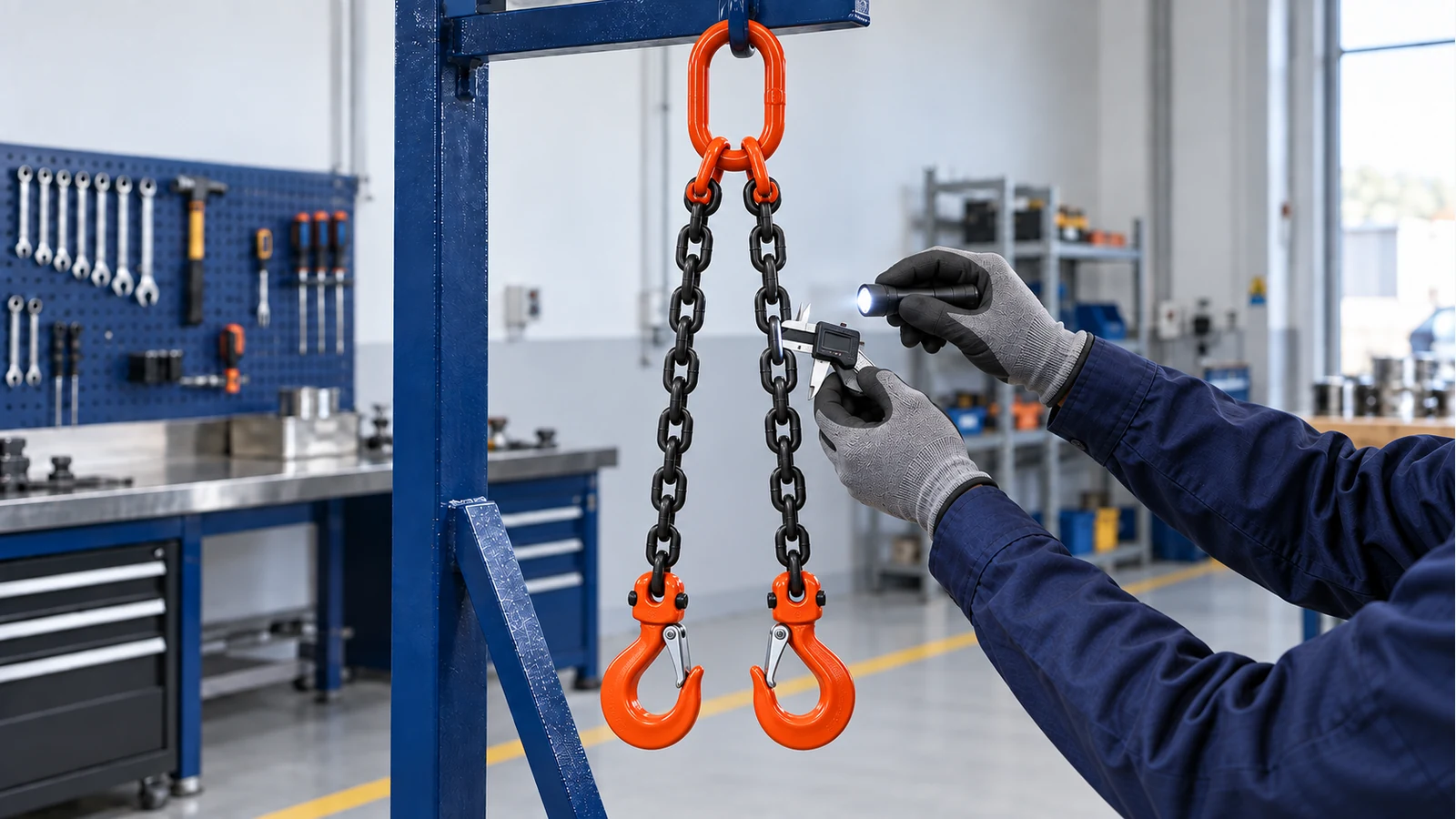
A Grade 80 chain sling can remain intact while wear, heat damage, a distorted master link, an opened hook or a missing identification tag makes the assembly unsuitable for another lift. A useful inspection therefore follows the complete sling from the top connection to every lower fitting, checks each chain link on all sides, confirms the sling’s identity and separates an operator’s pre-use check from a documented periodic inspection.
This guide covers finished alloy-steel chain sling assemblies used for material lifting. It supports users of KKV Grade 80 chain sling assemblies and compatible lifting components, but it does not replace the certificate, tag, manufacturer instructions, applicable standard, local law or competent-person decision for the exact sling.
Grade 80 describes a chain strength class, not the capacity of an unidentified assembly. The Working Load Limit depends on the complete configuration. If that configuration cannot be confirmed, do not accept the sling by appearance alone.
Quick answer: Before each use, identify the exact chain sling and confirm that its tag is readable and appropriate for the planned configuration. Clean and lay out the unloaded assembly, then inspect the master link, every connector, every chain link, shortening devices, hooks and latches. Remove and quarantine the sling if you find a crack, break, bend, twist, stretch, severe wear, gouge, heat or weld damage, harmful corrosion, a distorted fitting, a missing or illegible required tag, an unauthorized repair, or any condition that creates doubt. Measure only against the original dimensions and reject limits for that exact chain and component system.
Table of contents
- Understand What This Checklist Covers
- Separate Pre-Use, Frequent and Periodic Inspection
- Prepare, Clean and Lay Out the Sling
- Verify the Tag, Identity and Service History
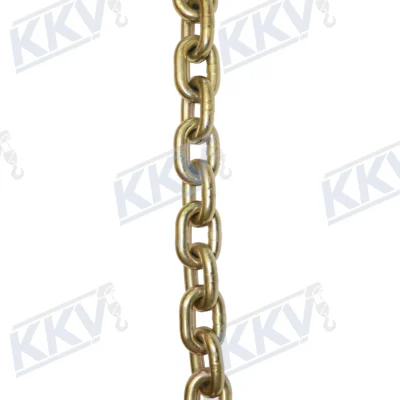
- Inspect Every Chain Link
- Measure Wear and Elongation Correctly
- Inspect Master Links, Connectors and Shorteners
- Inspect Hooks and Latches
- Check Heat, Chemicals, Corrosion and Environment
- Use the Step-by-Step Pre-Use Checklist
- Plan Periodic Inspection, Records and Disposition
- Frequently Asked Questions
- Technical Reference Note
1. Understand What This Checklist Covers
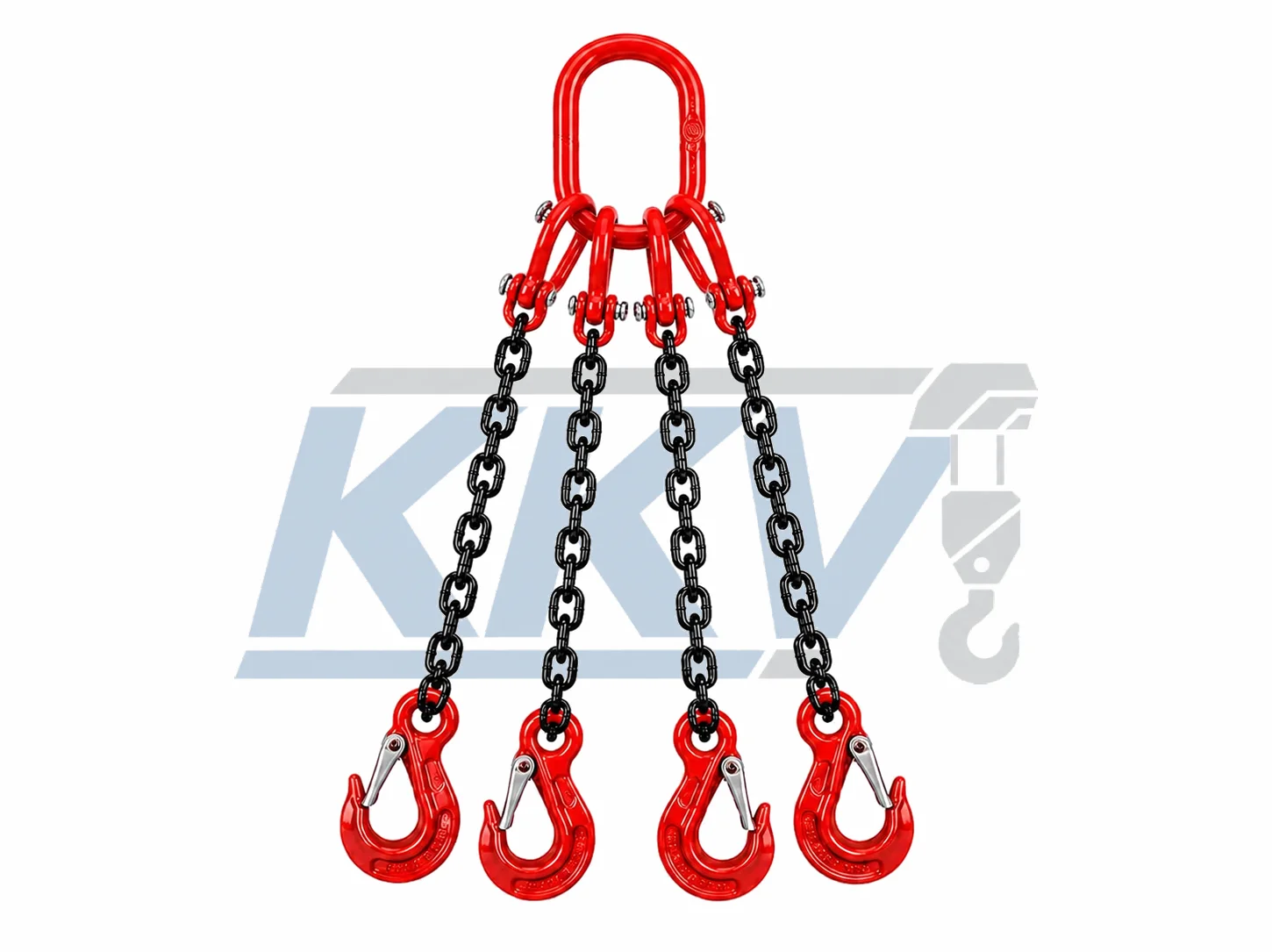
A finished chain sling is an assembly, not simply a length of chain. A typical unit may include an oblong master link, master-link subassemblies, one to four chain legs, coupling links, shortening clutches, grab hooks, sling hooks or other end fittings. Its rated capacity applies only when those parts are compatible and the sling is used in the configuration shown by its tag and manufacturer data.
This checklist is intended to answer four practical questions:
- Can the exact sling and its rated configuration be positively identified?
- Is every load-bearing component free from visible or measurable rejectable damage?
- Has the sling experienced an event or environment that requires a higher-level examination?
- Is there a controlled decision to return it to service, quarantine it or send it for authorized repair?
| Inspection area | What the check establishes | Important boundary |
|---|---|---|
| Tag and records | The sling, grade, size, rated configurations and traceability are known | An old inspection date does not prove today’s condition |
| Master link and top assembly | The crane-hook connection and upper load path remain serviceable | The crane hook and lifting machine need their own inspection |
| Chain legs | Every link is free from rejectable damage and the legs retain their intended reach | A few clean visible links cannot represent the hidden or load-bearing surfaces of the whole leg |
| Couplers and shorteners | Pins, retainers, seats and articulation remain complete and compatible | Bolts, wire, knots and improvised shortening are not acceptable substitutes |
| Hooks and latches | Hook geometry, saddle, tip, eye or clevis connection and retention device remain serviceable | The latch is not a load-bearing part and does not correct poor rigging |
| Complete assembly | The sling is suitable for the planned hitch, leg angle, load and environment | Inspection cannot increase the WLL or authorize an unlisted configuration |
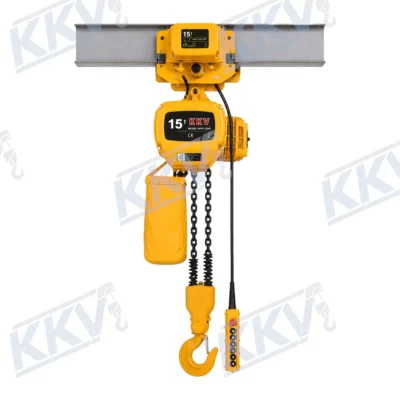
The scope differs from hoist load-chain inspection. A chain hoist uses calibrated chain that must engage a load sheave with controlled pitch and dimensions. Grade 80 sling chain is designed for a sling system and must not be substituted for a manual or electric hoist’s load chain. See Grade 80 lifting chain vs hoist load chain for that distinction.
It also differs from transport restraint. A lifting sling, a load-binding chain and a hoist load chain can share visual features while being governed by different product requirements, ratings and use instructions. Confirm the intended application from the marking and documentation rather than from color or link shape.
2. Separate Pre-Use, Frequent and Periodic Inspection
Inspection depth and authority are not the same at every stage. A practical sling-control program defines who performs each level, what must be recorded and who can decide whether a questionable sling returns to service.
Pre-use or daily inspection. The user checks the tag, visible condition, complete load path and planned configuration before the sling is used. This is a hands-on check of the whole unloaded assembly, not a glance while it hangs on a rack. If the sling remains in use through a changing operation, additional checks may be needed when conditions change.
Frequent or in-service inspection. A designated person examines the sling as often as service conditions require. Abrasive handling, repeated high-cycle work, heat, corrosive exposure, shock loading, sharp edges and rough storage can justify shorter intervals. The terms used for this level vary between companies and jurisdictions.
Periodic inspection. A designated, competent or otherwise authorized person performs and records a detailed examination at an interval determined by the governing requirements, service severity, manufacturer instructions and inspection history. The sling is cleaned sufficiently, every component is accessible, dimensions are compared with the correct criteria and a documented disposition is made.
For U.S. workplaces, OSHA’s alloy-steel chain sling guidance states that a designated or qualified person should inspect the sling and its attachments each day before use, with periodic inspection intervals based on use, severity, nature of lifts and experience; OSHA’s maximum periodic interval is jurisdiction-specific and should not be exported as a worldwide rule. Other countries, projects and standards can use different titles and schedules.
Calendar dates are only part of the program. Trigger a special examination after a suspected overload, shock load, snag, dropped load, impact, fire, arc strike, weld spatter, chemical spill, immersion, uncontrolled heating, severe corrosion, unknown repair, long storage period or any event that may have affected the sling. A tag showing a recent inspection does not cancel damage that occurred afterward.
3. Prepare, Clean and Lay Out the Sling
Inspect the sling without a suspended load in a controlled, well-lit area. Land and secure any load first. Prevent other workers from taking the sling while it is being inspected by using the site’s quarantine tag, locked bin or other approved isolation method.
Gather the documents and tools before starting:
- the sling certificate, register entry and previous inspection report;
- the exact manufacturer’s component catalogue, wear table and instructions;
- a clean surface large enough to lay out every leg without overlap;
- approved lighting and, where permitted, a magnifier;
- calibrated measuring tools appropriate to the specified measurement method;
- an approved cleaning method and materials that will not attack the chain or fittings;
- defect tags, record forms and a controlled quarantine location.
Remove dirt, grease and loose contamination only far enough to see the metal surface and markings. Do not use acid, caustic chemicals, aggressive blasting, uncontrolled heat, grinding or polishing as a quick cleaning method. Such treatment can damage the material or hide evidence. If the manufacturer’s cleaning instructions are unavailable and contamination prevents inspection, quarantine the sling rather than improvise.
Lay the sling out at its natural unloaded length. Separate the legs, remove twists and position each component so all sides can be viewed. Do not force a stiff link or fitting to articulate. Do not hammer a connector, straighten a bent link or pull the assembly under tension merely to make it look normal.
Use a consistent route. Start at the top master link, follow the first leg link by link to its end fitting, return to the top and repeat for every remaining leg. Inspect adjustable sections, intermediate master links, coupling links and unused shortening tails as carefully as the primary load path. A defect does not become acceptable because it is on a part that was not planned for today’s lift.
4. Verify the Tag, Identity and Service History
Positive identification comes before measurement. Confirm that the durable tag or marking belongs to the exact assembly being inspected. Check it against the certificate and register rather than assuming that a loose tag stored nearby belongs to the sling.
The required information depends on the governing system, but a Grade 80 chain sling’s identification commonly needs to support verification of:
- the manufacturer or responsible supplier;
- the individual sling or traceability number;
- chain grade and nominal chain size;
- number of legs and sling type;
- rated load for the permitted hitch and angle ranges;
- reach or effective length where relevant;
- any special limitations, component family or inspection status required by the system.
If the required tag is missing, illegible, detached, inconsistent with the chain or incapable of identifying the rated configurations, remove the sling from service. Do not create a capacity tag from memory, chain diameter, color, a nearby sling or an online chart. A replacement tag should be issued only through an authorized process using traceable records for the exact assembly.
Read intended markings on the chain, hooks, coupling links, master links and shorteners. Mixed brands are not automatically prohibited, but physical assembly does not prove compatibility. The responsible manufacturer or assembler must confirm the complete system.
Review the history before accepting a visually clean sling. Ask about overload, shock, edge damage, heat, welding, chemicals, impact, repair or modification. Compare reach and component arrangement with the original record; unexplained change can indicate stretch or reassembly.
Also verify the intended lift. The tag may rate more than one angle range or hitch, but the planned arrangement must match a listed configuration. A two-leg sling does not automatically have twice the single-leg capacity, and a four-leg sling does not necessarily distribute load equally to all four legs. For selection principles, use the separate Grade 80 lifting chain guide.
5. Inspect Every Chain Link
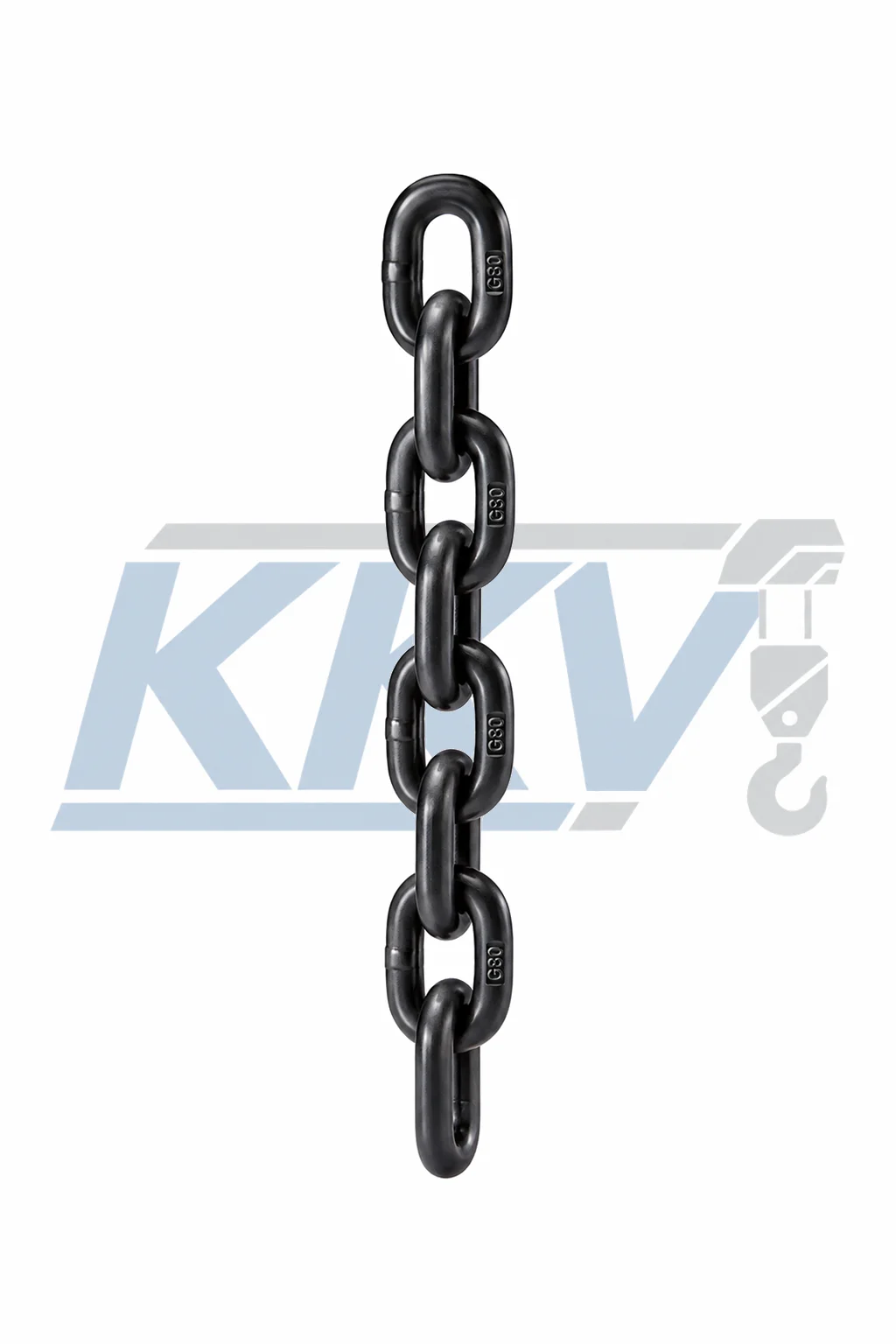
Handle and visually inspect every link. Rotate the chain so both sides, the weld area, the crown and the inner bearing surfaces can be seen. Pay particular attention to the lower portions of legs, the areas that pass over load edges and the links next to end fittings or shortening devices. These locations often experience concentrated wear or damage.
Look and feel for the following conditions:
| Condition | What it can indicate | Immediate inspection response |
|---|---|---|
| Crack or break | Fatigue, overload, impact, embrittlement or severe damage | Stop; quarantine the complete sling and refer for authorized disposition |
| Nick, gouge or sharp notch | Edge contact, impact or cutting action that creates stress concentration | Do not smooth it away; assess with the exact reject criteria |
| Flattened or worn bearing surface | Link-to-link wear, dragging or abrasive service | Clean, measure by the specified method and compare with the correct wear table |
| Elongated, bent or twisted link | Overload, side loading, jamming or heat damage | Remove from service; do not straighten the link |
| Stiff articulation | Deformation, corrosion, paint, debris or incompatible connection | Isolate the cause; do not force the joint free for continued use |
| Pitting or heavy corrosion | Material loss or chemical/environmental attack | Quarantine until remaining section and exposure are evaluated |
| Heat discoloration, scale or arc mark | Temperature exposure, welding or electrical damage | Remove from service and obtain manufacturer or qualified-person direction |
| Weld spatter or unauthorized weld | Local heat effect, surface damage or unapproved alteration | Do not chip, grind or heat-repair the link during inspection |
| Paint or coating that hides the surface | Concealed damage or uncontrolled modification | Use only an approved removal/inspection process or quarantine the sling |
Inner bearing surfaces deserve special attention because adjacent links rub there under load. Slight surface polishing is not automatically a defect, but measurable section loss must be assessed against the correct original dimension and manufacturer table. Measuring only the easiest outside face can miss the controlling wear.
Do not repair a cracked, broken, bent or stretched chain by welding, brazing, heating, hammering, splicing with a bolt or adding an unapproved mechanical link. OSHA’s alloy-chain guidance specifically rejects makeshift repair links and requires cracked, broken or bent links to be replaced through a qualified repair process. The complete sling then needs the inspection, identification and proof-test treatment required by the controlling system.
6. Measure Wear and Elongation Correctly
Measurement is useful only when the inspector has the right baseline, location and reject table. A single internet percentage is not a universal Grade 80 rule. Chain makers can specify different nominal dimensions, tolerances, measurement spans and minimum allowable sections. Hooks, master links and connectors also have component-specific criteria.
Before measuring, confirm:
- the exact chain manufacturer, product family, grade and nominal size;
- whether the table applies to sling chain rather than hoist chain or lashing chain;
- the original nominal or recorded new dimension;
- the required measuring tool, points and orientation;
- whether coating is included in the reference dimension;
- the allowable wear or elongation limit in the controlling document;
- the authority of the person interpreting the result.
For link section wear, the controlling point is often the most worn load-bearing surface, not an average of convenient readings. Clean the surface, locate the minimum section and use the method and tool shown by the manufacturer.
For chain elongation, some procedures measure a specified number of links under defined alignment or light tension. Others compare pitch, leg reach or an individual link dimension. Use the exact procedure. Measuring an unknown number of loose, twisted links and comparing it with a generic formula does not establish acceptance.
Do not mix WLL and inspection calculations. The original design factor is not a wear allowance, and a sling does not gain permission to continue at a reduced self-assigned capacity after it crosses a discard limit. Unless an authorized manufacturer or qualified repair organization provides a recognized re-rating process, a rejected sling remains out of service.
7. Inspect Master Links, Connectors and Shorteners
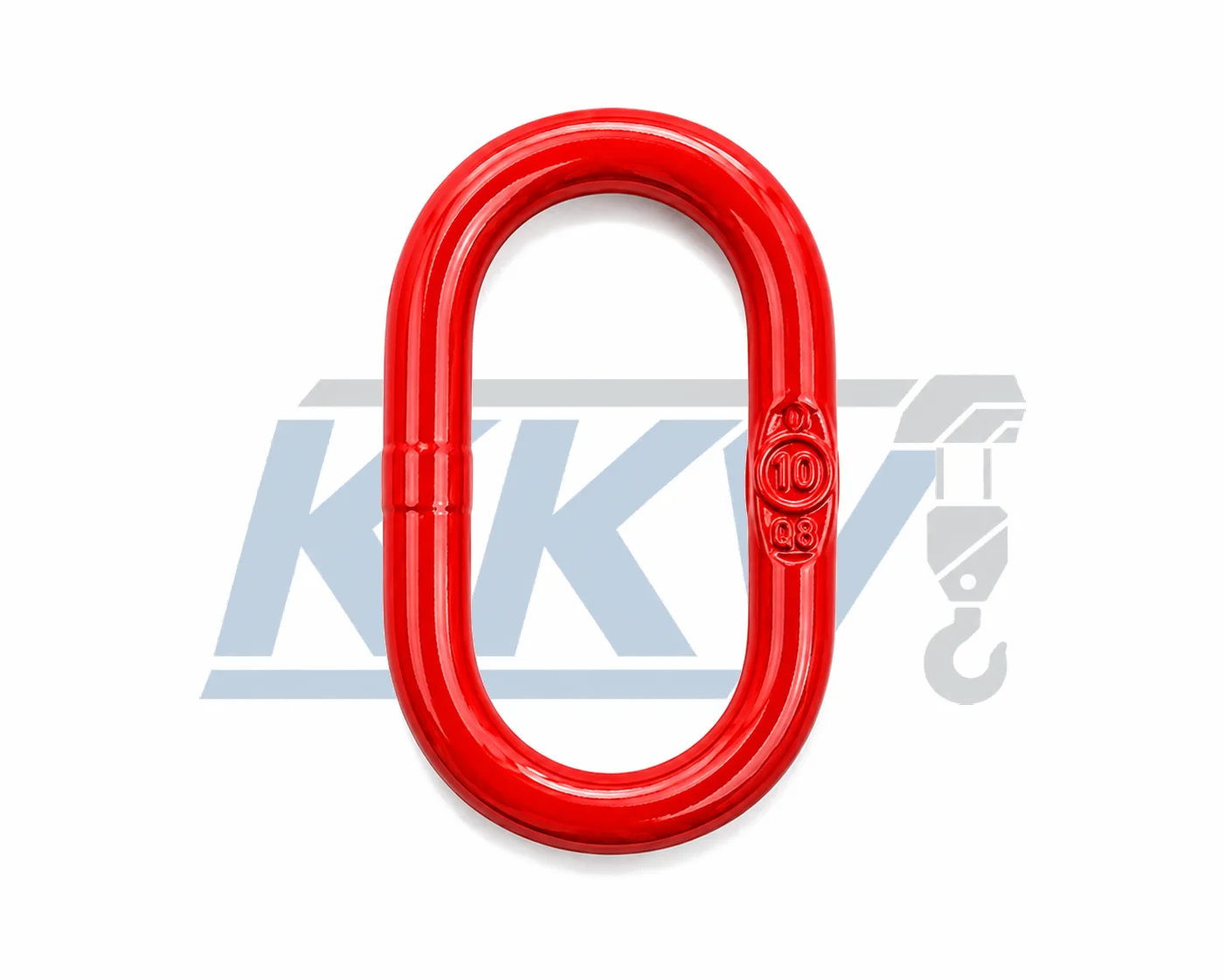
The master link transfers the entire sling load to the lifting-machine hook or other approved connection. Inspect its crown, straight sides and lower bearing regions for cracks, nicks, gouges, wear, flattening, stretch, twist, bend, corrosion, heat damage and unauthorized repair. Confirm that its dimensions and usable opening remain within the exact manufacturer’s criteria.
The master link must seat freely in the crane hook bowl without crowding, point loading, binding against the latch or bearing on the hook tip. Sublinks must articulate without being trapped or side loaded. If the connection does not fit, select an approved interface rather than modifying the link.
Inspect coupling links, hammerlocks and mechanical connectors for:
- matching manufacturer-approved bodies, pins, bushings and retainers;
- complete seating and correct assembly orientation;
- cracks, wear, deformation, corrosion or heat effects;
- bent, loose, displaced, substituted or missing pins and retainers;
- free articulation without excessive looseness or binding;
- evidence of hammering, grinding, welding or field modification;
- compatibility with the connected chain size, grade and fitting.
A hardware-store bolt, split pin, wire tie or fabricated pin is not an acceptable replacement for a designed connector part. Retainers keep the specified load pin in position; they do not make an incompatible pin safe. If the connector’s assembly cannot be verified from manufacturer instructions, quarantine it.
Shortening clutches and grab components concentrate load into selected chain links. Inspect the pocket or seat for wear, cracking, spreading and debris. Check the locking or retaining feature and confirm that the chain is seated in the direction required by the manufacturer. Inspect the engaged link and nearby links for distortion or localized wear.
Never shorten a sling by knotting or twisting the chain, wrapping it around a hook, using a bolt between links or placing an unapproved grab hook into the leg. Do not allow a loose tail to create a snag or enter the load path. Where the component system applies a capacity reduction or a specific reeving rule, keep that instruction with the sling record.
8. Inspect Hooks and Latches
Inspect each sling hook, grab hook, foundry hook or other end fitting by its own manufacturer’s criteria. Begin with the body and connection, then follow the load path through the saddle, throat, tip and any latch or locking mechanism.
Look for cracks, nicks, gouges, wear steps, corrosion, heat discoloration, weld damage, twist, bend, opening and other permanent deformation. Check the eye, clevis, pin, coupling link or swivel connection. Pins and retainers must be the specified parts, fully seated and free from unauthorized modification.
The hook saddle should carry the load as intended. Evidence of repeated tip loading, side loading or latch loading requires investigation. A rigging connection that crowds the throat, bears on the tip or cannot seat in the bowl should be redesigned rather than forced into place.
Check the latch for correct spring action, alignment and closure against the hook tip where the design requires it. A damaged or missing latch is a defect when the hook is designed to use one. However, the latch only helps retain slack rigging; it is not a structural support and must never carry the load. Replacing a latch does not correct an opened, twisted or worn hook.
Measure throat opening, twist and section loss at the defined reference points. Do not copy a hook-opening percentage from another brand. The hook might have model-specific marks or recorded original dimensions. If the baseline is absent, refer the hook to the manufacturer or qualified inspection process instead of inventing one.
For a typical end-fitting example, review the KKV Eye Sling Hook with Latch, while confirming that the exact hook is compatible with the chain and complete sling.
9. Check Heat, Chemicals, Corrosion and Environment
Environmental history can control the decision even when dimensions appear normal. Alloy chain and heat-treated fittings depend on their material properties. Uncontrolled heating, welding, aggressive chemicals or an unsuitable coating process can change those properties without creating an obvious external crack.
Treat blueing, unusual darkening, scale, soot, melted coating, spatter, arc strikes and local surface change as evidence requiring investigation. Record where the sling was and what temperature or process may have been involved. Do not estimate safe exposure from color alone. Manufacturer temperature limits and capacity reductions vary by material and product family.
Chemical exposure requires the substance, concentration, temperature, duration and cleaning response to be identified. Acids and caustics can damage alloy steel or contribute to embrittlement. If the chemical is unknown, quarantine the sling and obtain manufacturer or specialist advice. Neutralizing or rinsing a sling after an uncontrolled exposure does not automatically restore it.
Corrosion should be evaluated for both material loss and cause. Surface rust can conceal pitting at inner bearing areas, under tags, inside connector joints and around hook or master-link contact zones. Clean by an approved method, inspect the deepest affected locations and compare the remaining section with the correct criteria. If corrosion prevents reliable measurement, remove the sling from service.
Galvanized or coated chain is not automatically approved for marine, offshore, chemical, food or high-temperature service. The coating process itself must be compatible with the heat-treated chain, and any later recoating needs manufacturer authorization. Never hot-dip galvanize, plate or heat-treat an existing sling through an uncontrolled local process.
Store chain slings clean, dry and off the floor. Keep tags attached and segregate serviceable, awaiting-inspection and rejected slings. Outdoor storage, salt spray, abrasive dust and chemical vapor should influence inspection frequency.
10. Use the Step-by-Step Pre-Use Checklist
The following sequence is designed for an operator’s external pre-use check. It does not replace a detailed periodic examination, measurement or authorized repair assessment.
| Step | Check | Stop and quarantine when |
|---|---|---|
| 1 | Match the sling tag and traceability number to the planned lift and record | Required identification is missing, illegible, inconsistent or cannot prove the rated configuration |
| 2 | Confirm chain size, grade, leg count, hitch, angle range and WLL for the actual arrangement | The intended use is not shown by the tag or verified manufacturer data |
| 3 | Ask about overload, shock, impact, heat, chemical exposure, repair and unusual events since the last check | A potentially damaging event has not been evaluated |
| 4 | Clean sufficiently and lay every leg out untwisted in good light | Contamination prevents inspection or the sling cannot be safely handled |
| 5 | Inspect the master link, sublinks and upper connection on every side | There is cracking, deformation, harmful wear, heat damage, corrosion, poor fit or doubt |
| 6 | Follow each leg and handle every chain link, including inner bearing surfaces and weld areas | Any link is cracked, broken, bent, twisted, stretched, gouged, severely worn, corroded, heat affected or stiff |
| 7 | Inspect coupling links, pins, retainers and shortening devices | Parts are loose, missing, substituted, damaged, incorrectly assembled or incompatible |
| 8 | Inspect each hook body, saddle, throat, tip, eye or clevis, latch and lock | The hook is opened, twisted, cracked, worn, improperly repaired or unable to retain rigging as designed |
| 9 | Compare leg reach and assembly arrangement with the record where required | There is unexplained length change, unequal configuration or unauthorized component replacement |
| 10 | Record the result and keep rejected equipment physically controlled | The decision, inspector or sling identity cannot be traced |
After connection and before travel, verify that links and fittings are not trapped, twisted, tip loaded or bearing on sharp unprotected edges. Take up slack slowly from a safe position. Inspection does not replace a lift plan, edge protection, exclusion zone or competent operation.
11. Plan Periodic Inspection, Records and Disposition
Periodic inspection should be built around service risk rather than a forgotten annual reminder. Define the normal interval from the manufacturer instructions, governing rules, use frequency, loading severity, environment and inspection history. Shorten it when the sling experiences severe service, repeated edge contact, corrosive conditions, high cycle counts or frequent transport between sites.
A useful inspection record allows another competent person to understand what was examined and why the disposition was made.
| Record field | What to capture | Why it matters |
|---|---|---|
| Sling identity | Unique number, tag details, manufacturer, grade, size, legs and reach | Prevents one sling’s result being assigned to another |
| Inspection basis | Manual, manufacturer table, standard or site procedure and revision | Shows which acceptance criteria controlled the decision |
| Service context | Location, frequency, environment, unusual events and planned use | Explains interval and special inspection needs |
| Findings | Component location, defect type, photographs and actual measurements | Supports trend review and prevents vague “OK” records |
| Measuring equipment | Tool identification and calibration status where required | Makes dimensional results defensible |
| Disposition | Return to service, shorten interval, quarantine, authorized repair or destroy | Prevents an observation from becoming an uncontrolled decision |
| Authorization | Inspector identity, competence/authority and date | Establishes accountability and traceability |
| Repair and test | Parts replaced, repair organization, proof-test evidence and revised tag/certificate | Supports controlled return to service |
Remove from service means the sling is no longer available for lifting. Attach a clear reject tag, place it in a controlled quarantine area and update the register. A red tag hanging on a shared rack is weak control if another worker can remove it and use the sling.
Repair is not an operator activity. Repairs and component replacement should be performed only by the sling manufacturer or another qualified organization authorized under the applicable system. Broken, cracked, bent, stretched or heat-damaged chain must not be field-welded or straightened. The repair organization determines whether repair is permitted, what parts are replaced and what proof test, inspection, marking and certification are required.
Trend the records. Repeated wear at one location can reveal sharp edges, poor storage, an unsuitable connection or a rigging method that needs correction.
12. Frequently Asked Questions
How often should a Grade 80 chain sling be inspected?
Check the complete sling before use and at the additional frequencies required by the governing rules, manufacturer and service conditions. Periodic inspection intervals depend on frequency, severity, environment and experience. Do not treat one country’s maximum interval as a universal rule, and do not wait for the next scheduled date after an overload, impact, heat or chemical event.
Can I use a universal percentage for chain wear or stretch?
No. Use the table and measurement method for the exact chain manufacturer, grade, product family and size. The controlling location can be an inner bearing surface, and elongation procedures can specify a particular span or alignment. A generic online percentage can reject a good chain or, more seriously, accept a damaged one.
What should I do if the identification tag is missing?
Remove the sling from service until an authorized party can positively identify the assembly from traceable records and issue the required identification. Do not estimate WLL from link diameter, color, leg count or a nearby sling. A new blank tag does not create traceability.
Does a current inspection tag mean the sling is safe today?
No. It shows that an inspection was recorded at an earlier time. Damage, overload, heat, corrosion or unauthorized modification may have occurred afterward. The operator still needs a pre-use check and must report any unusual event.
Can a cracked or bent chain link be welded or straightened?
Not as a field repair. Quarantine the complete assembly. Repair or component replacement is limited to the manufacturer or a qualified organization using an approved process, followed by the required inspection, proof test and documentation. Makeshift mechanical links, bolts and low-carbon repair links are not substitutes.
Is a hook safe if only the latch is damaged?
The hook should be removed from service when a required latch is missing or defective until the correct replacement and the underlying cause are addressed. The latch is not load bearing, so replacing it does not make an opened, twisted, cracked or worn hook acceptable.
Can I mix Grade 80 components from different manufacturers?
Only when the responsible manufacturer or qualified assembler confirms compatibility and rating of the complete system. Matching color, nominal chain size or grade marking does not prove that pins, seats, articulation, dimensions, heat treatment and WLL are compatible.
Can I keep using a worn sling at a lower self-assigned capacity?
Not merely by reducing the load. Crossing a manufacturer discard limit means the sling is removed from service. Re-rating, if permitted at all, requires an authorized engineering, repair, test, identification and certification process. The original design factor is not an allowance for continued use after rejection.
Is galvanized Grade 80 chain automatically suitable for marine service?
No. Confirm that the chain, coating process, fittings and complete sling are approved for the actual environment. Salt, chemicals and trapped moisture can cause corrosion, and uncontrolled recoating or galvanizing can damage heat-treated components.
Should every chain link be inspected individually?
Yes. Inspect each link and all sides, including weld regions and inner bearing surfaces. Handle the chain systematically so no section is skipped. A sample of convenient visible links cannot represent the entire leg.
Can Grade 80 sling chain replace a chain hoist’s load chain?
No. Hoist load chain is calibrated for a specific load sheave and hoist design. Grade 80 sling chain is selected for sling assemblies. Even when nominal diameters appear similar, the pitch, dimensions, tolerances and application are different.
13. Technical Reference Note
This guide is based on publicly available scope and safety information from ASME B30.9 Slings, OSHA 29 CFR 1910.184, OSHA’s alloy-steel chain sling guidance, Columbus McKinnon’s alloy chain sling inspection guidance and the current Kito Crosby Chain and Accessories application and warning information.
These references support the general approach of positive identification, complete link-by-link inspection, environment-based frequency, controlled removal from service and qualified repair. They do not make one manufacturer’s wear table, hook-opening limit, temperature reduction or connector instruction applicable to every KKV or third-party component. The purchased standard, local law, exact certificate, current manual, manufacturer criteria and competent-person decision remain controlling.
Build a Traceable Grade 80 Chain Sling Inspection Program
A reliable program connects each physical sling to its certificate and tag, defines what users check before every lift, sets periodic inspection according to service, controls measuring criteria and prevents a rejected assembly from returning to the rack. It also uses defect trends to correct sharp edges, poor storage, unsuitable connections and repeated rigging mistakes.
KKV can help identify a suitable Grade 80 chain sling configuration and provide product information for a quotation. Send the maximum load, centre of gravity, lifting-point layout, hitch, number of legs, sling angle convention, required reach, master-link connection, end fittings, environment, destination, documentation and quantity. Review the KKV Grade 80 chain sling assemblies, G80 blackened lifting chain, master link and complete G80 lifting chain range as starting points.
For product selection or documentation support, contact KKV or email sales@kkvhoist.com with the application details and required quantity.
Safety note: This article provides general inspection guidance. It is not a substitute for the exact manufacturer’s instructions, a competent-person examination, a repair procedure, proof-test authorization or a lift plan. Never exceed the tagged WLL, improvise repairs, use an unidentified sling, stand under a suspended load or place any person in a tightening sling or stored-energy release path.