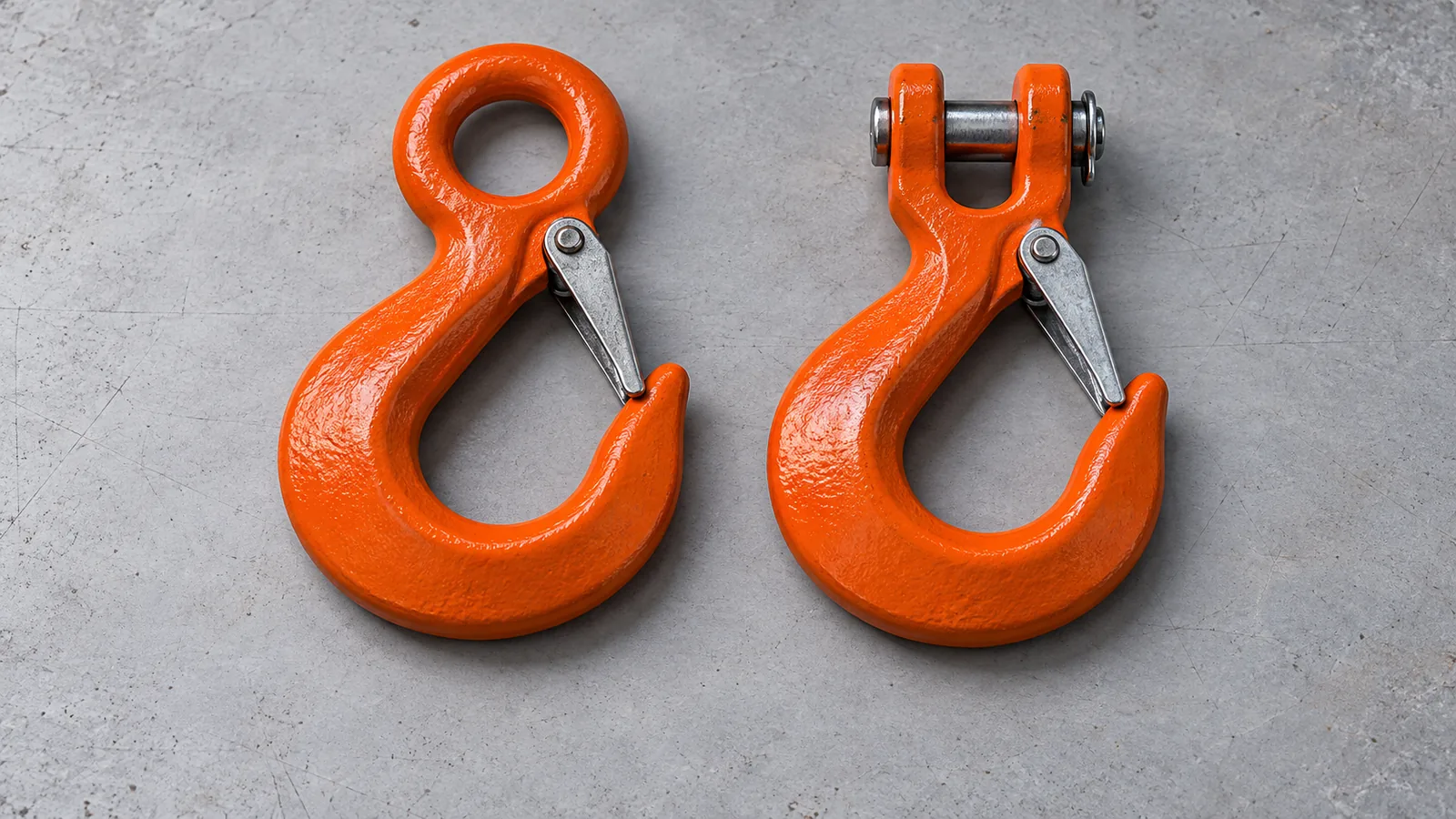
How to Choose a Lifting Hook: WLL, Connection Type, Latch and Compatibility
Knowing how to choose a lifting hook involves more than matching a catalogue capacity to a load weight. The hook must suit the force applied at its position in the sling, the upper connection, the load’s lifting point, the closure mechanism and the working conditions. A hook can have sufficient Working Load Limit and still be unsuitable if the connected fitting cannot seat correctly.
This guide focuses on common sling terminal hooks, including eye and clevis connections. It explains the information a buyer should obtain before ordering a hook or approving a replacement. It is not a procedure for modifying a crane or replacing a hoist’s original top or bottom hook.
Quick answer: Establish the required load at the hook and the complete sling configuration first. Then select an approved eye, clevis or swivel connection with suitable WLL, dimensions and retention or locking features. Confirm compatibility with the chain and connecting components, proper seating at the load, permitted movement, identification and documentation. Do not infer lifting suitability from colour, a grade marking or physical fit alone.
Table of contents
- Define the hook’s role in the lifting system
- Eye, clevis, swivel and shank connections
- Select WLL for the hook and complete assembly
- Safety latch versus self-locking mechanism
- Match the upper connection and pin system
- Check chain grade, size and component identity
- Measure throat opening, bowl and lifting-point fit
- Confirm rotation and working conditions
- A six-step selection process
- Pre-use checks and replacement decisions
- Information to include in an RFQ
- Frequently asked questions
- References and application scope
Define the Hook’s Role in the Lifting System
Start by identifying where the hook will be used. A lower terminal hook on a chain-sling leg is not the same purchasing item as the load hook supplied as part of a hoist, a shortening hook or a hook intended only for load securement.
Record both interfaces: what connects above the hook, and what the hook engages below it. Ask whether the inquiry concerns a new complete sling, a replacement terminal component or a replacement assembly for a particular machine.
Do not assume a familiar shape or grade description establishes overhead-lifting suitability. The CMCO Utility Products Catalogue separates lifting equipment from load-securement hardware and explicitly excludes some hook products from overhead lifting.
For machine replacements, provide the manufacturer, model, serial number and hook-assembly reference. The CMCO Yale/Shawbox replacement-parts manual illustrates why model identification and approved replacement parts matter. A terminal sling-hook comparison does not authorise substitution of a hoist hook.
Eye, Clevis, Swivel and Shank Connections
Connection type describes the upper attachment. It does not, on its own, describe the throat closure, material grade or permission to rotate under load.
| Connection | General arrangement | Information to confirm |
|---|---|---|
| Eye hook | An integral eye accepts an approved connecting arrangement | Eye dimensions, connector fit and system compatibility |
| Clevis hook | A forked connection and specified pin connect to a compatible chain system | Chain size/grade, pin and retaining system, assembly instructions |
| Swivel hook | A swivel forms part of the upper connection | Exact rotation permission, bearing arrangement and maintenance |
| Shank hook | A shank forms part of a designed supporting assembly | Manufacturer-approved shank, thread, nut, bearing and retention details |
This is a selection map, not permission to connect any hook to any sling. Manufacturer product sheets must establish the approved arrangement. For example, the pewag HSWP eye sling hook is offered within a defined connecting system, rather than as a universal fitting.
Which connection should the buyer choose?
For an eye hook, include the proposed coupling component or other approved connection in the inquiry. For a clevis hook, identify the chain and specified pin system. If alignment or rotation is required, describe that need separately rather than simply asking for a swivel.
A useful order line distinguishes connection and closure: for example, an eye connection with a spring retention latch, or a clevis connection with a self-locking mechanism. These are configurations to verify, not interchangeable names.
Shank and machine-integrated hooks require their designed supporting assemblies. Do not create a replacement by machining, threading or modifying a hook to make it fit.
Select WLL for the Hook and Complete Assembly
The required load at a terminal hook depends on its position and the lifting arrangement. In a multi-leg sling, the buyer cannot establish each hook’s requirement simply by dividing the cargo mass by the number of legs.
Provide the load, centre of gravity, attachment-point positions, number of legs and intended angles to the responsible sling designer or lifting planner. Describe foreseeable movement, dynamic effects and snagging risks as well. Avoid shock loading; do not compensate for it simply by selecting a larger catalogue WLL. Obtain the required hook rating and the permitted complete-assembly configuration from that assessment.
For US alloy-steel chain slings, OSHA 1910.184 addresses attachment ratings and the limiting component. Its chain-sling guidance also explains configuration-dependent ratings and the assessment needed for nonsymmetrical loads.
Three capacity questions to keep separate
- Hook rating: What is the marked and documented WLL of this exact model in its permitted application?
- Connected-component rating: Are the chain, coupling component and other fittings compatible and adequately rated?
- Assembly rating: What load may the complete sling carry in the specified configuration and conditions?
Proof-load or breaking-load data are not permission to exceed WLL. Confirm whether capacity is expressed in kilograms, metric tonnes, US tons or force units before comparing quotations.
Do not treat a sling table as a standalone hook table
The KKV Eye Hook With Latch page retains a chain-sling configuration reference table. The page expressly states that it is not the standalone WLL of the hook.
Request the exact hook’s identification, WLL, dimensional drawing and compatible-component data. Do not take a chain-size row or a multi-leg capacity from that reference table and assign it to an individual hook.
Safety Latch Versus Self-Locking Mechanism
A spring-loaded safety latch and a self-locking mechanism are different features. Specify the required function, not merely “hook with safety.”
Spring-loaded retention latch
A conventional latch helps retain a loose attachment when the system becomes slack. The hook body must support the load; the latch is not a load-bearing surface. This distinction is explicit in the Crosby hook warnings.
Check that the proposed attachment can enter and settle correctly without holding the latch open or bearing against it. A latch is not a substitute for visual confirmation of engagement.
Self-locking mechanism
A self-locking hook has a model-specific closure and locking arrangement. Confirm how it closes, how the locked condition is checked and how it is released when unloaded.
The pewag KLHW clevis safety hook is an example of a defined self-closing and self-locking design. Its features must not be assumed for every product described as a “safety hook.”
Specify spare parts with the hook
Ask whether a replacement latch or locking kit is available for the exact model and size. Record its part reference. A kit that physically fits is not necessarily an approved replacement, and changing the closure does not establish a new hook WLL.

Match the Upper Connection and Pin System
A compatible connection needs more than matching catalogue load ratings. It must also suit the shape, dimensions, articulation and assembly method of the connected parts.
For an eye-type hook, send the proposed connecting-component drawing along with the hook inquiry. Identify the eye’s clear opening and section dimensions, and ask the supplier to confirm the combination without forcing or binding.
For a clevis connection, request the designated coupling pin and retention components. Do not replace a missing pin with a convenient bolt, or mix unidentified pins and retainers from similar-looking hooks. OSHA’s chain-sling provisions prohibit makeshift attachments formed from bolts or rods.
Include installation, retention and inspection instructions in the order. Assembly must be performed by an appropriately competent party following the manufacturer’s procedure, not by adapting parts until they appear secure.
When replacing a terminal hook, review the complete sling records and identification. If the proposed component changes the rating, dimensions or configuration, obtain the necessary assembly reassessment and documentation before use.
Check Chain Grade, Size and Component Identity
Chain diameter is only one compatibility field. The chain grade, hook model, permitted connecting system and component ratings also need confirmation.
A higher-grade hook does not upgrade the remaining sling components. Similarly, a matching nominal chain size does not prove that every supplier’s clevis, pin or coupling link is interchangeable.
Documented cross-grade suitability can exist for particular models. For example, the Crosby S-1317 clevis hook sheet specifies suitability for Grade 80 and Grade 100 chain. That is an exact-product statement, not a general rule for other hooks.
Record the manufacturer, model, size and traceability information with the approved configuration. Treat paint colour, a photograph or an unexplained “G80” description as insufficient evidence for purchase approval.
For chain selection context, see How to Choose Grade 80 Lifting Chain. The hook still needs its own verified data and system compatibility.
Measure Throat Opening, Bowl and Lifting-Point Fit
A hook must admit the attachment and allow it to seat on the intended load-bearing surface. A generous opening alone does not demonstrate acceptable contact.
| Interface or dimension | What to obtain | What the review should establish |
|---|---|---|
| Upper eye or clevis | Hook and connecting-component drawings | Approved fit, retention and movement |
| Throat opening | Clear opening and closure movement | Attachment can enter without forcing |
| Bowl or saddle | Contact geometry and attachment dimensions | Load seats in the intended bearing area |
| Lifting point | Opening, section, orientation and surrounding clearance | Engagement does not create an unintended load path |
| Operating envelope | Access around latch/lock and adjacent structure | Hook can be engaged, checked and released safely |
For common sling hooks, the load should sit in the bowl or saddle, not on the tip, side, back or latch. The Crosby application instructions show these distinctions for the products they cover.
Do not stretch the throat, grind the tip or remove a required latch to make an unsuitable attachment fit. Select a compatible hook or have the connection redesigned through an approved process.
If a collector, link or shackle is proposed, confirm its complete geometry and rating rather than inserting it as an improvised adapter. The KKV lifting-shackle selection guide provides related purchasing checks.
For textile sling eyes, request approval for the exact hook contact and sling arrangement. Do not assume a hook intended for chain provides suitable support for every webbing or round-sling eye.

Confirm Rotation and Working Conditions
“Swivel” does not necessarily mean “may rotate while carrying a load.” Ask the supplier to distinguish unloaded positioning from authorised rotation under load, including any applicable limitations.
As an explicit example, the pewag WLH-OS swivel safety hook is self-closing and self-locking but does not permit rotation while loaded. Its description demonstrates why connection, locking and rotation permissions are separate purchasing fields.
If the work involves turning a load, describe the operation to the lifting planner. A swivel hook alone does not establish that the load can be rotated safely or control the resulting movement.
For environmental selection, state the expected temperatures, chemical exposure, moisture, corrosion conditions and service frequency. Request model-specific suitability, any derating and required maintenance. OSHA’s chain-sling guidance addresses manufacturer consultation for extreme temperatures and chemically active service.
Avoid copying another brand’s temperature limits or coating claims onto a quotation. A coating description is not proof that the complete assembly is suitable for every marine or chemical environment.
A Six-Step Selection Process
Step 1: Identify the application and hook position
State whether the hook is a sling terminal component, a complete machine replacement or specialised equipment. Describe both upper and lower interfaces and the intended lifting task.
Step 2: Establish the required rating
Provide maximum load and configuration details to the competent planner or assembly supplier. Obtain the required hook WLL and complete-sling rating, including the relevant angles and operating conditions.
Step 3: Select connection and closure independently
Specify eye or clevis connection, any swivel requirement, and the required latch or self-locking function. Make under-load rotation a separate question with a documented answer.
Step 4: Check dimensions and compatible parts
Compare drawings for the upper connection, pin/retainer system and load attachment. Review throat clearance, saddle contact, orientation and access.
Step 5: Confirm service conditions and support
Record exposure and operating frequency. Request the exact manual, inspection criteria, permitted maintenance and model-specific spare-part information.
Step 6: Approve identification and delivered configuration
Check the quotation, label or markings, technical sheet and required documents against the same model reference. Verify a delivered sample and have the assembled system approved before placing it in service.
The HSE guidance on planning lifting operations supports competent planning and proportionate consideration of the complete operation. This checklist is a purchasing workflow, not a lift plan.
Pre-Use Checks and Replacement Decisions
Selection does not replace inspection. Establish checks and periodic examinations appropriate to the exact equipment, service conditions and applicable requirements.
| Check area | What to examine | Response when uncertain or defective |
|---|---|---|
| Identity and rating | Legible identification and agreement with assembly records | Hold from use until verified |
| Hook body and connection | Cracks, deformation, wear, corrosion, gouges and signs of heat damage | Withdraw for competent assessment |
| Throat and contact area | Change from documented dimensions and unsuitable seating | Stop use; apply the exact discard criteria |
| Latch or lock | Damage, free movement and correct closure/locking | Do not bypass the required mechanism |
| Pins, retainers and connectors | Correct parts, secure retention and condition | Replace only through an approved procedure |
| Swivel, where fitted | Condition and function under the permitted instructions | Do not assume free movement proves load capability |
The damage categories align with OSHA’s alloy-chain sling guidance. Manufacturer limits and applicable rules determine the actual inspection decision; this table does not supply a universal wear percentage or examination interval.
Do not heat, weld, bend or reshape a hook to restore its opening. Do not perform improvised grinding or repair. Any permitted repair, replacement and return-to-service decision needs the exact manufacturer’s instructions and qualified authorisation.
Replacing a latch does not make a cracked or deformed hook body serviceable. For assembly-level checks, use the Grade 80 Chain Sling Inspection Checklist alongside the supplied instructions.
Information to Include in an RFQ
Use a specification that lets the supplier verify both ratings and interfaces. A photograph is helpful, but it does not replace dimensions or identification.
| RFQ field | Information to provide |
|---|---|
| Application | Sling terminal, replacement component or complete machine assembly |
| Required rating | Hook WLL requirement and units; full assembly/load information |
| Configuration | Number of legs, angles, attachment positions, centre of gravity and foreseeable dynamic effects |
| Upper connection | Eye/clevis preference, chain size/grade and connected-part references |
| Lower connection | Lifting-point drawing, section dimensions, orientation and clearances |
| Closure | Spring latch or self-locking requirement and inspection access |
| Movement | Unloaded positioning or required rotation under load |
| Environment | Temperatures, chemicals, corrosion and service frequency |
| Identification | Manufacturer/model, size, traceability and assembly-record needs |
| Documents | Drawing, manual, compatibility confirmation and specified test/conformity evidence |
| Spares | Approved latch/lock, pin and retainer references |
| Supply | Quantity, sample approval, packing, destination and delivery schedule |
If the rating or geometry assessment is unfinished, mark that item as pending and identify who will supply it. Do not let a provisional sketch become an approved lifting specification by default.
For repeat orders, retain the approved drawing, model and component references. Recheck any substitution, even if the supplier describes it as equivalent. Review changes to the lifting point or sling arrangement before reusing an old purchase specification.
Frequently Asked Questions
Is an eye hook safer than a clevis hook?
There is no universal answer. The suitable choice is the documented connection that fits the chain or other approved system, has sufficient rating and suits the application. Closure features are a separate selection.
Does a safety latch increase hook WLL?
No. A conventional spring retention latch does not increase WLL and must not support the load. It also does not replace correct seating and visual engagement checks.
Can a self-locking hook swivel under load?
Not necessarily. Self-locking describes the closure function. Permission to rotate under load must be explicitly established for the exact swivel model.
Can I choose hook capacity by dividing the load by the number of legs?
Not without assessing the arrangement. Sling angles, load distribution and centre of gravity affect individual leg loading. Obtain the rating requirement from the responsible planner.
Are same-size G80 components always compatible?
No. Nominal size and grade do not establish every connection, pin or retaining arrangement. Request confirmation of the exact chain, hook and connecting parts.
Can I use a hook’s proof load as its working capacity?
No. The approved WLL controls permitted working use. A proof test or breaking-load figure does not authorise lifting above that rating.
Can I replace a hoist hook with a sling hook of equal WLL?
Equal WLL alone is insufficient. Obtain the hook assembly approved for the exact hoist model, including its connection and supporting parts. This guide does not authorise machine modifications.
What if a product page provides only a chain-sling capacity table?
Request standalone data for the exact hook and approved assembly. A sling configuration table is not a substitute for the hook’s own marking, dimensional drawing and documented rating.
References and Application Scope
The following primary sources support the distinctions and checks in this guide. Manufacturer examples are not specifications, approvals or certificates for KKV products.
- Crosby 2025 Hooks & Swivels warnings — loading, latch and model-specific application principles.
- Crosby S-1317 clevis hook sheet — an example of documented grade compatibility.
- pewag HSWP eye sling hook — an identified connecting-system example.
- pewag KLHW clevis safety hook — an identified self-locking design.
- pewag WLH-OS swivel safety hook — specific limits on loaded rotation.
- OSHA 1910.184 and alloy-chain sling guidance — US sling-rating and inspection context.
- CMCO Utility Products Catalogue — separating overhead lifting from load-securement applications.
- CMCO replacement-parts manual — machine-specific replacement identification.
- HSE lifting-operation planning guidance — UK planning and competence context.
Apply the rules for the equipment, workplace and destination. The linked regulations and manufacturer instructions have different scopes and should not be combined into a universal hook standard.
Specify the Hook and Both Connections
A useful hook specification combines verified WLL, connection type, closure function, dimensional fit, compatible parts and operating conditions. Choosing only by tonnage leaves important questions unanswered.
Review the KKV Eye Hook With Latch and chain-rigging assemblies. Send the exact application and connection details so the required configuration and missing technical data can be confirmed before quotation.
For help preparing a lifting-hook inquiry: Contact KKV or email sales@kkvhoist.com with the required rating, chain/connector information, lifting-point drawing, working conditions and quantity.
Safety note: This is a product-selection guide for common sling hooks, not authorisation to modify equipment or approve a lift. Use suitable, identifiable and undamaged components, keep people clear of suspended loads, and have the complete assembly and operation assessed by competent personnel.
Knowing how to choose a lifting hook involves more than matching a catalogue capacity to a load weight. The hook must suit the force applied at its position in the sling, the upper connection, the load’s lifting point, the closure mechanism and the working conditions. A hook can have sufficient Working Load Limit and still be unsuitable if the connected fitting cannot seat correctly.
This guide focuses on common sling terminal hooks, including eye and clevis connections. It explains the information a buyer should obtain before ordering a hook or approving a replacement. It is not a procedure for modifying a crane or replacing a hoist’s original top or bottom hook.
Quick answer: Establish the required load at the hook and the complete sling configuration first. Then select an approved eye, clevis or swivel connection with suitable WLL, dimensions and retention or locking features. Confirm compatibility with the chain and connecting components, proper seating at the load, permitted movement, identification and documentation. Do not infer lifting suitability from colour, a grade marking or physical fit alone.
Table of contents
- Define the hook’s role in the lifting system
- Eye, clevis, swivel and shank connections
- Select WLL for the hook and complete assembly
- Safety latch versus self-locking mechanism
- Match the upper connection and pin system
- Check chain grade, size and component identity
- Measure throat opening, bowl and lifting-point fit
- Confirm rotation and working conditions
- A six-step selection process
- Pre-use checks and replacement decisions
- Information to include in an RFQ
- Frequently asked questions
- References and application scope
Define the Hook’s Role in the Lifting System
Start by identifying where the hook will be used. A lower terminal hook on a chain-sling leg is not the same purchasing item as the load hook supplied as part of a hoist, a shortening hook or a hook intended only for load securement.
Record both interfaces: what connects above the hook, and what the hook engages below it. Ask whether the inquiry concerns a new complete sling, a replacement terminal component or a replacement assembly for a particular machine.
Do not assume a familiar shape or grade description establishes overhead-lifting suitability. The CMCO Utility Products Catalogue separates lifting equipment from load-securement hardware and explicitly excludes some hook products from overhead lifting.
For machine replacements, provide the manufacturer, model, serial number and hook-assembly reference. The CMCO Yale/Shawbox replacement-parts manual illustrates why model identification and approved replacement parts matter. A terminal sling-hook comparison does not authorise substitution of a hoist hook.
Eye, Clevis, Swivel and Shank Connections
Connection type describes the upper attachment. It does not, on its own, describe the throat closure, material grade or permission to rotate under load.
| Connection | General arrangement | Information to confirm |
|---|---|---|
| Eye hook | An integral eye accepts an approved connecting arrangement | Eye dimensions, connector fit and system compatibility |
| Clevis hook | A forked connection and specified pin connect to a compatible chain system | Chain size/grade, pin and retaining system, assembly instructions |
| Swivel hook | A swivel forms part of the upper connection | Exact rotation permission, bearing arrangement and maintenance |
| Shank hook | A shank forms part of a designed supporting assembly | Manufacturer-approved shank, thread, nut, bearing and retention details |
This is a selection map, not permission to connect any hook to any sling. Manufacturer product sheets must establish the approved arrangement. For example, the pewag HSWP eye sling hook is offered within a defined connecting system, rather than as a universal fitting.
Which connection should the buyer choose?
For an eye hook, include the proposed coupling component or other approved connection in the inquiry. For a clevis hook, identify the chain and specified pin system. If alignment or rotation is required, describe that need separately rather than simply asking for a swivel.
A useful order line distinguishes connection and closure: for example, an eye connection with a spring retention latch, or a clevis connection with a self-locking mechanism. These are configurations to verify, not interchangeable names.
Shank and machine-integrated hooks require their designed supporting assemblies. Do not create a replacement by machining, threading or modifying a hook to make it fit.
Select WLL for the Hook and Complete Assembly
The required load at a terminal hook depends on its position and the lifting arrangement. In a multi-leg sling, the buyer cannot establish each hook’s requirement simply by dividing the cargo mass by the number of legs.
Provide the load, centre of gravity, attachment-point positions, number of legs and intended angles to the responsible sling designer or lifting planner. Describe foreseeable movement, dynamic effects and snagging risks as well. Avoid shock loading; do not compensate for it simply by selecting a larger catalogue WLL. Obtain the required hook rating and the permitted complete-assembly configuration from that assessment.
For US alloy-steel chain slings, OSHA 1910.184 addresses attachment ratings and the limiting component. Its chain-sling guidance also explains configuration-dependent ratings and the assessment needed for nonsymmetrical loads.
Three capacity questions to keep separate
- Hook rating: What is the marked and documented WLL of this exact model in its permitted application?
- Connected-component rating: Are the chain, coupling component and other fittings compatible and adequately rated?
- Assembly rating: What load may the complete sling carry in the specified configuration and conditions?
Proof-load or breaking-load data are not permission to exceed WLL. Confirm whether capacity is expressed in kilograms, metric tonnes, US tons or force units before comparing quotations.
Do not treat a sling table as a standalone hook table
The KKV Eye Hook With Latch page retains a chain-sling configuration reference table. The page expressly states that it is not the standalone WLL of the hook.
Request the exact hook’s identification, WLL, dimensional drawing and compatible-component data. Do not take a chain-size row or a multi-leg capacity from that reference table and assign it to an individual hook.
Safety Latch Versus Self-Locking Mechanism
A spring-loaded safety latch and a self-locking mechanism are different features. Specify the required function, not merely “hook with safety.”
Spring-loaded retention latch
A conventional latch helps retain a loose attachment when the system becomes slack. The hook body must support the load; the latch is not a load-bearing surface. This distinction is explicit in the Crosby hook warnings.
Check that the proposed attachment can enter and settle correctly without holding the latch open or bearing against it. A latch is not a substitute for visual confirmation of engagement.
Self-locking mechanism
A self-locking hook has a model-specific closure and locking arrangement. Confirm how it closes, how the locked condition is checked and how it is released when unloaded.
The pewag KLHW clevis safety hook is an example of a defined self-closing and self-locking design. Its features must not be assumed for every product described as a “safety hook.”
Specify spare parts with the hook
Ask whether a replacement latch or locking kit is available for the exact model and size. Record its part reference. A kit that physically fits is not necessarily an approved replacement, and changing the closure does not establish a new hook WLL.
Match the Upper Connection and Pin System
A compatible connection needs more than matching catalogue load ratings. It must also suit the shape, dimensions, articulation and assembly method of the connected parts.
For an eye-type hook, send the proposed connecting-component drawing along with the hook inquiry. Identify the eye’s clear opening and section dimensions, and ask the supplier to confirm the combination without forcing or binding.
For a clevis connection, request the designated coupling pin and retention components. Do not replace a missing pin with a convenient bolt, or mix unidentified pins and retainers from similar-looking hooks. OSHA’s chain-sling provisions prohibit makeshift attachments formed from bolts or rods.
Include installation, retention and inspection instructions in the order. Assembly must be performed by an appropriately competent party following the manufacturer’s procedure, not by adapting parts until they appear secure.
When replacing a terminal hook, review the complete sling records and identification. If the proposed component changes the rating, dimensions or configuration, obtain the necessary assembly reassessment and documentation before use.
Check Chain Grade, Size and Component Identity
Chain diameter is only one compatibility field. The chain grade, hook model, permitted connecting system and component ratings also need confirmation.
A higher-grade hook does not upgrade the remaining sling components. Similarly, a matching nominal chain size does not prove that every supplier’s clevis, pin or coupling link is interchangeable.
Documented cross-grade suitability can exist for particular models. For example, the Crosby S-1317 clevis hook sheet specifies suitability for Grade 80 and Grade 100 chain. That is an exact-product statement, not a general rule for other hooks.
Record the manufacturer, model, size and traceability information with the approved configuration. Treat paint colour, a photograph or an unexplained “G80” description as insufficient evidence for purchase approval.
For chain selection context, see How to Choose Grade 80 Lifting Chain. The hook still needs its own verified data and system compatibility.
Measure Throat Opening, Bowl and Lifting-Point Fit
A hook must admit the attachment and allow it to seat on the intended load-bearing surface. A generous opening alone does not demonstrate acceptable contact.
| Interface or dimension | What to obtain | What the review should establish |
|---|---|---|
| Upper eye or clevis | Hook and connecting-component drawings | Approved fit, retention and movement |
| Throat opening | Clear opening and closure movement | Attachment can enter without forcing |
| Bowl or saddle | Contact geometry and attachment dimensions | Load seats in the intended bearing area |
| Lifting point | Opening, section, orientation and surrounding clearance | Engagement does not create an unintended load path |
| Operating envelope | Access around latch/lock and adjacent structure | Hook can be engaged, checked and released safely |
For common sling hooks, the load should sit in the bowl or saddle, not on the tip, side, back or latch. The Crosby application instructions show these distinctions for the products they cover.
Do not stretch the throat, grind the tip or remove a required latch to make an unsuitable attachment fit. Select a compatible hook or have the connection redesigned through an approved process.
If a collector, link or shackle is proposed, confirm its complete geometry and rating rather than inserting it as an improvised adapter. The KKV lifting-shackle selection guide provides related purchasing checks.
For textile sling eyes, request approval for the exact hook contact and sling arrangement. Do not assume a hook intended for chain provides suitable support for every webbing or round-sling eye.
Confirm Rotation and Working Conditions
“Swivel” does not necessarily mean “may rotate while carrying a load.” Ask the supplier to distinguish unloaded positioning from authorised rotation under load, including any applicable limitations.
As an explicit example, the pewag WLH-OS swivel safety hook is self-closing and self-locking but does not permit rotation while loaded. Its description demonstrates why connection, locking and rotation permissions are separate purchasing fields.
If the work involves turning a load, describe the operation to the lifting planner. A swivel hook alone does not establish that the load can be rotated safely or control the resulting movement.
For environmental selection, state the expected temperatures, chemical exposure, moisture, corrosion conditions and service frequency. Request model-specific suitability, any derating and required maintenance. OSHA’s chain-sling guidance addresses manufacturer consultation for extreme temperatures and chemically active service.
Avoid copying another brand’s temperature limits or coating claims onto a quotation. A coating description is not proof that the complete assembly is suitable for every marine or chemical environment.
A Six-Step Selection Process
Step 1: Identify the application and hook position
State whether the hook is a sling terminal component, a complete machine replacement or specialised equipment. Describe both upper and lower interfaces and the intended lifting task.
Step 2: Establish the required rating
Provide maximum load and configuration details to the competent planner or assembly supplier. Obtain the required hook WLL and complete-sling rating, including the relevant angles and operating conditions.
Step 3: Select connection and closure independently
Specify eye or clevis connection, any swivel requirement, and the required latch or self-locking function. Make under-load rotation a separate question with a documented answer.
Step 4: Check dimensions and compatible parts
Compare drawings for the upper connection, pin/retainer system and load attachment. Review throat clearance, saddle contact, orientation and access.
Step 5: Confirm service conditions and support
Record exposure and operating frequency. Request the exact manual, inspection criteria, permitted maintenance and model-specific spare-part information.
Step 6: Approve identification and delivered configuration
Check the quotation, label or markings, technical sheet and required documents against the same model reference. Verify a delivered sample and have the assembled system approved before placing it in service.
The HSE guidance on planning lifting operations supports competent planning and proportionate consideration of the complete operation. This checklist is a purchasing workflow, not a lift plan.
Pre-Use Checks and Replacement Decisions
Selection does not replace inspection. Establish checks and periodic examinations appropriate to the exact equipment, service conditions and applicable requirements.
| Check area | What to examine | Response when uncertain or defective |
|---|---|---|
| Identity and rating | Legible identification and agreement with assembly records | Hold from use until verified |
| Hook body and connection | Cracks, deformation, wear, corrosion, gouges and signs of heat damage | Withdraw for competent assessment |
| Throat and contact area | Change from documented dimensions and unsuitable seating | Stop use; apply the exact discard criteria |
| Latch or lock | Damage, free movement and correct closure/locking | Do not bypass the required mechanism |
| Pins, retainers and connectors | Correct parts, secure retention and condition | Replace only through an approved procedure |
| Swivel, where fitted | Condition and function under the permitted instructions | Do not assume free movement proves load capability |
The damage categories align with OSHA’s alloy-chain sling guidance. Manufacturer limits and applicable rules determine the actual inspection decision; this table does not supply a universal wear percentage or examination interval.
Do not heat, weld, bend or reshape a hook to restore its opening. Do not perform improvised grinding or repair. Any permitted repair, replacement and return-to-service decision needs the exact manufacturer’s instructions and qualified authorisation.
Replacing a latch does not make a cracked or deformed hook body serviceable. For assembly-level checks, use the Grade 80 Chain Sling Inspection Checklist alongside the supplied instructions.
Information to Include in an RFQ
Use a specification that lets the supplier verify both ratings and interfaces. A photograph is helpful, but it does not replace dimensions or identification.
| RFQ field | Information to provide |
|---|---|
| Application | Sling terminal, replacement component or complete machine assembly |
| Required rating | Hook WLL requirement and units; full assembly/load information |
| Configuration | Number of legs, angles, attachment positions, centre of gravity and foreseeable dynamic effects |
| Upper connection | Eye/clevis preference, chain size/grade and connected-part references |
| Lower connection | Lifting-point drawing, section dimensions, orientation and clearances |
| Closure | Spring latch or self-locking requirement and inspection access |
| Movement | Unloaded positioning or required rotation under load |
| Environment | Temperatures, chemicals, corrosion and service frequency |
| Identification | Manufacturer/model, size, traceability and assembly-record needs |
| Documents | Drawing, manual, compatibility confirmation and specified test/conformity evidence |
| Spares | Approved latch/lock, pin and retainer references |
| Supply | Quantity, sample approval, packing, destination and delivery schedule |
If the rating or geometry assessment is unfinished, mark that item as pending and identify who will supply it. Do not let a provisional sketch become an approved lifting specification by default.
For repeat orders, retain the approved drawing, model and component references. Recheck any substitution, even if the supplier describes it as equivalent. Review changes to the lifting point or sling arrangement before reusing an old purchase specification.
Frequently Asked Questions
Is an eye hook safer than a clevis hook?
There is no universal answer. The suitable choice is the documented connection that fits the chain or other approved system, has sufficient rating and suits the application. Closure features are a separate selection.
Does a safety latch increase hook WLL?
No. A conventional spring retention latch does not increase WLL and must not support the load. It also does not replace correct seating and visual engagement checks.
Can a self-locking hook swivel under load?
Not necessarily. Self-locking describes the closure function. Permission to rotate under load must be explicitly established for the exact swivel model.
Can I choose hook capacity by dividing the load by the number of legs?
Not without assessing the arrangement. Sling angles, load distribution and centre of gravity affect individual leg loading. Obtain the rating requirement from the responsible planner.
Are same-size G80 components always compatible?
No. Nominal size and grade do not establish every connection, pin or retaining arrangement. Request confirmation of the exact chain, hook and connecting parts.
Can I use a hook’s proof load as its working capacity?
No. The approved WLL controls permitted working use. A proof test or breaking-load figure does not authorise lifting above that rating.
Can I replace a hoist hook with a sling hook of equal WLL?
Equal WLL alone is insufficient. Obtain the hook assembly approved for the exact hoist model, including its connection and supporting parts. This guide does not authorise machine modifications.
What if a product page provides only a chain-sling capacity table?
Request standalone data for the exact hook and approved assembly. A sling configuration table is not a substitute for the hook’s own marking, dimensional drawing and documented rating.
References and Application Scope
The following primary sources support the distinctions and checks in this guide. Manufacturer examples are not specifications, approvals or certificates for KKV products.
- Crosby 2025 Hooks & Swivels warnings — loading, latch and model-specific application principles.
- Crosby S-1317 clevis hook sheet — an example of documented grade compatibility.
- pewag HSWP eye sling hook — an identified connecting-system example.
- pewag KLHW clevis safety hook — an identified self-locking design.
- pewag WLH-OS swivel safety hook — specific limits on loaded rotation.
- OSHA 1910.184 and alloy-chain sling guidance — US sling-rating and inspection context.
- CMCO Utility Products Catalogue — separating overhead lifting from load-securement applications.
- CMCO replacement-parts manual — machine-specific replacement identification.
- HSE lifting-operation planning guidance — UK planning and competence context.
Apply the rules for the equipment, workplace and destination. The linked regulations and manufacturer instructions have different scopes and should not be combined into a universal hook standard.
Specify the Hook and Both Connections
A useful hook specification combines verified WLL, connection type, closure function, dimensional fit, compatible parts and operating conditions. Choosing only by tonnage leaves important questions unanswered.
Review the KKV Eye Hook With Latch and chain-rigging assemblies. Send the exact application and connection details so the required configuration and missing technical data can be confirmed before quotation.
For help preparing a lifting-hook inquiry: Contact KKV or email sales@kkvhoist.com with the required rating, chain/connector information, lifting-point drawing, working conditions and quantity.
Safety note: This is a product-selection guide for common sling hooks, not authorisation to modify equipment or approve a lift. Use suitable, identifiable and undamaged components, keep people clear of suspended loads, and have the complete assembly and operation assessed by competent personnel.