How to Choose a Forklift Drum Grab: Drum Type, Capacity and Fork Compatibility
Knowing how to choose a forklift drum grab starts with the drum, not the forklift’s nominal tonnage. The attachment must engage the actual drum profile, carry the required gross weight, fit the forks and remain within the truck’s approved capacity for that attachment and load position. A grab can fit onto the forks and still be unsuitable for the job.
This guide focuses on fork-mounted attachments for lifting and moving upright drums, especially automatic rim-gripping designs. It covers purchasing checks and the information needed for a supplier inquiry. It is not an operating procedure for every drum handler, and it does not authorise changes to a forklift.
Quick answer: Identify the drum material, head style, rim profile, dimensions and gross-weight range first. Select a grab with documented compatibility, adequate per-drum and total ratings, suitable gripping action and the correct fork pockets and retention system. Then obtain confirmation of the forklift’s capacity with the selected attachment at the required load centre and height. Check the route, inspection instructions and delivered configuration before use.
Table of contents
- Choose the correct type of drum-handling equipment
- Identify the drum and its gripping surface
- Understand the grip and minimum-load requirements
- Check per-drum and total capacity
- Measure fork fit and attachment retention
- Confirm forklift capacity with the attachment
- Review the route, access and working environment
- Compare the KKV DG360 and DG720 models
- A six-step selection process
- Information to include in an RFQ
- Pre-use checks and purchase mistakes
- Frequently asked questions
- References and application scope
Choose the Correct Type of Drum-Handling Equipment
Begin with the task: moving an upright drum, placing it on a platform, loading a vehicle, tipping it to pour, or handling it beneath a crane. These are different requirements.
An upright rim-gripping forklift drum grab is not automatically a drum rotator. A device that holds a drum securely in one orientation does not, by that fact, have permission to turn or invert it. Likewise, an overhead drum lifter is not automatically approved for mounting on forklift forks.
State the required pickup and deposit locations, drum orientation and maximum placement height. If pouring, inversion or horizontal racking is required, ask for equipment explicitly designed and approved for that operation. The KKV Forklift-Karrier offers a different drum-handling arrangement to review, not an interchangeable DG grab.
Mechanical operation can remove the need for a hydraulic or electrical connection, but it does not remove the need for truck approval, correct engagement, inspection or trained operation. Compare the complete handling task rather than treating “automatic” as a safety specification.
Identify the Drum and Its Gripping Surface
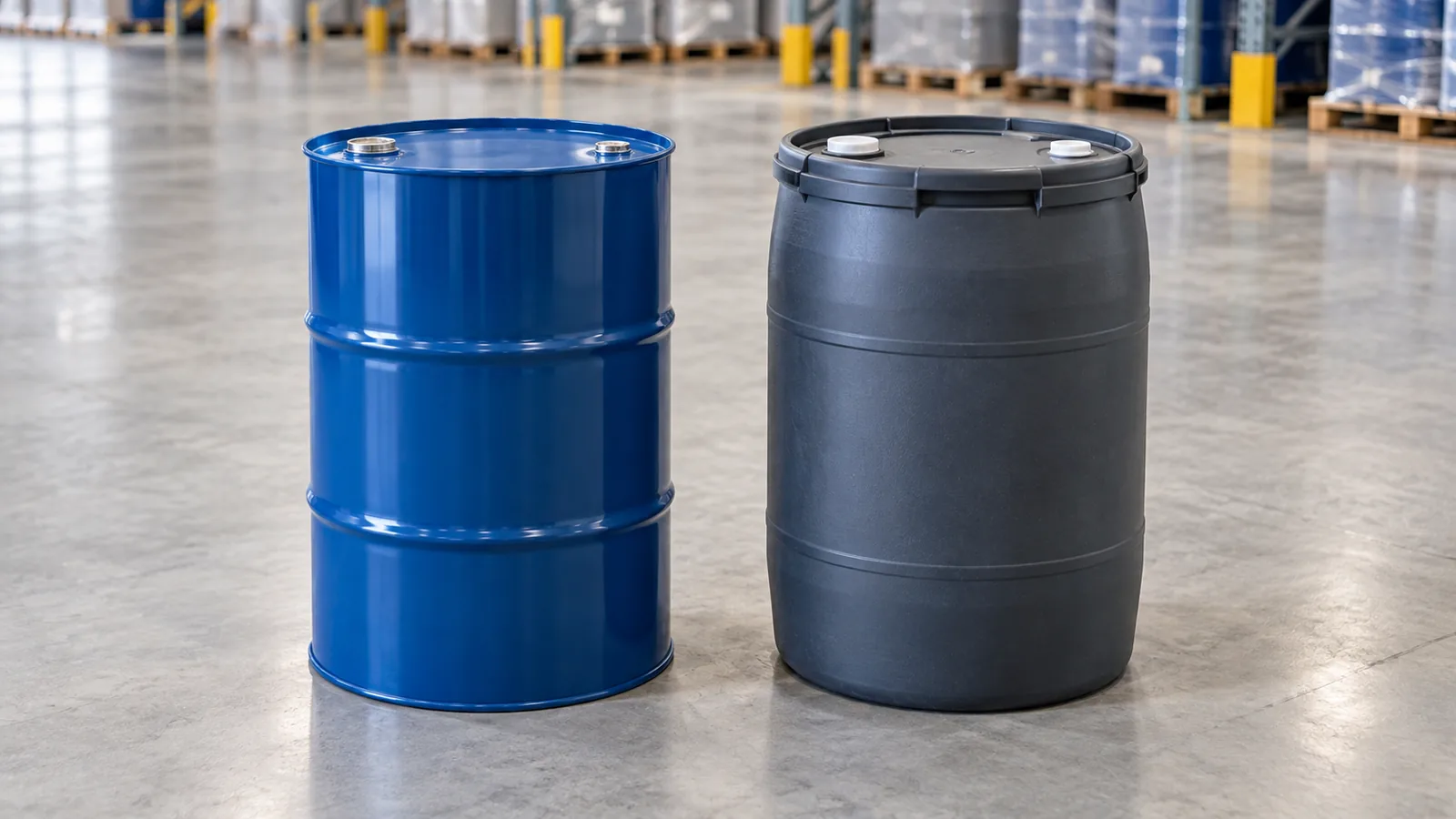
“Steel drum,” “plastic drum” and “200-litre drum” are incomplete purchasing descriptions. Drums with the same nominal volume can have different diameters, heights, shoulders, rims and closures.
For a rim-grip attachment, the top chime or moulded lip is part of the gripping interface. Its shape and condition must suit the jaws and the manufacturer’s permitted drum construction. A smooth-sided plastic barrel without the required handling rim is not equivalent to a rimmed plastic drum.
| Drum detail | What to record | What to confirm with the supplier |
|---|---|---|
| Material and construction | Steel, plastic or fibre; drum manufacturer/type | Exact construction is approved for the selected grab |
| Head and closure | Closed head or removable lid; closure condition | Required lid and closure arrangements |
| Rim or chime | Close-up photographs and a profile drawing | Suitable engagement and load-bearing interface |
| Dimensions | Overall height, diameter, shoulder and rim dimensions | Fits the permitted dimensional range |
| Gross-weight range | Drum, contents, lid and carried accessories | Maximum capacity and any minimum gripping weight |
| Condition | Dents, distortion, corrosion, leaks or contamination | Acceptance criteria and any recovery requirements |
Manufacturer examples show why these details matter. Vestil’s FMDL family specifies permitted drum materials, a suitable top lip and closure conditions. Its FPDL family distinguishes a bottom-engaging design for specified tapered plastic drums from a top-lip design. These are model-specific differences, not compatibility claims for KKV attachments.
Do not approve a drum merely because its nominal size appears in another brand’s catalogue. Supply photographs of the top, side and closure, plus measured dimensions. If the drum is damaged or leaking, arrange an appropriate recovery assessment rather than testing whether a standard grab will hold it.
Understand the Grip and Minimum-Load Requirements
Automatic rim grippers use a defined mechanism to engage the drum. Selection should establish what drum feature the jaws engage, how correct engagement is recognised and what conditions allow release.
Ask whether the grab needs a minimum drum weight to actuate. An empty or nearly empty drum may be unsuitable even though it is far below the maximum capacity. The Morse 286-1 product information, for example, specifies a minimum 50 lb (22.7 kg) drum weight. That requirement belongs to that model; it is not a minimum specified for every KKV grab.
Grip-head count is not the same as drum count
Keep two questions separate: how many drums the attachment handles, and how many gripping heads engage each drum. A supplier’s “single” or “double” grip description does not, by itself, answer both questions.
Obtain the layout drawing and operating limits for the exact model. Do not assume a double-grip arrangement doubles the rated load or provides an independent backup if one grip fails.
Confirm light, partial and mixed loads
Describe the lightest and heaviest drums, whether they contain liquids or solids, and whether two different drum types will be moved together. Ask for explicit approval of the proposed configuration.
The St Clare Grab-O-Matic 2-DLR provides an example of a model that expressly permits particular one-drum and mixed-drum arrangements. That permission should not be transferred to another double-drum attachment.
Automatic engagement is not a guarantee against release under every disturbance. The Morse 286-1 manual identifies abrupt unloading of the gripping mechanism as a potential problem. Obtain the selected grab’s instructions instead of relying on an “automatic” label.

Check Per-Drum and Total Capacity
Use the actual gross weight of each drum, including its contents and closure. Do not use the contents’ weight alone, or assume a nominal volume establishes loaded mass.
For a multi-drum attachment, confirm the permitted load at each station as well as the complete attachment’s total rating. Unused capacity at one station does not automatically increase the permitted load at another.
For example, a catalogue entry written as 360 × 2 kg must not be read as permission to put a 720 kg drum on one gripping station. Obtain the manufacturer’s interpretation and permitted loading layout before approving a quotation.
A procurement worksheet should list each drum separately, its maximum gross weight, its assigned station and the intended combination. This makes an unequal pair visible instead of hiding it within one total figure.
Also establish whether a two-drum device may carry only one drum and, if so, in which position. An off-centre load may require a different assessment from a balanced pair. Do not try an unapproved one-sided arrangement simply because the total load is low.
Keep the attachment’s own weight separate from the drum payload. Both are needed for the forklift assessment, but the published drum-handling capacity and the truck’s permitted payload are different fields.
Measure Fork Fit and Attachment Retention
Send measured fork details and request the attachment drawing. “Fits a standard forklift” is not a substitute for a dimensional review.
| Interface | Information to obtain | Selection question |
|---|---|---|
| Fork width and thickness | Actual dimensions at the mounting region | Will the forks fit the pockets without interference? |
| Fork spacing | Adjustment range and proposed centre spacing | Does the truck achieve the required pocket spacing? |
| Fork length and pocket depth | Usable length and required engagement | Is the prescribed insertion arrangement possible? |
| Fork shape | Taper, heel area and any existing accessories | Are there obstructions or unsuitable contact areas? |
| Retention system | Approved chain, clamp, pin or other securing arrangement | Can it be fitted exactly as required? |
| Mast and carriage clearance | Drawings or photographs through the intended movement | Is there interference with the installed attachment? |
Manufacturers use different retention arrangements. Morse specifies a carriage chain for its 286-1, while St Clare lists T-bolt retention for its 2-DLR. These examples do not authorise substituting one method for another.
The HSE lift-truck guidance, L117, addresses secure attachment mounting and clearance from the mast structure. Follow the exact truck and attachment instructions.
Do not rely on friction between the pockets and forks, add arbitrary packing pieces, drill new holes or weld improvised brackets. If extensions or other accessories are proposed, obtain approval for that complete arrangement rather than assuming longer forks solve the problem.
Physical fit is only one approval. It does not establish drum compatibility, truck capacity or suitability for a particular working surface.
Confirm Forklift Capacity With the Attachment
A forklift’s original rated capacity does not automatically remain available after fitting a drum grab. The attachment adds weight and changes the load’s position.
Provide the truck manufacturer and model, mast details, capacity plate, required lift height, attachment net weight and the relevant centre-of-gravity dimensions to the truck manufacturer or authorised supplier. Obtain the permitted capacity for the actual combination.
OSHA’s forklift nameplate guidance explains that attachments generally reduce capacity and that load position and distribution matter. Subtracting the attachment weight from the bare-fork rating is not, by itself, an approved residual-capacity assessment.
Do not substitute shipping weight for installed weight
A packed shipment includes items that may not be carried by the truck in service. Request the installed attachment weight and its centre-of-gravity drawing, including the options that will actually be fitted.
For multi-drum handling, include the proposed drum positions and unequal-load cases in the review. Ask whether the approval covers the requested placement height, not only pickup near floor level.
Keep approval and markings consistent
For US workplaces, OSHA 1910.178(a)(4)–(5) addresses prior written manufacturer approval for additions affecting capacity or safe operation and identification of nonfactory front-end attachments. HSE’s L117 also discusses attachment suitability, derating and corresponding capacity information in the UK context.
These references have different jurisdictions. Follow the requirements for the destination and workplace; a generic catalogue capacity is not worldwide truck approval.
Review the Route, Access and Working Environment
Measure the loaded attachment’s overall width, the turning space and the access needed at each drum position. A multi-drum model may reduce trips but still be unsuitable for a narrow aisle or closely packed pickup area.
Record the floor condition, joints, thresholds, ramps, dock arrangements, overhead clearance, pedestrian traffic and pickup/deposit surfaces. Have the responsible planner assess the actual route and task, not just the warehouse floor in a product photograph.
Confirm how the route and pickup/deposit areas will be segregated from pedestrians, with controlled crossings where needed. HSE L117 addresses pedestrian separation and crossing arrangements.
Read the operating restrictions before accepting a statement about outdoor or rough-ground use. The Vestil FMDL manual, for example, excludes specified truck types and unimproved surfaces. An extra strap is not general permission to use a grab outside its approved surface conditions.
For chemical, food or corrosive service, describe the contents and exposure. Request suitable materials, cleaning instructions and any required documentation. Stainless steel construction alone does not establish hygienic suitability, chemical resistance or approval for an explosive atmosphere.
In US workplaces, OSHA’s industrial-truck standard includes requirements for truck selection in hazardous locations. Site classification and the complete truck/attachment combination need appropriate review; “mechanical” does not mean ignition hazards are absent.
The HSE lifting-operation planning guidance supports competent assessment of the complete operation. This purchasing guide does not replace that plan.
Compare the KKV DG360 and DG720 Models
The current KKV Forklift Drum Grab page lists the following information. The capacity notation and grip descriptions are retained as published.
| Model | Published load capacity | Published net weight | Published grip description |
|---|---|---|---|
| DG360A | 360 kg | 42 kg | Single Eagle-grip |
| DG720A | 360 × 2 kg | 70 kg | Single Eagle-grip |
| DG360B | 360 kg | 50 kg | Double Eagle-grip |
| DG720B | 360 × 2 kg | 77 kg | Double Eagle-grip |
Use this table to shortlist an inquiry, not to approve a lift. Request exact drum compatibility, minimum gripping weight, pocket dimensions, retention instructions and the permitted loading arrangement. The published table does not provide those answers.
Other DG series have their own model references and specifications. Do not confuse DG360A with a differently rated DG-A series item, or assume matching letters establish identical construction.
For alternative support arrangements, review the KKV DG-C drum-grab page and ask for its drawings. A product photograph or catalogue family name cannot confirm fit to the drum and truck you own.

A Six-Step Selection Process
Step 1: Define the drum-handling task
Record pickup and deposit locations, required orientation, placement height and daily handling frequency. Separate upright transfer from pouring or inversion.
Step 2: Identify every drum type
Supply measured drum dimensions, material, head/closure details and rim photographs. Include unusual, light and partially filled drums rather than describing only the easiest example.
Step 3: Establish the load range and layout
List minimum and maximum gross weights by drum position. Confirm per-drum and total limits, minimum gripping weight and permission for one-drum or unequal-load configurations.
Step 4: Match the forks and retention system
Compare the mounting drawing with actual fork dimensions, spacing and length. Verify that the supplied securing arrangement can be fitted without unauthorised changes or interference.
Step 5: Obtain truck and site approval
Submit attachment weight, centre-of-gravity data and the intended load/height configuration for capacity confirmation. Review access, surfaces, contents and applicable workplace requirements.
Step 6: Verify the quotation and delivered unit
Match the model, drawings, rated-load marking, options, manual and approved configuration. Arrange the required inspection, operator training and commissioning checks before production use.
If an essential field remains unanswered, keep the order specification provisional. A sample demonstration cannot substitute for a documented rating or approval of every drum variant.
Information to Include in an RFQ
An RFQ should let the supplier check the drum interface and the truck installation. Send a short specification with photographs and drawings, not only “drum grab, 500 kg.”
| RFQ field | Information to provide |
|---|---|
| Handling task | Upright transfer, pickup/deposit locations and required height |
| Drum construction | Manufacturer/type, material, head style and closure details |
| Drum geometry | Diameter, height, rim profile and clear photographs |
| Drum weights | Minimum and maximum gross weights, including contents and closures |
| Load combination | Number of drums, their positions and unequal/mixed-load cases |
| Contents | Liquid/solid, filling range, hazards and relevant safety information |
| Forklift | Make/model, serial number, mast and capacity-plate information |
| Fork measurements | Width, thickness, length and available spacing |
| Attachment data | Installed weight, centre of gravity and mounting/retention drawing |
| Site conditions | Surfaces, aisles, ramps, docks, clearances and exposure |
| Technical support | Manual, permitted drums/configurations, inspection criteria and spare parts |
| Required documents | Rated-load identification and project-specific test/conformity evidence |
| Supply details | Quantity, options, sample review, destination and delivery schedule |
State who will confirm the forklift’s capacity with the attachment. Drum-grab selection and truck approval may involve different suppliers; do not let that responsibility fall between them.
For repeat orders, retain the approved model, drawings and drum specification. Recheck a new drum supplier, changed rim design or substituted attachment even if the nominal volume and rated capacity appear unchanged.
Pre-Use Checks and Purchase Mistakes
The exact manual determines the inspection procedure. As purchasing requirements, make sure the supplied information enables competent checks of:
- Identification, rated-load marking and agreement with the approved model.
- Fork pockets, frame, welds and other structural components.
- Gripping jaws, pivots, springs and model-required adjustment/function checks.
- Correct securing components and their condition.
- Drum rim, closure and contact areas against the permitted drum criteria.
- Required supports, protective pads or other fitted options.
- Truck condition, capacity information and the approved installation.
The Vestil manual provides a model-specific example of checking the grip, mounting and drum condition. Do not copy its maintenance intervals, replacement limits or operating sequence onto a different unit.
Stop using equipment with defects or uncertain engagement and arrange competent assessment. Do not weld, reshape or bypass the jaws, replace prescribed parts with convenient substitutes, or add an unapproved restraint to make an unsuitable drum seem acceptable.
Common mistakes to avoid
Choosing only by maximum capacity misses drum geometry and minimum gripping load. Treating “double grip” as “two drums” mixes different specifications. Comparing payload with the bare truck rating overlooks the installed configuration.
Other frequent gaps include confusing shipping and net weight, omitting the fork drawing, assuming any plastic drum is compatible, and expecting an upright grab to pour. Put these decisions in the specification before comparing prices.
Frequently Asked Questions
Can a forklift drum grab handle both steel and plastic drums?
Some models can, but the exact rim, construction and closure must be approved. A general material description is not enough, and suitability of another manufacturer’s grab does not establish KKV compatibility.
Can it lift an empty drum?
Only if the exact model permits the drum’s weight and construction. Some automatic mechanisms need a minimum gross weight to actuate; being below maximum capacity does not answer this question.
Does a double-grip design handle two drums?
Not necessarily. Gripping-head arrangement and number of drum positions are separate fields. Check the layout drawing, ratings and model description.
Can a two-drum grab carry just one drum?
Only in a configuration approved for that attachment and truck combination. Confirm the permitted station and any off-centre-load limitations rather than assuming a low total weight makes it acceptable.
Is a 3-ton forklift sufficient for any 500 kg drum grab?
The original truck rating does not decide that. Obtain the approved capacity with the actual attachment, drum load position and required height; also verify the grab’s own rating and drum fit.
Are all nominal 200-litre drums the same size?
No. Provide the actual dimensions and rim/closure details. Nominal volume is not a dimensional compatibility standard.
Can an upright grab tilt a drum for pouring?
Do not assume so. Select a rotator or other handler explicitly approved for the required pouring operation and drum construction.
Does stainless steel mean explosion-proof?
No. Material choice alone does not approve the truck, attachment or operation for a hazardous location. Obtain the required site assessment and appropriate equipment documentation.
References and Application Scope
The following primary sources support the purchasing distinctions in this guide. Manufacturer examples are not KKV specifications or interchangeable operating instructions.
- Morse 286-1 product information — rimmed drums, minimum gripping weight and mounting dimensions.
- Morse 286-1 operator manual — model-specific grip behaviour, attachment data and maintenance context.
- Vestil FMDL family and FPDL family — different permitted drum interfaces and closure requirements.
- Vestil FMDL manual — mounting, inspection and surface restrictions for covered models.
- St Clare Grab-O-Matic 2-DLR — a defined multi-drum configuration and retention example.
- OSHA 1910.178 and nameplate guidance — US industrial-truck approval, capacity and identification context.
- HSE L117 and lifting-operation planning guidance — UK attachment and planning context.
Apply the current instructions and requirements for the exact equipment, workplace and destination. This guide does not provide a universal load-centre calculation, inspection interval or approval for hazardous-area use.
Specify the Drum, the Grab and the Forklift Together
A complete selection matches three things: a compatible drum interface, a suitably rated attachment and an approved forklift configuration. Maximum capacity alone cannot establish all three.
Review the KKV forklift drum-grab range and DG-C options. Send the drum photographs, load range and fork measurements so the required model and outstanding technical information can be confirmed before quotation.
For help preparing a forklift drum-grab inquiry: Contact KKV or email sales@kkvhoist.com with your drum details, truck information, handling task and quantity.
Safety note: This is a product-selection guide, not forklift operator training or permission to modify equipment. Use the exact approved truck/attachment combination and compatible drums, follow the supplied instructions, keep people clear of elevated equipment and loads, and have the operation assessed by competent personnel.