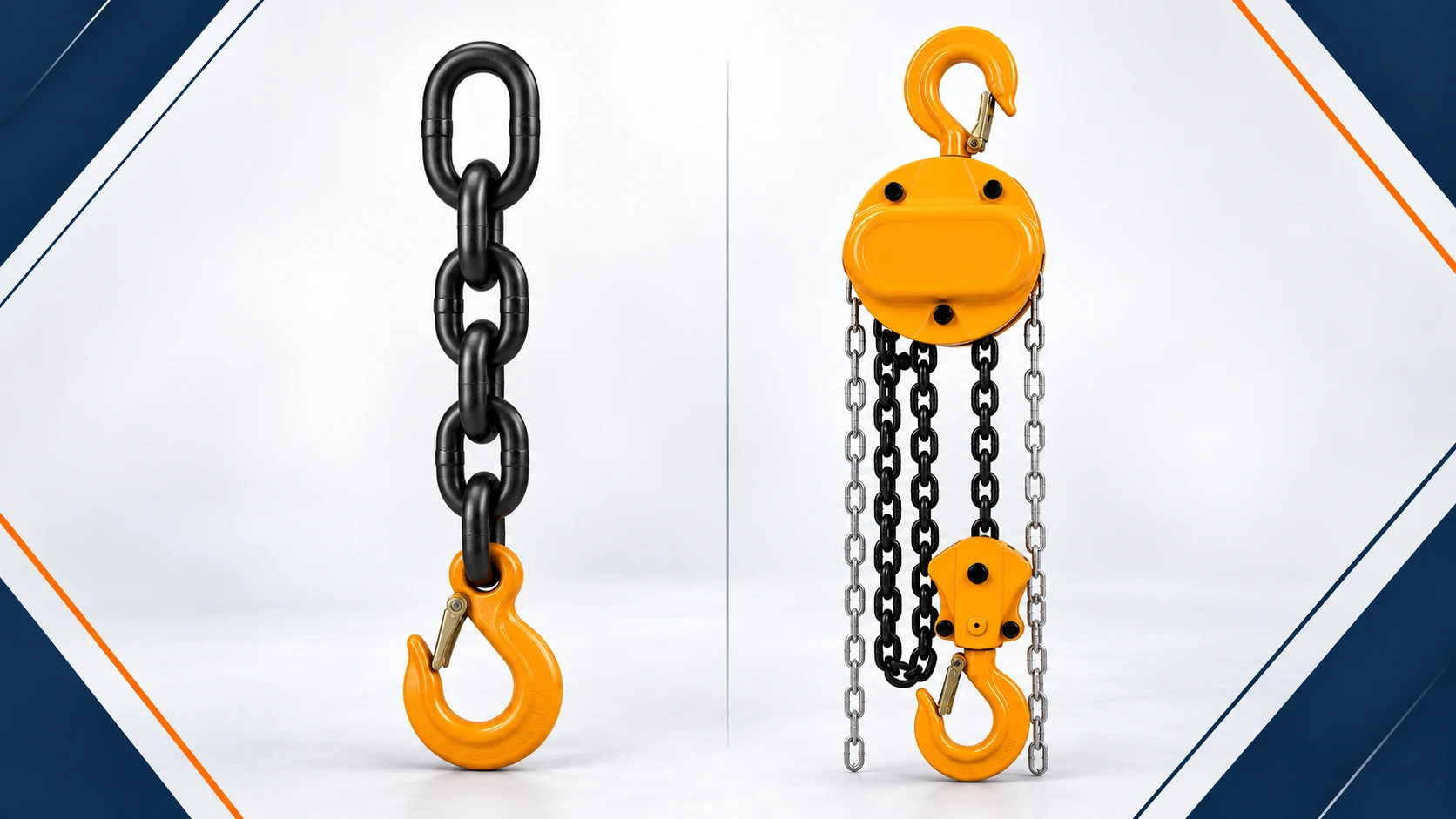
Grade 80 Lifting Chain vs Hoist Load Chain: Why They Are Not Interchangeable
Grade 80 lifting chain and hoist load chain can look similar, especially when both are short-link alloy-steel chains with a dark or metallic finish. That visual similarity causes a serious purchasing mistake: ordering replacement hoist chain by grade and nominal diameter alone.
The two chains perform different jobs. Grade 80 lifting chain is commonly used to manufacture chain slings and other approved lifting assemblies that connect a load to a hook. Hoist load chain is a calibrated operating component that must pass through a specific load sheave or pocket wheel inside a manual, lever or electric chain hoist. A third chain, the hand chain on a manual chain hoist, is the operator’s input chain and does not carry the suspended load.
Correct replacement therefore depends on the exact equipment, not on appearance. The hoist manufacturer or approved chain specification must confirm the link geometry, multiple-pitch tolerance, material and heat treatment, surface condition, length, reeving and compatibility with the load sheave, guides, lower block and end connection.
Quick answer: Do not install ordinary Grade 80 sling chain in a chain hoist merely because its diameter, color or strength grade appears suitable. First identify the hoist manufacturer, exact model, rated capacity, serial or production revision, number of chain falls, required lift and original chain specification. Obtain the exact manufacturer-approved replacement load chain, inspect the mating load sheave and guides, install and reeve it under the approved procedure, and complete the required inspection and testing before returning the hoist to service.
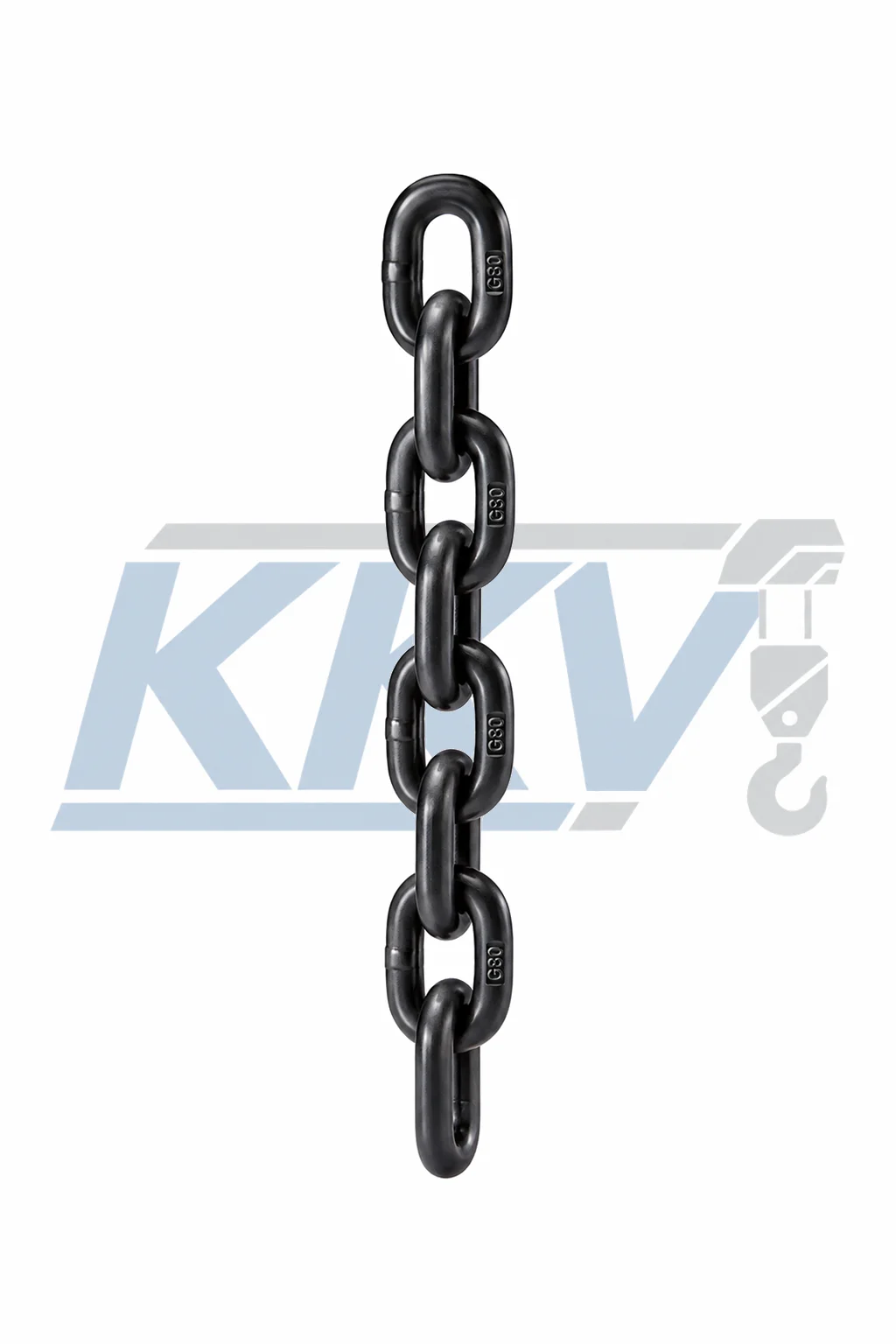
Table of contents
- Three different chains buyers often confuse
- Grade 80 lifting chain vs hoist load chain
- How the standards separate their uses
- Why matching diameter is not enough
- What can happen when the wrong chain is installed
- How to identify the correct hoist replacement chain
- Replacement, reeving and return to service
- Inspection differences
- How this applies to KKV products
- Information to include in an RFQ
- Common chain-selection mistakes
- Frequently asked questions
Three Different Chains Buyers Often Confuse
The phrase “lifting chain” is ambiguous. It may describe a chain used in a sling, the load-bearing chain inside a hoist, or simply any chain seen near a lifting operation. A safe quotation and purchase order should use the chain’s actual function.
Grade 80 lifting or sling chain
In this guide, Grade 80 lifting chain means alloy-steel short-link chain intended for approved lifting and chain-sling applications. It becomes part of a complete lifting assembly with compatible master links, connecting links, shortening devices, hooks and identification.
The working load limit of that assembly depends on the approved chain size, component system, number of legs, hitch, sling angle, temperature, environment and manufacturer data. “Grade 80” describes a chain grade; it is not a hoist model and does not mean that the chain can lift 80 tonnes.
For sling selection, see the KKV Grade 80 lifting chain guide. That article covers WLL, component compatibility, sling geometry, angles and surface conditions. The present article addresses a different question: whether that type of chain can run through a chain hoist.
Hoist load chain
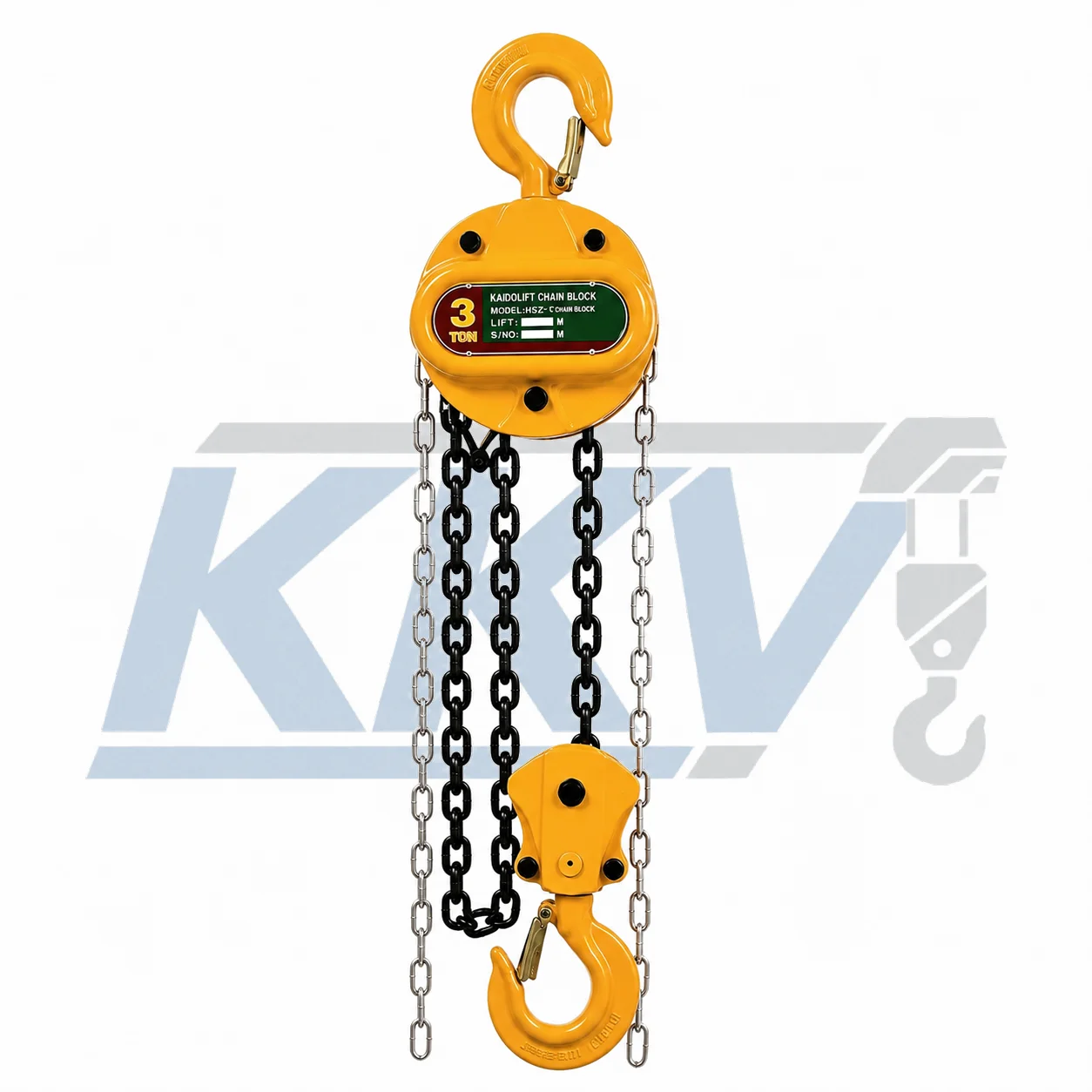
Hoist load chain is the load-bearing chain that travels through the hoist mechanism. Its links engage the pockets of the load sheave or liftwheel as the mechanism raises or lowers the lower hook. Depending on the hoist, the chain may run in a single fall or through a multi-fall lower block and idle sheave.
The chain is part of a matched mechanical system. Link pitch, width, diameter, weld profile, dimensional tolerance, material condition and hardness profile affect how the chain enters, seats in and leaves the load sheave. Its end anchorage, chain stopper, lower-block connection and reeving are also model-specific.
Hand chain
A manual chain hoist normally has a separate endless hand chain. Pulling it turns the hand wheel and internal gearing. It is an operating chain, not the chain that supports the load.
The hand chain may use visibly different link dimensions and finish, but color alone is not a reliable identification method. Lever hoists do not normally use a separate hand-chain loop; the operator moves a ratcheting lever while the load chain travels through the body.
| Chain type | Main function | Where it works | What controls selection |
|---|---|---|---|
| Grade 80 lifting or sling chain | Connects and supports a load as part of an approved sling or lifting assembly | Between the crane or hoist hook and the load, with compatible sling components | Applicable sling standard, manufacturer WLL table, chain size, components, geometry, hitch, angle and environment |
| Hoist load chain | Carries the load while travelling through the hoist mechanism | Load sheave or pocket wheel, chain guides, lower block and end anchorage | Exact hoist model and capacity, approved chain specification, link geometry, tolerance, hardness profile, length, number of falls and reeving |
| Hand chain | Provides manual operating input | Hand wheel of a manual chain hoist | Exact hand-chain specification, loop length, connector and operating arrangement |
Grade 80 Lifting Chain vs Hoist Load Chain
Both products may be heat-treated welded alloy-steel short-link chains, but that shared description does not make them interchangeable.
| Comparison point | Grade 80 lifting chain | Hoist load chain | Buyer implication |
|---|---|---|---|
| Primary application | Chain slings and approved general lifting assemblies | Serial manual, lever or power-driven chain hoists | State the application before requesting a quotation |
| Interaction with equipment | Connects through approved sling components and bears against hooks or links as designed | Repeatedly articulates and engages a specific pocket wheel or load sheave | Mechanical fit is as important as nominal strength |
| Dimensional category | Commonly specified as medium-tolerance sling chain under EN 818-2 | Specified as fine-tolerance hoist chain under EN 818-7 or a manufacturer-specific chain standard | Do not substitute one standard designation for the other |
| Capacity basis | WLL is assigned for the sling chain and complete assembly under the applicable system | Hoist rated capacity is assigned to the complete hoist using its specified chain and reeving | A sling-chain WLL does not approve it for a hoist |
| Important geometry | Nominal diameter, pitch and link dimensions needed for compatible sling components | Diameter, pitch, inside and outside dimensions, multiple-pitch tolerance and weld geometry matched to running components | One matching dimension is insufficient |
| Material and heat treatment | Grade and manufacturer process suitable for sling service | Through-hardened or case-hardened chain selected for the particular hoist design and duty | Appearance cannot confirm the hardness profile |
| Identification | Chain grade and manufacturer markings plus sling tag and certificate | Chain marking, part number or certificate linked to the exact hoist specification | Record the hoist and chain identities together |
| Replacement decision | Replace chain or complete sling according to the sling manufacturer’s criteria | Use the exact approved load chain and inspect mating hoist components | Generic chain from stock is not an automatic replacement |
This table describes the selection logic rather than a universal dimensional specification. Individual manufacturers may use proprietary chain dimensions or approved chains outside a simple standards-based description. The hoist manual, parts information and written supplier confirmation remain controlling.
How the Standards Separate Their Uses
Standards use different scopes because the applications create different design and operating requirements.
EN 818-2 addresses Grade 8 sling chain
BS EN 818-2 describes Grade 8 medium-tolerance short-link chain for chain slings and general lifting purposes. It sits within the EN 818 series alongside requirements for complete chain slings, information for use and other chain grades.
This scope is directly relevant when specifying chain for a Grade 80 sling. It does not state that every chain made to that part is suitable for travel through a chain hoist.
EN 818-7 addresses fine-tolerance hoist chain
BS EN 818-7 addresses fine-tolerance Grade T hoist chain for serial manual and power-driven chain hoists. Its scope includes types T, DAT and DT and recognizes the special dimensional and material requirements associated with hoist service.
Type names should not be used as a shortcut. A buyer must not assume that any T, DAT or DT chain fits any manual or electric hoist. The required type, exact dimensions, finish and approved chain remain specific to the equipment and manufacturer.
ASME separates slings from hoists
ASME B30.9 covers the fabrication, attachment, use, inspection, testing and maintenance of slings, including alloy-steel chain slings. ASME B30.16 addresses overhead underhung and stationary hoists, including hand-chain-operated and powered chain hoists within its scope.
The separation is useful even where another national or project standard applies: a sling is below-the-hook lifting equipment, while the hoist load chain is an operating component of the hoist.
Apply regulatory statements only within their scope
US 29 CFR 1910.179, within its overhead and gantry crane scope, defines hoist chain as load-bearing chain in a hoist and notes that its properties do not conform to the sling-chain properties referenced in ANSI B30.9. It also requires pocketed sheaves used with hoist chains to be dimensioned so the chain does not catch or bind.
That language supports the functional distinction, but it should not be presented as the only rule governing every portable hoist in every country. The installation must identify its applicable laws, standards, manufacturer instructions and employer procedures.
| Reference family | Equipment addressed in this article | Practical use |
|---|---|---|
| EN 818-2 | Medium-tolerance Grade 8 chain for chain slings and general lifting | Specify sling chain and its approved assembly system |
| EN 818-7 | Fine-tolerance Grade T chain for serial manual and power-driven hoists | Establish a hoist-chain framework, subject to exact manufacturer compatibility |
| ASME B30.9 | Alloy-steel chain slings and other sling types | Sling fabrication, use, inspection, testing and maintenance within scope |
| ASME B30.16 | Hand-chain-operated and powered overhead hoists within scope | Hoist construction, installation, operation, inspection, testing and maintenance |
| Hoist manufacturer manual and parts data | One exact model, capacity and production configuration | Final authority for replacement chain, installation, inspection and return to service |
Why Matching Diameter Is Not Enough
Nominal chain diameter is easy to measure, so it is often the first and only value included in an inquiry. It is not enough to establish hoist compatibility.
Pitch must match the pocket wheel
Pitch is the distance associated with the repeating link pattern. A load sheave has pockets arranged to receive that pattern. If the chain’s individual or multiple-pitch geometry does not match, the error accumulates as several links engage the wheel.
A chain may enter the body yet fail to seat correctly under load. It may climb, jump, bind or concentrate contact at the edge of a pocket. Do not use a successful no-load movement as proof that an unidentified chain is compatible.
Link width and weld geometry affect clearance
Inside width, outside width, link length, roundness and weld profile influence the chain’s passage through guides, stripper components, idle sheaves and the lower block. Excessive clearance is not automatically safe, and a visibly tight chain must never be forced through the mechanism.
The position of the welded area relative to the load sheave can also be specified by the manufacturer during reeving. This is an installation instruction for the exact model, not a visual rule to copy from another hoist.
Tolerance controls accumulated fit
Hoist chain is commonly described as calibrated or fine-tolerance chain because its repeated dimensions must stay within the operating geometry of the hoist. Two chains with the same nominal diameter can have different pitch, link widths and allowable dimensional variation.
The supplier should confirm the exact chain part number or approved specification. Measuring an old, worn chain and asking a chain factory to copy those values can reproduce wear rather than the original design.
Material condition and hardness profile matter
Strength grade alone does not describe surface hardness, core properties, case depth, fatigue behavior or resistance to wear against the pocket wheel. EN 818-7 distinguishes through-hardened and case-hardened hoist-chain types, but the correct selection still comes from the hoist specification.
Do not identify heat treatment by spark testing, filing, color or a portable hardness reading taken without an approved procedure. Those methods can damage the chain or produce an incomplete conclusion.
Surface finish is not a compatibility code
Blackened, galvanized, plated or phosphated finishes may be available for different products and environments. Finish can affect corrosion protection, lubrication behavior and dimensions, but it does not tell a buyer whether the chain is a sling chain or the correct hoist chain.
A silver chain is not automatically a hand chain, and a black chain is not automatically a load chain. Use markings, documentation and equipment identity.
What Can Happen When the Wrong Chain Is Installed
Installing a chain that merely looks similar can damage the chain and the hoist. The fault may appear immediately or develop through accelerated wear.
| Mismatch | Possible symptom | Why operation must stop |
|---|---|---|
| Incorrect pitch or multiple-pitch tolerance | Chain climbs, jumps, chatters or fails to seat in the pocket wheel | Load movement may become uncontrolled and the wheel or chain may be damaged |
| Incorrect inside or outside width | Chain rubs guides, binds, enters at an angle or will not pass the lower block | Concentrated contact and interference can reduce reliable operation |
| Incorrect weld profile or orientation | Weld contacts a wheel or guide abnormally | Local wear and damage can increase with every cycle |
| Incorrect material or hardness profile | Rapid chain wear, pocket-wheel wear, cracking or unexpected service life | Visual similarity gives no assurance of the required fatigue and wear behavior |
| Incorrect chain length or reeving | Insufficient lift, loose-end problems, overloaded chain container, twisted multi-fall arrangement | End anchorage and lower-block movement may no longer work as designed |
| Unapproved joining or repair link | Discontinuous geometry and unverified strength in the running chain | A joining device may not pass safely through the hoist mechanism |
| New chain installed on damaged mating parts | Premature wear, rough running or repeated chain damage | Replacing only the chain may leave the original cause unresolved |
An official Columbus McKinnon Lodestar manual warns that commercial or another manufacturer’s chain may cause load loss and requires the specified replacement chain for that hoist. A Harrington ER2 manual similarly requires replacement load chain to match the original size, grade and construction. These are model-specific instructions, but they illustrate the broader purchasing principle: approval is established by the equipment documentation, not by visual comparison.
If a newly installed chain jumps, binds, runs noisily, twists, fails to track or produces abnormal hand force, stop immediately. Do not continue operating it in the hope that the components will “wear in.”
How to Identify the Correct Hoist Replacement Chain
The safest inquiry begins with the hoist, not with a loose piece of chain.
1. Identify the complete hoist
Record:
- manufacturer and brand;
- complete model or product code;
- rated capacity;
- serial number, lot number or production date;
- manual or powered type;
- suspension and trolley arrangement;
- number of load-chain falls;
- original and required lift;
- voltage and frequency for an electric hoist, where relevant;
- operating environment and duty;
- country of installation and required documentation.
Photograph the nameplate, warning labels, complete hoist, lower block, end anchorage and current chain marking. Do not rely on a cropped photo of one chain link.
2. Find the exact manual and parts information
Use the manual and parts list for the same model and revision. Similar product names can cover different capacities, generations and chain sizes. A parts drawing may identify a chain assembly or part number even when it does not publish all manufacturing dimensions.
If the nameplate is unreadable or the equipment cannot be positively identified, quarantine the hoist until an authorized person resolves its identity. Do not reverse-engineer rated capacity from the hook, chain diameter or body size.
3. Record the approved chain specification
The specification may include a manufacturer part number, chain designation, diameter and pitch, required length or link count, finish, heat-treatment type, marking, number of falls and installation orientation. Use the exact format provided by the manufacturer.
Measurements of the existing chain can help confirm identity or wear, but they do not create approval. A worn chain may have reduced diameter and increased pitch, and an incorrectly installed chain may not be the original specification.
4. Confirm compatibility in writing
Ask the hoist manufacturer, authorized distributor or technically qualified chain supplier to state that the proposed chain is approved for the exact hoist model, capacity and configuration. A statement such as “10 mm Grade 80 chain” is not sufficient.
The quotation should identify any exclusions and state whether the chain is supplied as a finished assembly, cut length, calibrated chain or manufacturer part. Clarify who will install, inspect and test it.
5. Check the required chain quantity correctly
Required lift is not always equal to the length of chain to order. Multi-fall reeving, end anchorage, lower-block path, loose end, chain container and manufacturer allowance affect the finished length or link count.
Do not calculate chain length with a generic multiplier unless the exact manual provides that method. Ask the supplier to confirm the required finished length for the stated lift and number of falls.
Replacement, Reeving and Return to Service
Buying the correct chain is only one stage of the work. Incorrect installation can make an approved chain unsafe.
Isolate the equipment
Remove the hoist from service, disconnect and lock out electrical energy where applicable, remove any load and control the work area. Follow the employer’s isolation procedure and the manufacturer’s maintenance instructions.
Inspect mating components
When load chain is rejected for wear or abnormal running, inspect the load sheave or liftwheel, guides, stripper, idle sheaves, lower block, bearings, end anchorage and chain container as applicable. Worn pockets or damaged guides can quickly damage a new chain.
The decision to reuse or replace those parts must follow the exact manual and authorized inspection criteria. Do not machine a pocket wheel or grind a guide to make an unsuitable chain fit.
Reeve the chain exactly as specified
Chain direction, standing-link orientation, welded-link orientation, lower-block path, loose-end anchorage and link count may be specified. Multi-fall hoists must not contain a twist between the body and lower block.
Replacement and internal access should be performed by personnel authorized and trained for that model. This article does not provide a universal chain-installation procedure.
Inspect and test before release
After installation, complete the manufacturer’s required inspection, lubrication, no-load operation, limit-device checks and controlled testing. Repairs or chain replacement may trigger a defined load test or proof test under the applicable procedure.
Do not improvise a test with an unknown load, exceed the stated test load or stand beneath the equipment. Record the chain identity, work performed, measurements, test result and person authorizing return to service.
Prevent reuse of rejected chain
Clearly identify and control rejected chain so it cannot return to service or be repurposed. Manufacturer manuals may instruct that removed hoist chain be destroyed or cut into short lengths. Follow the approved disposal procedure and local environmental requirements.
Do not convert rejected hoist chain into a sling, tie-down, towing chain or lifting accessory.
Inspection Differences
Both chain types require inspection, but their records and rejection criteria are not interchangeable.
Inspect a Grade 80 chain sling as a complete assembly
The inspection should cover the chain, master link, intermediate links, connecting devices, shortening devices, hooks, identification tag and any other component. Confirm that the sling identity and WLL information are legible and that the complete assembly suits the planned hitch and geometry.
Look for wear, elongation, cracks, deformation, gouges, corrosion, heat damage, unauthorized repair and damaged components according to the sling manufacturer’s instructions and applicable standard. Do not apply a chain-hoist measurement table to a chain sling.
Inspect hoist load chain within the operating system
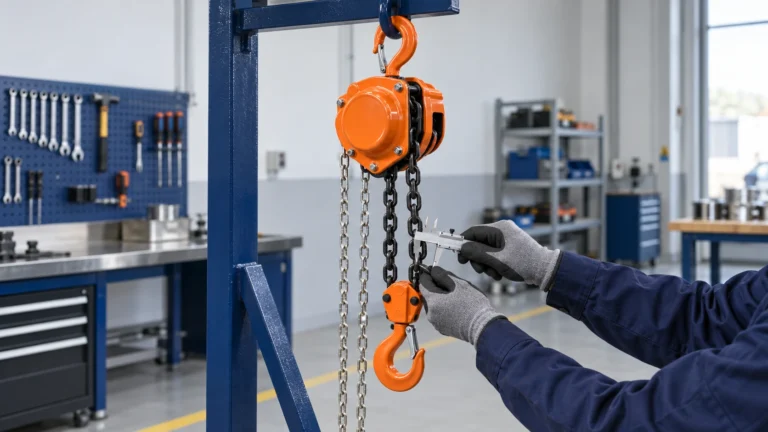
Examine the accessible working length, end connection, reeving, lower block and chain travel. Pay attention to the links repeatedly engaging the load sheave and any idle sheave. Measure wear and accumulated pitch using the number of links, tension, reference points and limits specified for the exact hoist chain.
Also observe the load sheave, guides and related components. Chain jumping or binding can be evidence of incorrect chain, wear, twist, damaged guides or an unsuitable mating wheel.
For a detailed operator and periodic inspection framework, use the manual chain hoist inspection checklist.
Inspect the hand chain as an operating component
Check the hand chain for twists, deformation, severe corrosion, unsuitable connectors, knots, unauthorized extensions and interference. Confirm that it moves freely around the hand wheel. Its condition affects control, but it is not assigned the suspended-load capacity of the hoist load chain.
| Inspection subject | Grade 80 chain sling | Hoist load chain | Hand chain |
|---|---|---|---|
| Identity | Sling tag, chain and component markings, certificate | Hoist identity plus approved chain part or specification | Hoist/manual identification and correct hand-chain assembly |
| Main wear locations | Chain bearing points and all sling components | Link bearing points, pocket-wheel contact, guides, idle sheave and lower block | Hand-wheel contact and chain connector |
| Dimensional method | Sling manufacturer’s chain measurement and discard criteria | Exact hoist manufacturer’s specified multi-link measurement and discard criteria | Model-specific operating-chain criteria |
| Functional observation | Correct assembly and load seating | Smooth tracking, correct reeving and no jumping or binding | Free manual operation without knots or interference |
| Key prohibition | Do not exceed sling WLL or use unapproved components | Do not install generic sling chain, splice links or force an unsuitable chain through | Do not treat the hand chain as load-bearing chain |
How This Applies to KKV Products
KKV supplies products in both chain categories, so the application must be stated clearly in every inquiry.
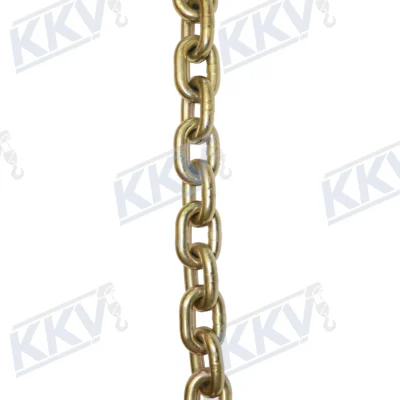
The KKV G80 Chain category includes blackened, bright-polished and galvanized Grade 80 lifting-chain products for lifting, rigging and chain-sling applications. Examples include G80 Blackened Lifting Chain, G80 Bright Polished Lifting Chain and G80 Galvanized Lifting Chain.
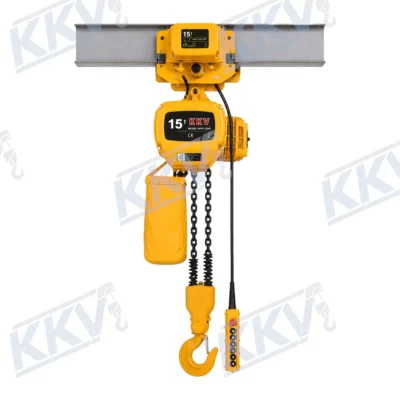
KKV’s hoist range includes products such as the HSZ-T Manual Chain Hoist and HHSY Electric Chain Hoist. Their travelling load chains must be specified from the approved documentation for the exact hoist model and capacity.
Listing a G80 chain product and a chain hoist on the same website does not mean that the G80 sling-chain product is an approved replacement for the hoist. These are different product families serving different functions.
For a new hoist, provide the complete lifting application described in the manual chain hoist selection guide or electric hoist selection guide. For replacement chain, provide the existing equipment identity and exact chain requirement.
Information to Include in an RFQ
A useful request for quotation removes ambiguity before price comparison.
| RFQ field | Example format | Why it matters |
|---|---|---|
| Application | Grade 80 chain sling assembly or replacement hoist load chain | Separates two fundamentally different products |
| Equipment manufacturer | Name shown on hoist nameplate | Begins the compatibility check |
| Exact hoist model | Complete code, not a shortened family name | Different models may use different load chains |
| Rated capacity | Value and unit from nameplate | Narrows the approved configuration |
| Serial, lot or production date | Full identifier and clear nameplate photo | Helps identify design revision |
| Hoist type | Manual chain hoist, lever hoist or electric chain hoist | Indicates the operating mechanism and likely chain family |
| Existing chain identification | Part number, marking, certificate and approved specification | Provides traceable evidence rather than appearance |
| Required lift | Hook travel with unit | Used to determine finished chain length |
| Number of falls | As documented for the exact capacity | Affects length, reeving and lower-block arrangement |
| Chain container | Type and capacity, if fitted | Must accommodate the finished chain correctly |
| Duty and environment | Cycles, shifts, temperature, moisture, corrosion and contamination | May affect approved type, finish, lubrication and inspection |
| Mating-component condition | Load sheave, guides, idle sheave and lower-block findings | Prevents a new chain being installed into damaged parts |
| Installation responsibility | Authorized workshop, distributor or site technician | Clarifies scope and competence |
| Required documents | Certificate, declaration, manual, inspection and test record | Defines acceptance evidence |
| Destination | Country and project standard | Identifies regulatory and documentation requirements |
Attach clear photographs, but do not request selection from photographs alone. Ask the supplier to identify the offered chain precisely and confirm compatibility in writing.
Common Chain-Selection Mistakes
Ordering by diameter and grade only
“10 mm G80 chain” does not state whether the chain is for a sling or a hoist, and it omits the hoist model, pitch, link widths, tolerance, heat treatment, length and reeving.
Treating WLL as a compatibility measurement
A sling-chain WLL shows rated use within an approved sling system. It does not demonstrate that the chain will engage a hoist’s load sheave or meet that hoist’s fatigue and wear requirements.
Copying dimensions from a worn chain
The removed chain may be elongated, worn or incorrect. Identify the original approved specification before using measurements as a confirmation.
Assuming a stronger chain is automatically safer
A higher strength grade or harder surface does not correct incompatible link geometry. It may change wear interaction with the load sheave. Compatibility must be engineered and approved as a system.
Identifying chain by color
Surface finish is not a universal function code. Black, silver or galvanized appearance cannot confirm whether a chain is the load chain, hand chain or sling chain required for the application.
Replacing only the chain after abnormal wear
Damaged pockets, guides, idle sheaves or incorrect alignment can destroy the replacement chain. Investigate the cause and inspect all specified mating components.
Installing a joining link in running chain
A generic joining link, repair link or sling connector is not a substitute for continuous approved hoist load chain. It may not pass through the load sheave or guides and creates an unverified load-bearing connection.
Welding, heating or reshaping chain
Do not weld, heat, bend, grind, plate or splice load-bearing chain to make it fit. Such work can alter material properties, dimensions and traceability.
Using rejected chain for another lifting job
Chain removed because of wear or damage must be controlled against reuse. It should not become a sling, tie-down or towing chain.
Letting a certificate replace equipment approval
A valid chain certificate identifies the supplied chain and its test basis. It does not, by itself, prove compatibility with an unrelated hoist. The chain specification and equipment approval must match.
Frequently Asked Questions
Can Grade 80 lifting chain be used in a manual chain hoist?
Not merely because it is Grade 80 or has the same nominal diameter. Use it only if the exact hoist manufacturer or approved technical documentation identifies that precise chain as compatible with the model, capacity and configuration. Generic Grade 80 sling chain is not an automatic hoist replacement.
Is hoist load chain also Grade 80?
Some manufacturers use strength-grade descriptions for their hoist chains, while EN 818-7 uses Grade T types. Neither label is enough to select a replacement. The exact chain part or approved specification for the hoist controls.
What is the difference between EN 818-2 and EN 818-7?
EN 818-2 addresses medium-tolerance Grade 8 chain for chain slings and general lifting purposes. EN 818-7 addresses fine-tolerance Grade T chain for serial manual and power-driven hoists. Check the current adopted edition and project requirements.
If the chain diameter and pitch match, is the chain safe to use?
No conclusion can be made from two dimensions alone. Link widths, weld geometry, accumulated pitch tolerance, material, heat treatment, finish, length, marking and equipment approval may still differ.
Can I test an unknown chain by running the hoist without a load?
No-load operation may reveal obvious binding but cannot prove rated-load compatibility, fatigue performance or correct material properties. Do not use trial operation to approve an unidentified chain.
Can I cut a longer hoist chain to the required length?
Only under the approved supplier or manufacturer procedure using the exact specified chain, finished link count, end connections and reeving. Do not calculate length or modify chain independently.
Can a damaged load-chain link be replaced individually?
Do not insert a generic repair or joining link into running hoist load chain. Follow the manufacturer’s replacement procedure, which commonly requires replacement of the specified chain length or assembly and inspection of mating components.
Can rejected hoist load chain be made into a chain sling?
No. It lacks approval as a sling assembly, and rejected material may be worn or damaged. Control and dispose of it under the manufacturer’s and employer’s procedure.
Can the hoist load chain be wrapped around the load?
No. Attach the load to the lower hook using suitable approved rigging. Wrapping the hoist chain around a load can cause bending, side loading, edge damage and incorrect seating in the mechanism.
What is the silver loop on a manual chain hoist?
It is often the hand chain used to operate the hand wheel. It is separate from the load chain supporting the lower hook. Confirm the model manual rather than relying on color.
Should the load sheave be replaced with the chain?
Not automatically, but it must be inspected as required. Worn or damaged pockets, guides and idle sheaves may require replacement and can prematurely damage a new chain.
What should I send a supplier for replacement-chain identification?
Send the complete nameplate, model, capacity, serial or production information, number of falls, lift, existing chain part or marking, manual reference, clear equipment photographs, environment and required documentation. Ask for written compatibility confirmation.
Specify the Chain by Equipment and Application
The safest purchase order begins with a clear decision: is the chain being supplied for a chain sling, for a hoist load path or for manual operation? Each function has its own specification and supporting documentation.
For a Grade 80 sling, specify the complete assembly, WLL, chain size, components, number of legs, hitch, angle convention, effective length, environment, identification and certificate. For a hoist replacement, identify the exact equipment and obtain the approved calibrated load chain, correct finished length, reeving information, mating-component inspection and return-to-service requirements.
For product identification or quotation support, email sales@kkvhoist.com with the application, hoist nameplate, model, capacity, required lift, number of falls, existing chain information, photographs, destination and required documents.
Safety note: This article provides general product-identification and purchasing guidance. It does not replace the hoist or sling manufacturer’s instructions, applicable standards and regulations, a competent inspection, an authorized replacement procedure or required testing. Do not install chain based only on grade, diameter, appearance or an unrelated WLL table. Remove equipment with uncertain chain identity, abnormal operation, wear or damage from service until compatibility and condition are confirmed by an authorized person.