How to Choose a Pallet Stacker: Capacity, Lift Height, Pallet Type and Aisle Width
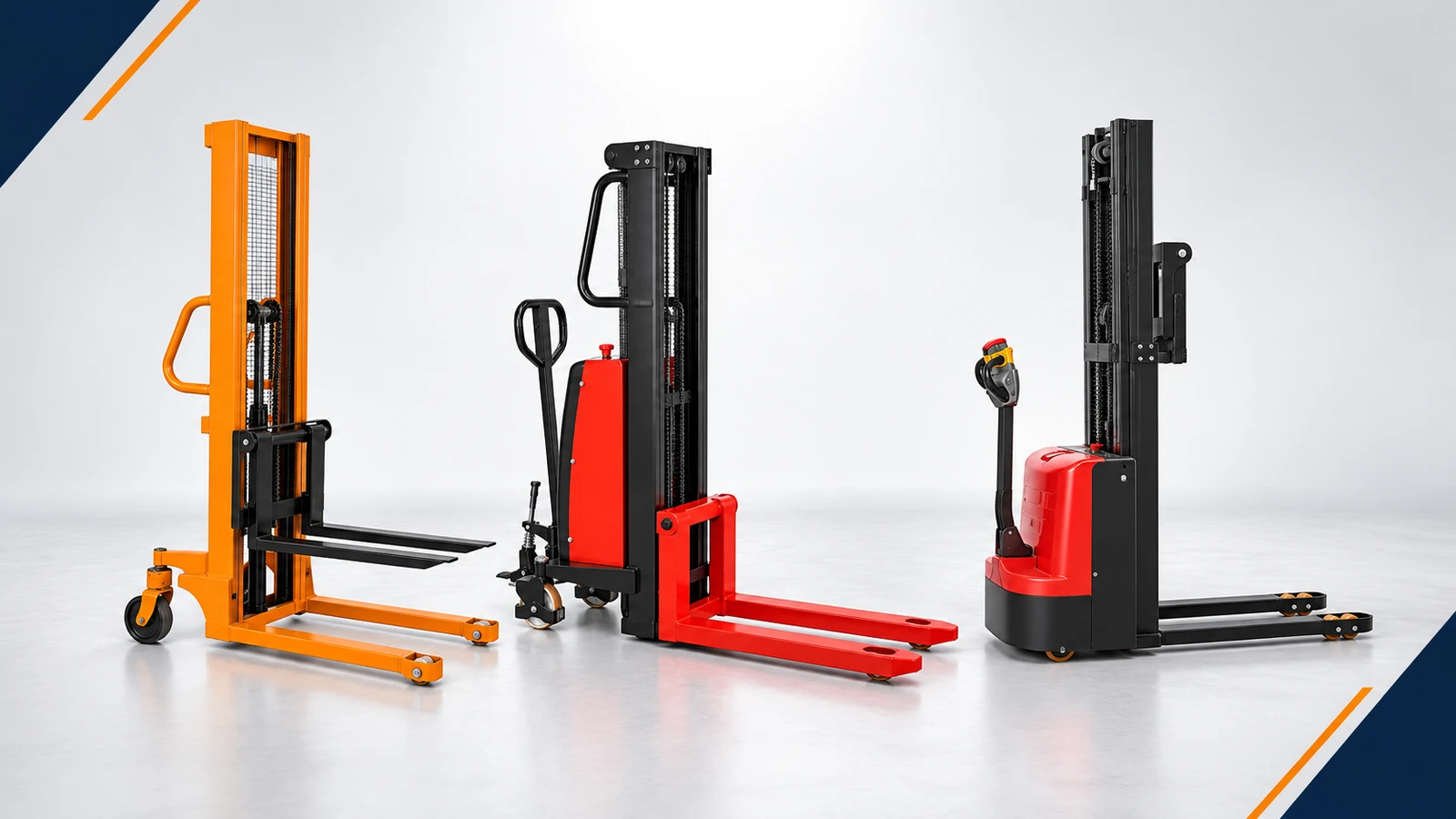
Choosing a pallet stacker involves more than matching pallet weight to a catalogue capacity. The truck must remain suitable at the required height and load center, enter the actual pallet, pass through doors with the mast lowered, clear overhead services when raised, and turn with the load inside the working aisle.
A correctly rated model can still be unsuitable if its support legs conflict with the pallet, its mast is too tall for the route, or its capacity changes at the highest rack level. This guide explains how to compare manual, semi-electric, walkie and stand-on stackers and prepare a verifiable quotation request.
Quick answer: Record the maximum complete load and actual load center. Measure the pallet entry, underside, required fork height, lowered and extended mast clearances, route and aisle. Confirm support-leg compatibility and the manufacturer’s capacity and working-aisle data for the exact model and pallet orientation. Match manual or powered functions to travel, frequency and operator exposure. Use the model table, drawing, capacity plate or load chart rather than assuming that a model suffix or nominal capacity proves suitability.
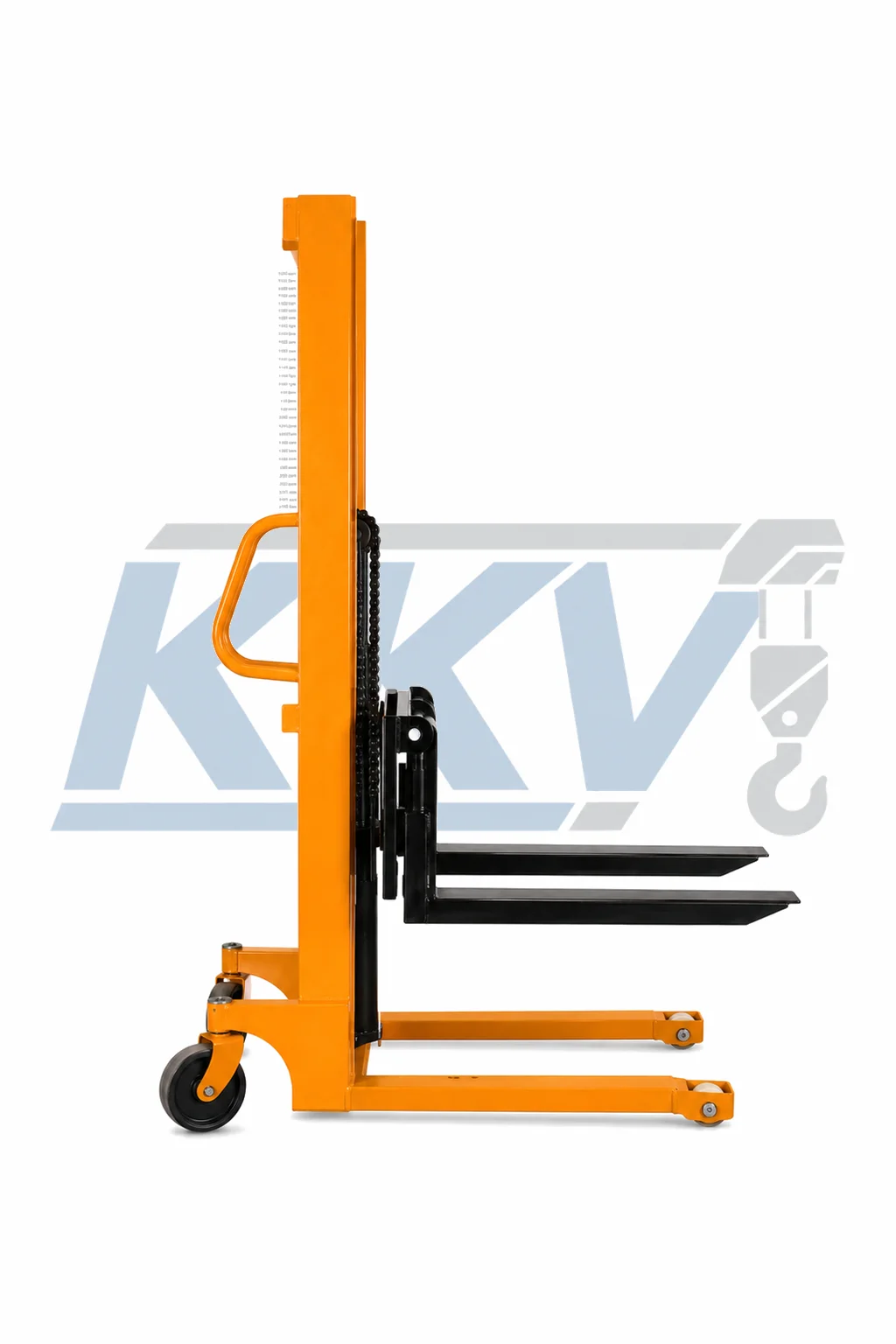
Table of contents
- What is a pallet stacker?
- When is a pallet stacker the right choice?
- Define the complete application before choosing a model
- Manual, semi-electric, walkie or stand-on?
- Nine factors to check before ordering
- How to check pallet and support-leg compatibility
- How to measure lift height, mast height and headroom
- How to check aisle width and turning space
- Comparing KKV pallet stacker models
- An eight-step selection process
- Information to include in your RFQ
- Common selection mistakes
- Pre-use checks and operating basics
- Frequently asked questions
What Is a Pallet Stacker?
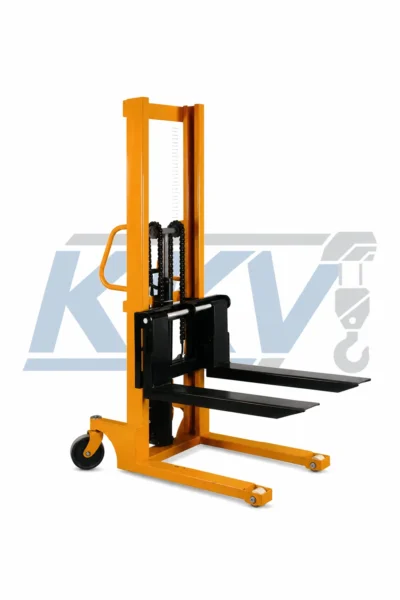
A pallet stacker is an industrial truck that raises a suitable unit load above floor-transport height for racking, stacking or workplace positioning. Most pedestrian models have forks, a mast, lifting carriage and ground-level support legs. Lifting can be manual or powered, and travel can be manual or motor-driven.
It is not simply a taller hand pallet truck. A stacker introduces elevated-load stability, mast clearance, capacity-at-height and rack-placement questions. It is also not a universal substitute for a counterbalanced forklift because its support legs and pallet-entry geometry restrict what it can approach. Choose the equipment category from the complete load and workplace.
When Is a Pallet Stacker the Right Choice?
A pallet stacker is often practical for rack placement, workplace positioning or short internal transfers followed by stacking when:
- the loads are stable and compatible with forks;
- the actual pallets allow the support legs and load wheels to enter or pass around them;
- the floor is hard, level and in suitable condition for the selected model;
- the required height is within the verified capacity and mast configuration;
- the aisle and turning area can accommodate the truck, pallet and operator;
- overhead clearances are known throughout the route;
- the work frequency and travel distance suit the selected manual or powered functions;
- trained operators and appropriate inspection and maintenance are available.
A stacker may be unsuitable for loose, suspended or unstable loads; incompatible closed-bottom skids; uneven yards; uncontrolled slopes; or unapproved attachments. Outdoor, cold-store, wet, corrosive or hazardous-area duties require model-specific confirmation.
Pedestrian-propelled trucks are addressed by ISO 3691-5, while self-propelled industrial trucks fall within ISO 3691-1. In the United States, OSHA 29 CFR 1910.178 applies to powered industrial trucks, not automatically to every completely manual stacker. Always identify the rules that apply at the destination.
Define the Complete Application Before Choosing a Model
Begin with a load and site survey. Record five groups of information before comparing models.
The complete load
Record the maximum gross load, including pallet, container, fixture and packaging. Identify unusual distribution, overhang or shifting risk. Measure load dimensions and determine the combined center of gravity; a long or offset load can move the load center forward beyond the catalogue assumption.
Every pallet and container type
Record pallet dimensions, entry direction, bottom construction, block or stringer spacing, fork pockets and underside clearance. Do not write only “standard pallet”: identical outside dimensions can hide different bottom boards and entry restrictions.
Pickup and placement points
Measure the highest required fork position, rack clearance and overhead obstructions. Record every low door and whether lifting occurs inside a container, vehicle or low-ceiling area.
The complete route
Measure clear aisles, right-angle turns, doors, lift entrances and staging areas with the largest pallet in mind. Note floor damage, joints, thresholds, gradients, blind corners and pedestrian crossings.
The duty
Record pallets per shift, lifts per hour, travel distance, lift height, shifts and peak periods. This distinguishes occasional manual work from duties requiring powered travel or a different energy system.
Manual, Semi-Electric, Walkie or Stand-On?
The four common configurations divide travel and lifting between the operator, hydraulics and electric motors. No universal distance or cycle threshold selects one category; use the complete duty and risk assessment.
| Stacker type | Travel | Lifting | Typical reasons to consider it | Main points to verify |
|---|---|---|---|---|
| Manual hydraulic | Operator pushes and steers | Operator pumps the hydraulic handle or foot control, depending on design | Occasional lifting, short movement, simple indoor duty and no charging requirement | Manual pushing, turning and pumping effort; floor quality; load weight; lift frequency; braking/control arrangements |
| Semi-electric | Operator pushes and steers | Electric hydraulic lift | Reduces repeated manual pump lifting while retaining a simpler manual-travel arrangement | It still requires manual travel; assess starting, stopping, turning and total operator exposure; verify battery and charger |
| Powered walkie | Motor-driven pedestrian travel | Powered lift | Frequent pallet handling, powered movement and compact pedestrian control | Working aisle width, tiller position, speed/control functions, emergency reverse device, braking, training, battery and charger |
| Stand-on electric | Motor-driven with standing platform | Powered lift | Higher activity or longer internal routes where an operator platform can improve travel efficiency and comfort | Larger operating envelope, platform and guarding, turning area, visibility, operator training, traffic control, battery and charging plan |
Manual hydraulic stackers
Manual models avoid a traction battery but transfer travel and lifting work to the operator. Consider them for occasional, short movement on a smooth level floor only after assessing pushing, pulling, pumping and control. A larger nominal capacity does not make a heavy load easier to move.
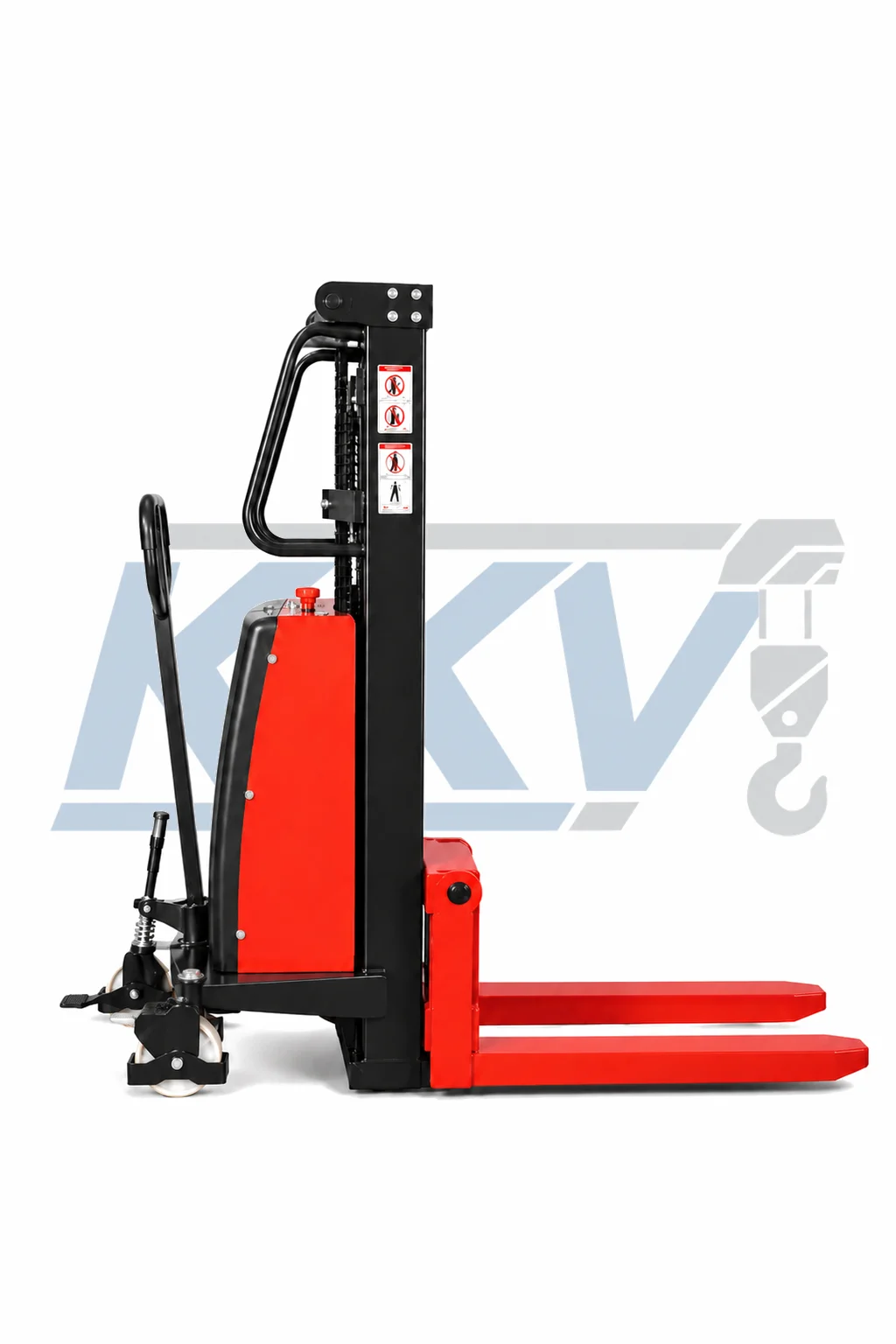
Semi-electric stackers
A semi-electric stacker powers lifting while travel remains manual. It removes repeated pumping but not pushing and steering, so assess both the lift duty and the operator’s ability to control the complete truck along the route. Include its battery and charger in the operating plan.
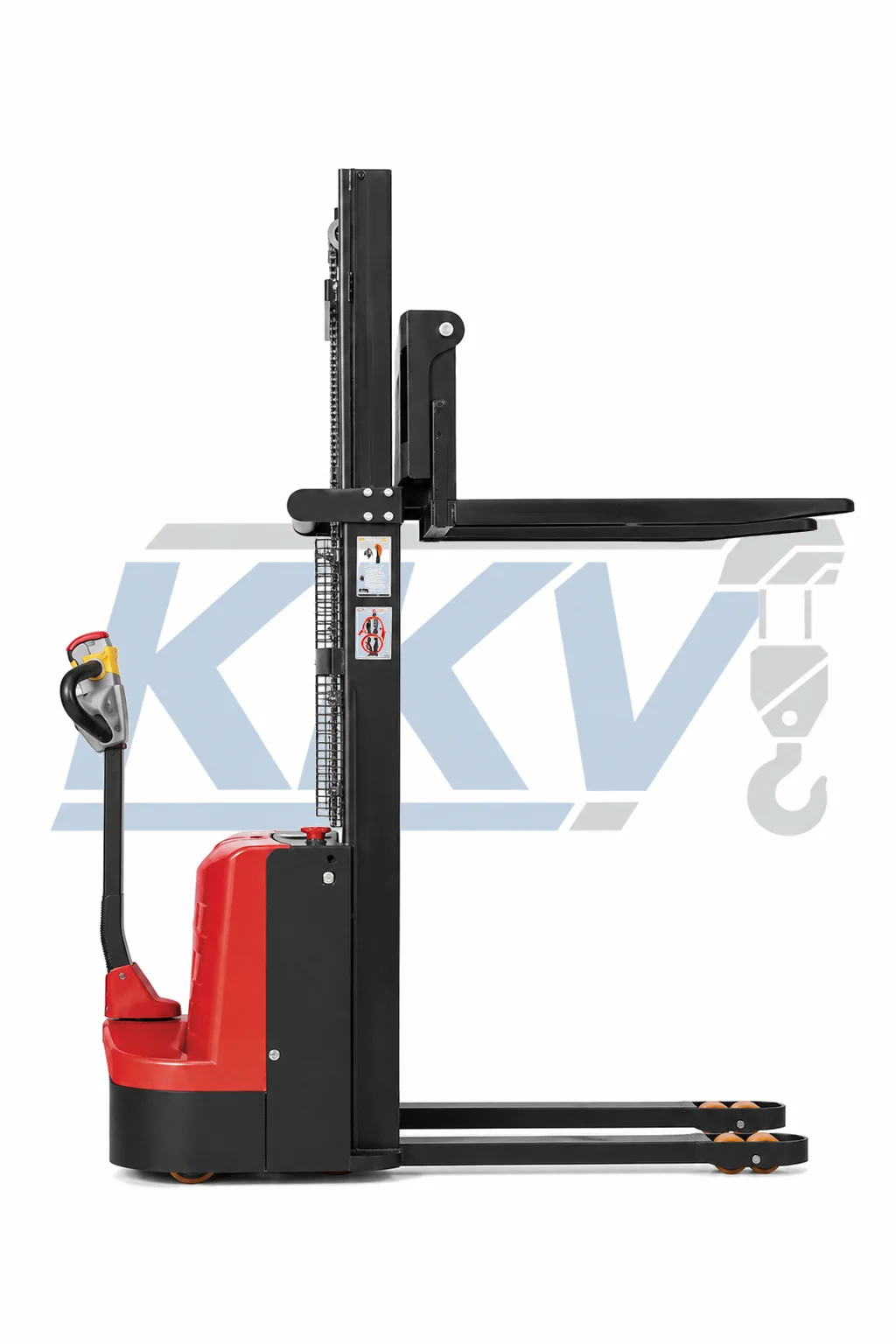
Powered walkie stackers
A powered walkie model uses motor-driven travel and lift while the operator walks with the tiller. It can suit repeated work where compact pedestrian control matters. Verify controls, braking, visibility, pedestrian separation and emergency-reverse functions. Powered travel does not approve every floor or slope.
Stand-on electric stackers
A stand-on model adds an operator platform or compartment. It can suit more travel-intensive work but usually changes the overall envelope, visibility and turning requirement. Verify the aisle with the platform and actual load, and review pedestrian routes, operator protection and training.
Nine Factors to Check Before Ordering
1. Rated capacity, load center and capacity at height
Nominal capacity is only a starting point. Compare the maximum complete load with the capacity allowed at its actual load center, fork height, mast and attachment configuration. Available capacity can decrease as the load center moves forward or the lift height changes. Use the capacity plate or manufacturer-approved load chart for the exact truck. Do not assume that a 2,000 kg rating applies at every height or increase the permitted load because the measured center is shorter.
The Crown SHC operator manual provides a useful manufacturer explanation of capacity, load center and reading a capacity plate. Apply only the instructions and chart supplied for the actual truck being purchased.
2. Pallet type, entry direction and support legs
A fork-over stacker has support legs beneath the fork path, so the pallet underside must admit the legs and wheels. Bottom boards can block them even when the forks fit. A straddle design places support legs outside the load, helping with some closed-bottom pallets but requiring lateral clearance. Confirm fork length, spread and lowered height together with support-leg dimensions, wheel positions and entry direction. This fork-over and straddle brochure illustrates the distinction.
3. Fork height, mast configuration, free lift and headroom
Check four separate dimensions:
- Required fork height: how high the fork surface must rise to place or retrieve the pallet.
- Lowered mast height: whether the truck can pass beneath doors, beams and other low obstructions.
- Extended mast height: whether the mast has adequate clearance below the roof, lights, pipes and sprinklers at full lift.
- Free lift: how far the forks can rise before the mast envelope increases significantly, where that feature is offered.
Required lift must let the pallet clear its support for placement and withdrawal; rack beam height alone is insufficient.
The Toyota mast guide explains common mast measurements. Terminology and dimension codes should still be confirmed on the selected manufacturer’s drawing.
4. Aisle width, turning radius and pallet orientation
Overall truck width is not the required aisle. Turning, alignment, fork entry and withdrawal depend on turning radius, wheelbase, tiller or platform, load distance, pallet dimensions and orientation. Use the manufacturer’s Ast working aisle value for the exact model and reference pallet, then allow for overhang, rack guards, walls and pedestrian routes.
The Toyota aisle-width guide shows how working aisle differs from a simple vehicle-width measurement. Confirm the result with a scaled layout and, where practical, a site demonstration using the real pallet and representative load.
5. Floor condition, gradients and route transitions
Inspect floor flatness, strength, joints, drains, plates, damage and debris. Treat ramps separately: obtain the exact truck’s limits, operating direction, braking method and load restrictions. Gradeability does not automatically permit turning, parking, stacking or continuous ramp travel. For docks, lifts or trailers, verify floor capacity, edge protection, clearances and movement controls.
6. Travel distance, work frequency and operator exposure
Record cycles, distance, lift height, peaks, shifts and operator walking, steering or pumping. Avoid fixed rules for when to use power or how long a battery lasts; load, route, temperature and work intensity change the result. Size the truck and energy system against the documented duty.
7. Battery, charger and site power
Confirm battery chemistry, voltage, capacity, approved charger, site supply, plug, charging location and opportunity-charging rules. Lead-acid charging needs controls for electrolyte, ventilation, hydrogen and ignition sources. Lithium systems depend on the approved battery, management system and charger. Do not interchange chargers because a connector fits.
OSHA’s electrical powered industrial truck guidance outlines common battery hazards. The actual charging area and procedure must follow the truck, battery and charger manuals plus local requirements.
8. Controls, braking, visibility and operator interface
Review tiller reach, travel control, emergency reverse, braking, horn and isolation on powered walkie models. On stand-on units, check platform access, protection, visibility and operating envelope. For manual or semi-electric units, establish how the truck is controlled during lifting, lowering and placement.
9. Environment, documentation and after-sales support
Tell the supplier about outdoor use, temperature, condensation, washdown, dust, corrosion, hygiene and hazardous-area classification. Specify manuals, declarations, labels, language, inspection information, spare parts, destination certification and service support. Maintain traceability for the exact truck, battery, charger and replacement components.
How to Check Pallet and Support-Leg Compatibility
Check every pallet family with measurements and drawings, not a regional name.
Step 1: Identify the required entry direction
Identify the entry side required by the real aisle. Even a four-way pallet may restrict support-leg travel because of its bottom boards or blocks.
Step 2: Measure the fork openings
Measure the narrowest opening height and width, allowing for sag, damage and variation. Check the full fork and wheel path.
Step 3: Map the underside structure
Draw or photograph bottom boards, blocks and stringers, marking the path of the support legs and wheels. A closed bottom may require a straddle model or different truck.
Step 4: Compare fork and support-leg dimensions
Compare fork length, width, spread and lowered height with support-leg widths, length and wheel positions. Adjustable forks do not necessarily mean adjustable legs.
Step 5: Check load support and overhang
Confirm support without mast collision or unsafe overhang. Show pallet depth, load depth and center of gravity in a side-view drawing.
Step 6: Verify with the supplier or a trial
Send the drawing and underside photographs with the RFQ. Where tolerances are uncertain, trial entry, lift, turning, placement and withdrawal with a representative pallet and load.
How to Measure Lift Height, Mast Height and Headroom
Check height along the complete route:
- Measure the floor-to-top height of the highest rack support beam or receiving surface.
- Add the vertical clearance needed to raise the pallet above that support before moving it horizontally.
- Confirm whether the required catalogue dimension is fork-top height, fork-under height or another reference.
- Measure the lowest doorway, beam, container opening and other obstruction along the travel path.
- Obtain the exact lowered mast height and check whether a load backrest, guard or optional feature is higher.
- Obtain the fully extended mast height at the required lift position.
- Check clearance to ceilings, pipes, lights, doors and sprinkler systems, including any locally required separation.
- If lifting must occur beneath a low ceiling, ask whether a suitable free-lift mast is available and obtain its exact drawing.
Never infer maximum fork height from a model suffix. Use the exact model table and drawing. Also distinguish fork height from extended mast height: a truck can pass a door when lowered yet strike overhead services while lifting.
How to Check Aisle Width and Turning Space
Measure the narrowest usable space after rack guards, columns, overhang and pedestrian routes, including corners and staging zones.
Ask the supplier for:
- turning radius for the exact configuration;
- working aisle width for the actual pallet dimensions and orientation;
- the reference load distance and clearance included in that figure;
- overall length with forks, tiller or platform in the relevant position;
- any additional operating clearance required by the manufacturer;
- a dimensioned plan view or turning-envelope drawing.
Include the stand-on platform or walkie tiller, operator, pallet and overhang. Where clearances are tight, use a supervised trial of the 90-degree approach, entry, placement, withdrawal and exit with pedestrians excluded.
Comparing KKV Pallet Stacker Models
The current KKV pallet stacker range includes manual, semi-electric, powered walkie and stand-on electric models. The table below summarizes published distinctions; it is not a substitute for a capacity plate, load chart, model drawing or final quotation.
| KKV range | Published operating concept | Published headline data | Best questions to resolve before ordering |
|---|---|---|---|
| ORM Manual Hydraulic Pallet Stacker | Manual travel and manual hydraulic lift | ORM-1000, ORM-1500 and ORM-2000 list capacities of 1,000, 1,500 and 2,000 kg; published maximum lift height 1,600 mm | Actual operator force, brake/control arrangement, pallet compatibility, capacity at the required height, fork and support-leg drawing |
| SPN Semi-Electric Pallet Stacker | Manual travel with electric lifting | Published 2,000 kg at 450 mm load center; 12 V battery system; listed forks 1,150 mm long with 640 mm outside and 340 mm inside width | Confirm exact mast variant, residual capacity, operator pushing effort, support-leg geometry, charger input and pallet compatibility |
| SPN Walkie Electric Pallet Stacker | Powered pedestrian travel and powered lift | Published 2,000 kg at 500 mm load center; 24 V system; listed forks 1,150 mm long with 640/340 mm outside/inside width | Working aisle, turning radius, support-leg dimensions, residual capacity, training, control functions, battery duty and charger input |
| SPN Stand-On Electric Pallet Stacker | Powered travel from a standing platform with powered hydraulic lift | Published 2,000 kg at 500 mm load center; listed nominal lift options from 1,600 to 3,500 mm; 24 V battery system | Exact fork height and extended mast height, capacity chart, platform operating envelope, working aisle, visibility, battery duty and destination compliance |
KKV manual model dimensions
KKV publishes the following values for the ORM manual hydraulic range. Confirm the final drawing because fork geometry, support legs, wheels and model options must all match the pallet and site.
| Model | Published capacity | Published maximum lift | Published fork length | Published fork outside width | Published overall L × W × H |
|---|---|---|---|---|---|
| ORM-1000 | 1,000 kg | 1,600 mm | 1,000 mm | 745 mm | 1,400 × 780 × 1,850 mm |
| ORM-1500 | 1,500 kg | 1,600 mm | 800 mm | 760 mm | 1,350 × 800 × 1,870 mm |
| ORM-2000 | 2,000 kg | 1,600 mm | 800 mm | 760 mm | 1,350 × 800 × 1,870 mm |
The page also lists a lowered fork height of 100 mm and net weights of 120, 140 and 180 kg respectively. These are useful screening values, not proof that a particular pallet or rack application is compatible.
Important note about SPN model names and fork heights
The current semi-electric and walkie product pages list model names from 2T-1.6m through 2T-3.5m. However, their published tables list maximum fork heights of 2,000, 2,510, 3,010, 3,510 and 4,010 mm for those five configurations. The same pages describe them more generally as 1.6-3.5 m configurations.
Because these values do not map directly, do not use the suffix as the final height specification. State the required fork height and headroom in the RFQ, then ask KKV to identify the exact model and provide its current drawing, lowered mast height, extended mast height, capacity chart and nameplate data. The published tables note an approximate dimensional tolerance of ±5%, which makes exact application confirmation especially important.
For the stand-on range, the page separately lists nominal lift height and extended mast height. Preserve that distinction in quotations and purchase orders.
An Eight-Step Pallet Stacker Selection Process
Step 1: Record the maximum load and its center of gravity
Weigh or reliably calculate the goods, pallet, container and fixtures. Record load length in the fork direction and identify any forward, side or vertical offset. Include the heaviest and most difficult load, not only the typical pallet.
Step 2: Draw the pallet underside
Provide overall dimensions, entry direction, fork-pocket openings, underside clearance, blocks, stringers and bottom boards. Add photographs from the entry side and underside. Repeat for every pallet or skid type.
Step 3: Measure pickup, rack and overhead heights
Determine the required fork height at the highest position, lowest overhead obstruction on the route, and available headroom at full lift. Identify any need for free lift or a particular mast arrangement.
Step 4: Survey the floor and travel route
Measure aisles, 90-degree turns, doors, lift cars and staging areas. Record gradients, thresholds, joints, drains, surface condition and traffic interactions. Mark where the truck will turn, lift and park.
Step 5: Define the duty and choose a power concept
List trips and lifts per shift, distance, peak activity and shifts per day. Decide whether manual travel and lifting are acceptable, whether powered lift alone addresses the task, or whether powered travel is needed. Avoid using a universal distance or cycle threshold.
Step 6: Shortlist exact configurations
Compare capacity at the actual load center and height, fork geometry, support legs, mast dimensions, working aisle and environment. For powered models, compare controls, brakes, battery and charger. Reject any option that depends on an unverified assumption.
Step 7: Obtain documents and written confirmation
Request the dimensional drawing, capacity plate or load chart, model table, manuals, applicable compliance documents, battery and charger specification, inspection requirements, spare-parts information and quotation. Put the application values in the purchase order.
Step 8: Validate the truck before routine use
Inspect the delivered configuration against the order. Confirm labels and documents, then arrange training and a controlled site validation with a representative pallet and load. Do not modify forks, mast, battery, support legs or attachments without the manufacturer’s approval.
Information to Include in Your RFQ
A clear RFQ allows the supplier to verify the application instead of guessing from a desired capacity and height.
| RFQ field | Information to provide |
|---|---|
| Maximum complete load | ___ kg including pallet/container/fixture |
| Typical load | ___ kg |
| Load dimensions | Length × width × height: ___ mm |
| Actual load center | ___ mm from vertical fork face, with drawing |
| Load characteristics | Even/offset, stable/unstable, liquid, fragile, overhang and restraint details |
| Pallet or skid | Overall dimensions, entry direction, bottom boards, blocks/stringers and underside photographs |
| Fork openings | Clear height × width and spacing: ___ mm |
| Required fork dimensions | Length, individual width, outside/inside spread and lowered height to be confirmed |
| Support-leg requirement | Fork-over or straddle compatibility; required inside/outside clearances |
| Highest required fork position | ___ mm, stating measurement reference |
| Lowest overhead clearance | ___ mm along the route |
| Headroom at lift point | ___ mm, including pipes, lights, doors and sprinklers |
| Rack layout | Beam heights, bay width, pallet clearance and rack-guard positions |
| Aisle and turns | Narrowest clear aisle, 90-degree turn, cross aisle and pallet orientation |
| Floor and gradient | Surface, joints, thresholds, drains, slopes, dock plates and lift entrances |
| Duty | Pallets/lifts per hour, hours/shift, shifts/day and distance/trip |
| Preferred operating type | Manual, semi-electric, powered walkie, stand-on or supplier recommendation |
| Environment | Indoor/outdoor, temperature, moisture, dust, corrosion, hygiene or hazardous-area details |
| Electrical supply | Site voltage, phase, frequency, plug and approved charging area |
| Required documents | Drawing, load chart, manuals, declarations/certificates, inspection and spare-parts information |
| Destination and delivery | Country, standards, language, packaging, port and requested quantity |
Attach dimensioned drawings and site photographs. If any value is unknown, mark it for joint verification rather than replacing it with a guess. Ask the supplier to state every assumption in the quotation.
Common Pallet Stacker Selection Mistakes
Selecting by nominal capacity alone
The headline rating may not apply at the required height or load center. Obtain the exact capacity plate or load chart and verify the complete load.
Treating the model suffix as the exact lift height
Product naming conventions vary. Use the detailed table and drawing, especially where published suffixes and maximum fork heights do not directly match.
Ignoring the pallet’s bottom boards
Forks can enter while support legs cannot. Map the underside and determine whether a fork-over or straddle arrangement is required.
Assuming one “standard pallet” proves compatibility
Pallets with the same outside size can have different blocks, stringers, entry directions and clearances. Measure the actual pallets used at the site.
Measuring rack height but not mast clearance
Required fork height, lowered mast height and extended mast height are separate values. Check the entire route and all overhead services.
Using truck width as aisle width
Working aisle includes turning geometry, pallet orientation, load distance and clearance. Ask for Ast or the manufacturer’s equivalent and validate the site layout.
Calling a semi-electric stacker fully powered
Electric lift does not power manual travel. Assess pushing, stopping and steering effort over the complete shift.
Treating gradeability as permission to stack on a slope
A gradeability figure has defined test and operating conditions. It does not automatically approve turning, parking, stacking or continuous ramp use.
Buying a battery without a duty and charging plan
Capacity and runtime depend on the real cycle, temperature, battery condition and charging practice. Match the approved battery and charger to the documented application.
Forgetting operator and pedestrian space
The operator, tiller or platform adds to the working envelope. Traffic controls and pedestrian segregation may be as important as the truck dimensions.
Modifying the truck after delivery
Changing forks, attachments, mast, battery or structural components can affect capacity, stability and compliance. Obtain manufacturer approval and update labels or plates as required.
Pre-Use Checks and Operating Basics
The manufacturer manual, local rules and site risk assessment determine the actual inspection program. The following list is a general starting point, not a substitute for the model-specific checklist.
Before use, a trained or otherwise authorized person should check, as applicable:
- capacity and warning labels are present and legible;
- forks, carriage, mast, support legs and guards show no obvious bending, cracking or damage;
- lifting chains, rollers and anchors show no obvious damage, abnormal slack or contamination;
- wheels and load rollers are secure and free from serious damage or embedded debris;
- hydraulic hoses, cylinders and connections show no leakage;
- steering, travel controls and brakes operate correctly;
- lift and lowering controls respond smoothly and return as designed;
- horn, emergency disconnect and emergency reverse or anti-trap device work where fitted;
- battery, connector, cables and charger show no obvious damage;
- the operating route and rack area are clear and adequately illuminated;
- the intended pallet and load are stable, undamaged and within the confirmed application.
For powered industrial trucks under US jurisdiction, OSHA requires examination before being placed in service, at least daily, and after each shift when used around the clock; unsafe trucks must be removed from service. Do not automatically apply that legal statement to every completely manual stacker in every country. Establish the required frequency from local law and the manufacturer manual.
During operation:
- keep body parts away from the mast, chains, rollers, carriage and load;
- approach pallets squarely and insert the forks fully as specified;
- center and stabilize the load before lifting;
- travel with the load in the manufacturer-recommended low position;
- avoid sudden starts, stops and turns;
- do not permit anyone beneath or on an elevated load;
- maintain visibility and use a spotter or approved alternative where required;
- keep safe clearance from rack, wall, dock and vehicle edges;
- do not exceed the capacity plate or bypass safety devices;
- lower the forks and secure the truck as instructed when parking.
Powered walkie and stand-on stacker operators need truck-specific and workplace-specific training. Relevant topics include controls, capacity, stability, load handling, restricted visibility, narrow aisles, pedestrian traffic, floor conditions, gradients, charging and daily inspection. HSE L117 also provides useful general guidance on rider-operated and pedestrian-operated lift trucks for UK workplaces; legal requirements still depend on jurisdiction.
Frequently Asked Questions
1. What capacity pallet stacker do I need?
Start with the maximum complete weight of the goods, pallet and fixtures. Then verify the permitted capacity at the actual load center, required fork height, mast and attachment configuration. Do not use only the largest number in the product title.
2. Can a 2-ton stacker lift 2 tons to its maximum height?
Not necessarily. Available capacity may change with lift height, load center and configuration. Use the exact capacity plate or load chart and obtain written confirmation for the intended load and height.
3. What is load center on a pallet stacker?
It is the horizontal distance from the vertical face of the forks to the combined center of gravity of the load. A deeper, overhanging or uneven load can move the center farther forward and reduce available capacity.
4. What is the difference between lift height and mast height?
Lift height describes the fork position. Lowered mast height determines whether the truck can pass under an obstruction, while extended mast height determines overhead clearance when lifting. These values must be checked separately.
5. What does free lift mean?
Free lift is the distance the forks can rise before the mast’s overall height increases significantly, on mast designs that provide it. It can be important inside containers, trailers or low-ceiling areas. Ask for the exact drawing because free-lift arrangements differ.
6. Will a pallet stacker handle Euro pallets?
Do not decide from the pallet’s outside size alone. Check entry direction, bottom boards, block or stringer positions, fork openings and support-leg path. A given Euro pallet may work from one side but conflict from another.
7. What is the difference between fork-over and straddle stackers?
A fork-over stacker’s support legs run beneath the fork path and require compatible pallet openings. A straddle model places its legs around the outside of the pallet or load, which can suit some closed-bottom pallets but requires lateral clearance.
8. How much aisle width does a pallet stacker need?
There is no safe universal value. Obtain the manufacturer’s working aisle width for the exact truck, pallet dimensions and orientation, then account for rack guards, walls, overhang, pedestrians and site clearance. Validate tight layouts with a trial.
9. Should I choose a manual or semi-electric stacker?
A manual stacker uses manual effort for travel and lifting. A semi-electric model powers the lift but still requires manual pushing and steering. Compare the load, floor, route, frequency and operator exposure; electric lift alone may not solve difficult manual travel.
10. When should I consider a walkie or stand-on electric stacker?
Powered travel is worth evaluating as handling frequency, travel demand or operator exposure increases. A walkie unit emphasizes pedestrian control and compactness, while a stand-on unit can support more travel-intensive work but often needs more operating space. Use the full duty and layout rather than a fixed distance threshold.
11. Can a pallet stacker be used on a ramp or outdoors?
Only when the manufacturer approves the exact model, load and conditions. Gradeability does not automatically permit stacking or turning on a slope. Outdoor, wet, uneven, cold or corrosive environments may require a special configuration or different equipment.
12. What information should I send for a pallet stacker quotation?
Send maximum gross load, load center, pallet drawings, entry direction, required fork height, overhead clearances, aisle and turns, floor and gradients, duty cycle, environment, site power, destination and required documents. Photographs and a dimensioned site layout greatly improve selection accuracy.
Choose the Stacker from the Load, Pallet and Workplace
The right pallet stacker is the configuration that can lift the actual load at the required height, enter the actual pallet, travel through the actual route and complete the actual duty within the manufacturer’s limits. Capacity, fork height, mast clearance, pallet underside, support legs, aisle geometry and power system must be evaluated together.
For pallet stacker selection or a project quotation, contact sales@kkvhoist.com. Send the completed RFQ information, pallet and rack drawings, site photographs, required quantity and destination. KKV can then identify the appropriate manual, semi-electric, walkie or stand-on configuration and confirm the exact model data.
Safety note: This article is general product-selection information. It does not replace the manufacturer manual, capacity plate, load chart, site risk assessment, operator training, inspection by a competent person or the laws and standards applicable at the place of use. Never operate above the approved capacity, modify the truck without authorization, work beneath an elevated load or use a stacker in an environment, on a gradient or with a pallet that has not been confirmed suitable.