How to Choose an Electric Hoist: Capacity, Duty Cycle, Speed and Power Supply
Choosing an electric hoist requires more than matching a load weight to a number on a nameplate. The hoist must lift the complete load, fit the available space, complete the required number of cycles without overheating, travel at a controllable speed and operate from the actual electrical supply at the installation site.
The supporting beam, trolley, controls and below-the-hook equipment are part of the same lifting system. A hoist with sufficient rated capacity can still be a poor choice if it has inadequate duty, too little lift, excessive headroom, the wrong power supply or an unsuitable environmental rating. This guide explains the information a buyer should confirm before requesting a quotation for an electric hoist.
Quick answer: Select an electric hoist whose rated load is at least equal to the maximum total load applied to the load hook, including below-the-hook attachments. Then confirm the required lift, available headroom, lifting and trolley speeds, operating frequency, average load, starts per hour, suspension arrangement, beam dimensions, site voltage, phase and frequency, control method, environment and required documentation. Capacity alone does not determine whether a hoist is suitable.
Table of contents
- What is an electric hoist?
- Electric chain hoist vs wire rope hoist
- Ten factors to check before ordering
- How duty cycle affects selection
- How to choose lifting speed
- Lift, headroom and suspension
- Power supply and controls
- Protection devices and brakes
- KKV electric hoist starting points
- A seven-step selection process
- Information to include in an RFQ
- Common selection mistakes
- Pre-use and installation checks
- Frequently asked questions
What Is an Electric Hoist?
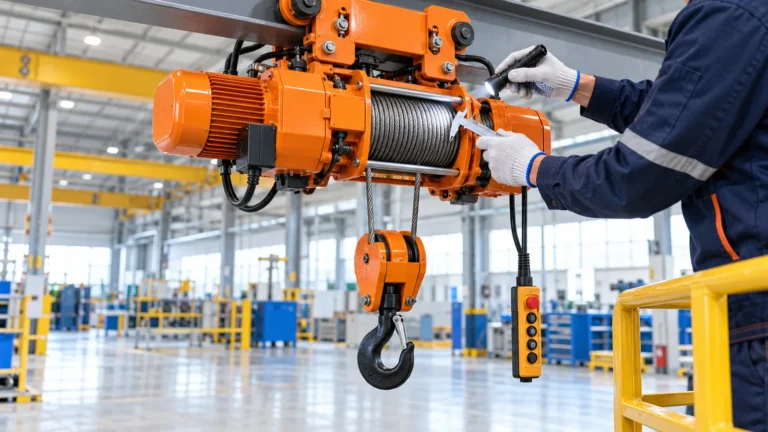
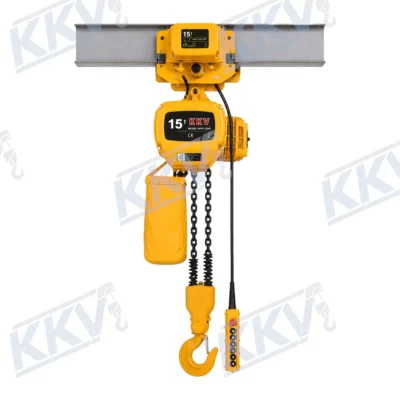
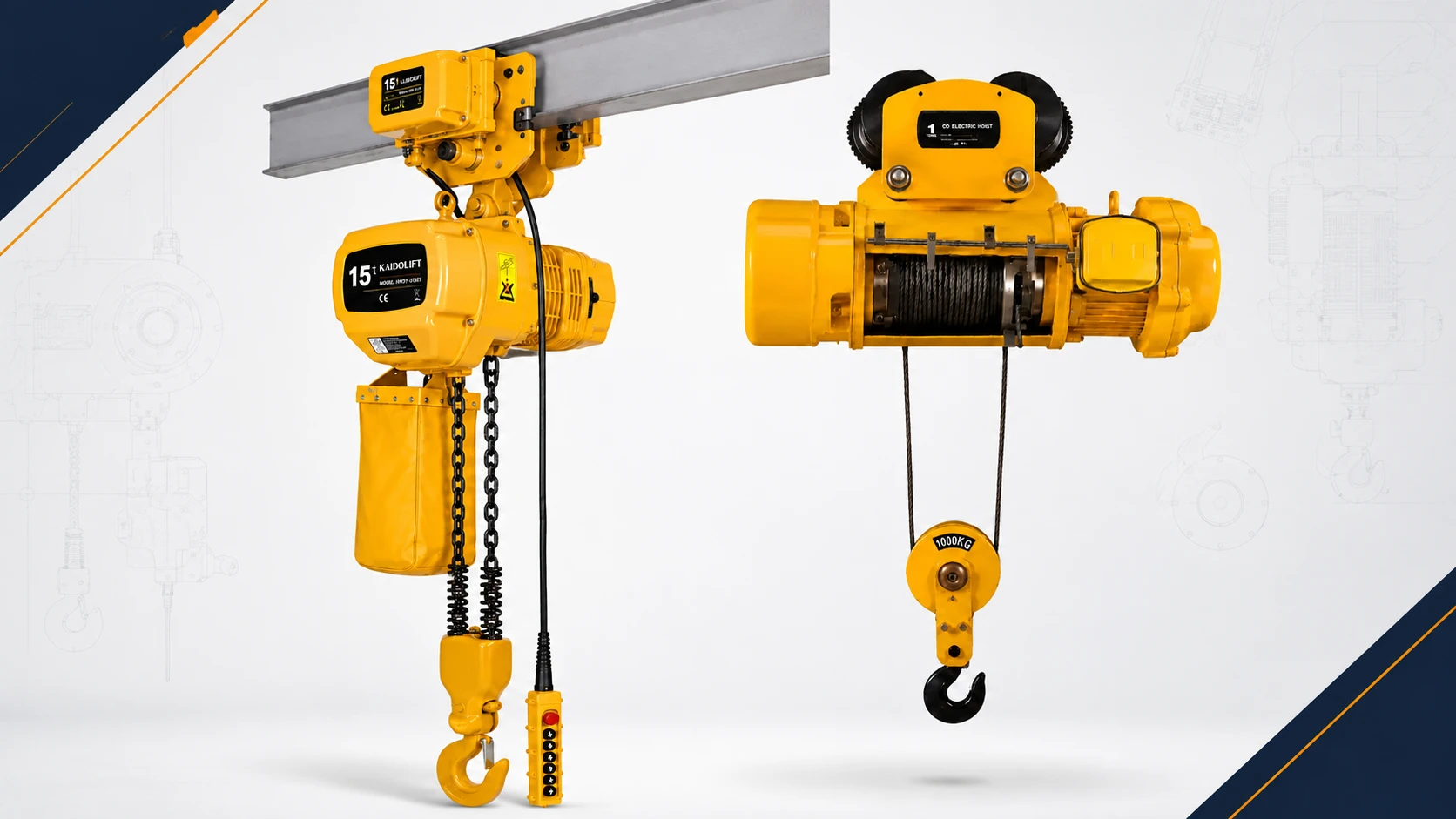
An electric hoist is a powered lifting machine that raises and lowers a freely suspended load. Its main elements normally include an electric motor, reduction gearing, a brake, a load-bearing medium, upper and lower hook or attachment points and a control system. Depending on the design, the load-bearing medium is calibrated load chain or wire rope.
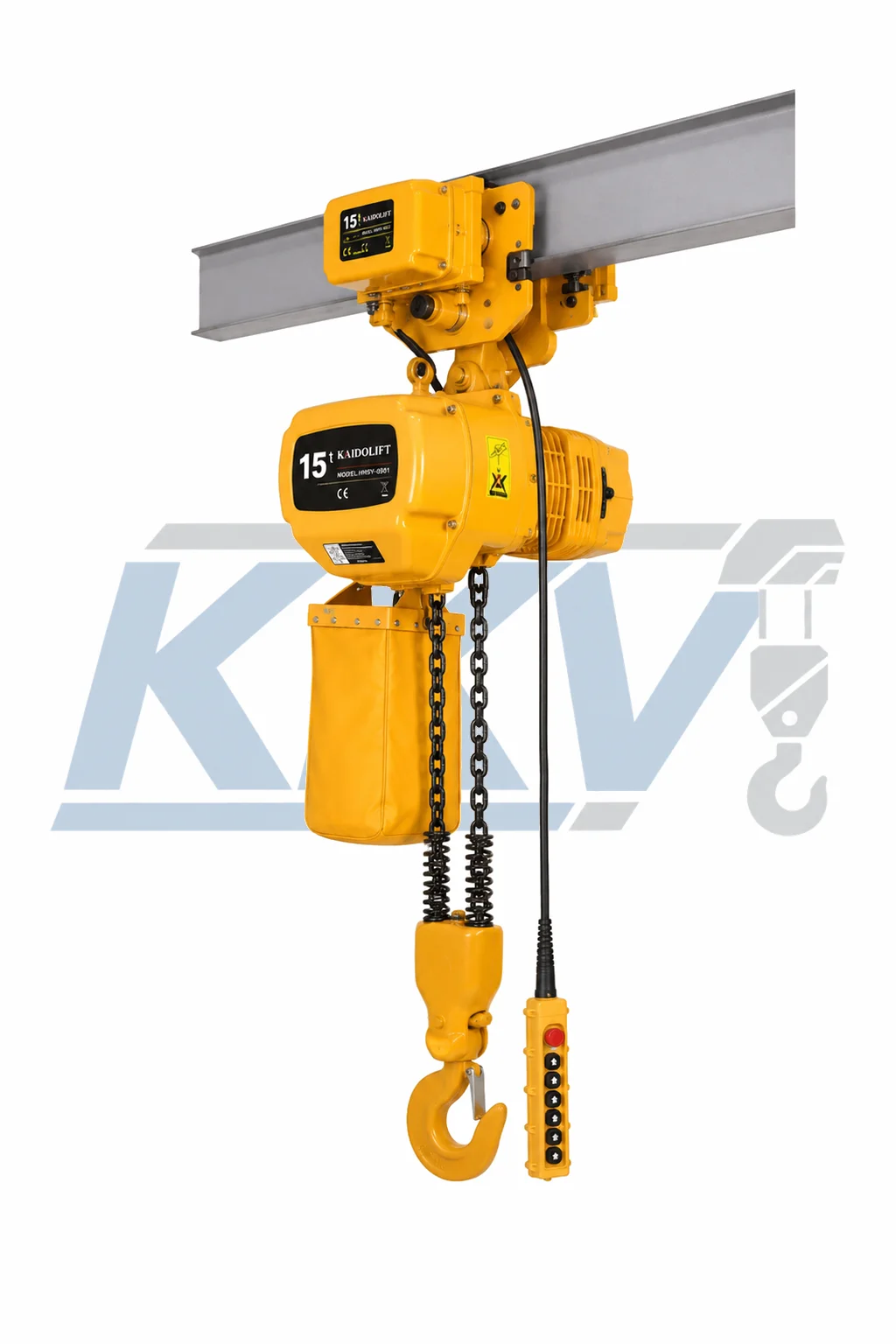
The hoist can be stationary, suspended from a push or geared trolley, or combined with an electrically driven trolley for horizontal travel along a beam. Some models are built in low-headroom form so the upper hook position can approach the beam more closely. The correct arrangement depends on whether the load only moves vertically or must also travel horizontally.
An electric hoist is usually considered when manual lifting would be too slow, too frequent or too physically demanding. It can improve repeatability and cycle time, but it also introduces electrical, control, duty and commissioning requirements that do not apply in the same way to a manual hoist.
ASME HST-1 describes performance requirements for electric chain hoists used to lift freely suspended, unguided loads. Project requirements may also refer to ASME B30.16, local occupational-safety rules, national electrical codes or another market-specific standard. The purchaser should identify the standards and certificates required at the destination instead of assuming that one document applies worldwide.
Electric Chain Hoist vs Wire Rope Hoist
Electric chain hoists and electric wire rope hoists perform the same basic task, but they store and guide the lifting medium differently. Neither design is automatically better for every application.
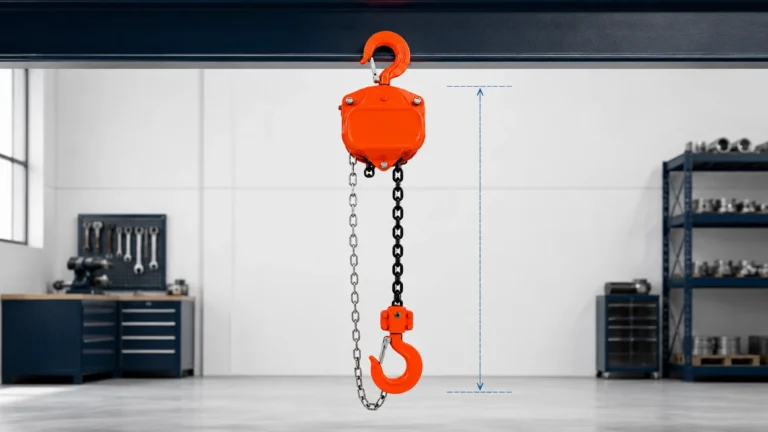
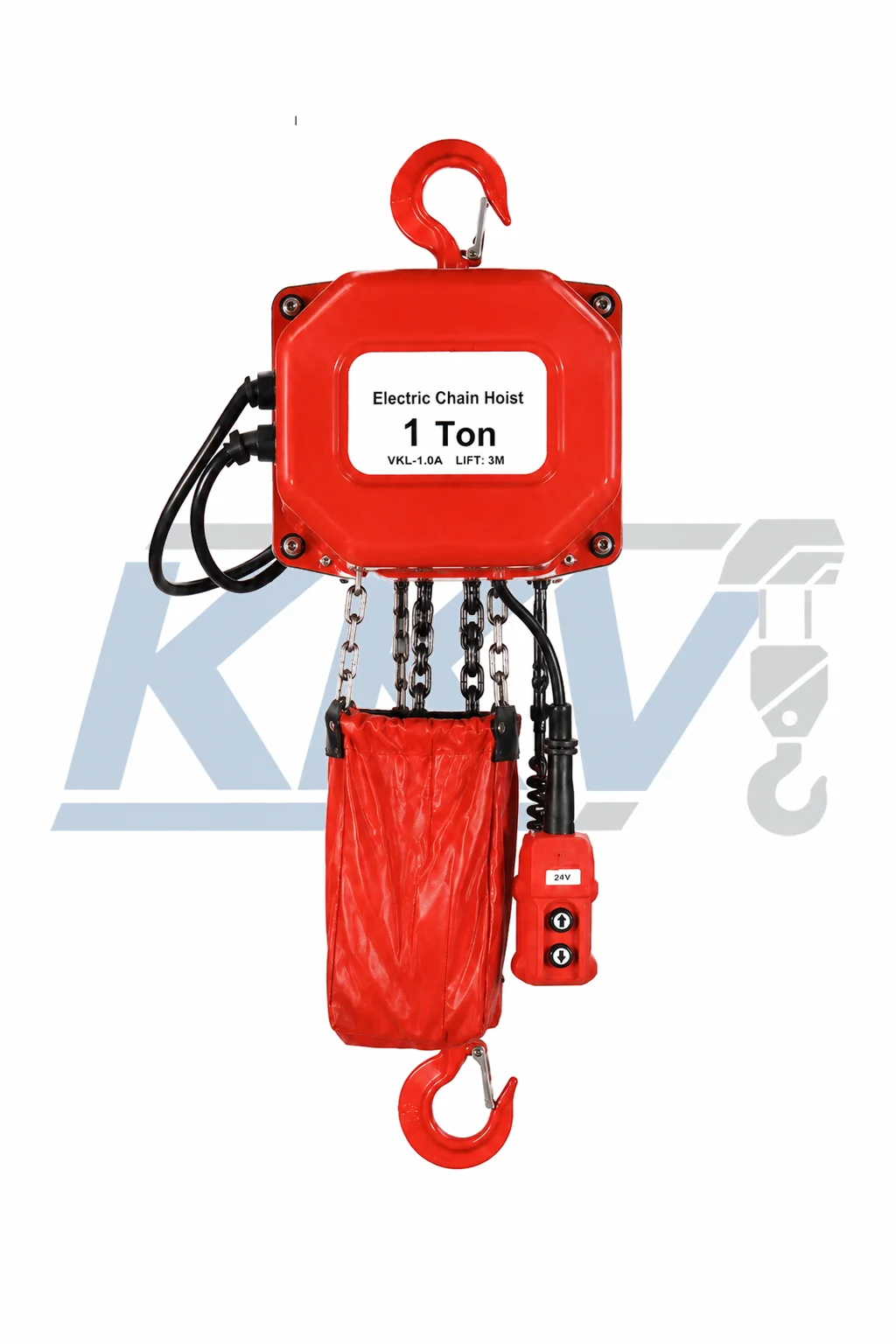
An electric chain hoist passes calibrated load chain through a load sheave and stores the unloaded chain in a chain container. It is often compact and well suited to workstations, production cells, maintenance areas and moderate vertical travel. Chain systems may be available in fixed, trolley and low-headroom configurations. The chain must be the exact size, pitch, material and specification approved for that hoist; general-purpose sling chain is not a substitute.
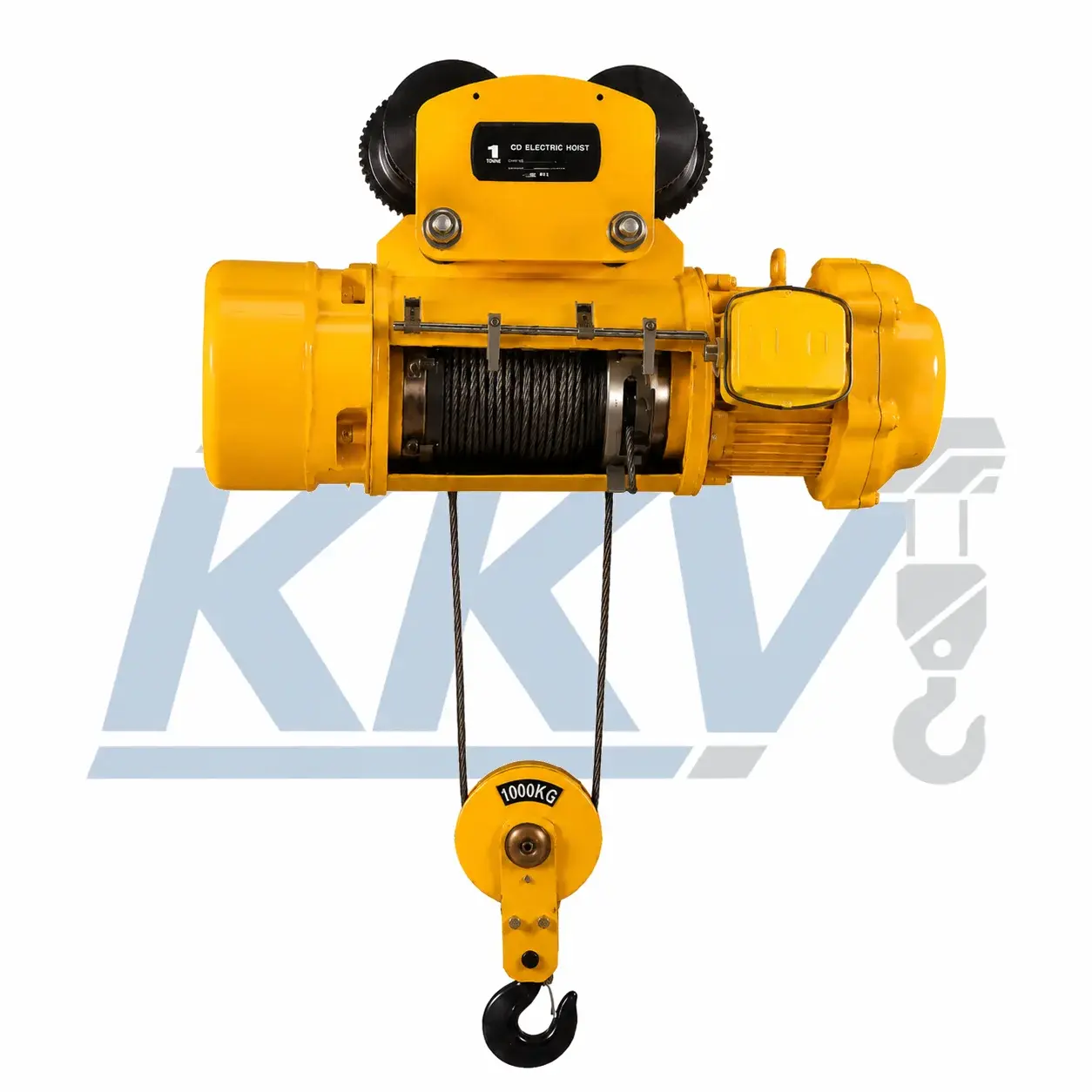
A wire rope hoist winds rope onto a drum. Depending on the model, it may provide longer lifts, higher speeds or higher capacities, although these are product-specific characteristics rather than universal rules. Drum and reeving geometry, rope condition, rope guidance and the available installation envelope must all be considered.
| Selection question | Electric chain hoist | Electric wire rope hoist |
|---|---|---|
| Typical starting point | Compact lifting at workstations and general industrial locations | Longer travel, higher speed or larger-capacity applications, subject to model |
| Load-bearing medium | Calibrated hoist load chain | Wire rope wound on a drum |
| Storage | Slack chain enters a chain container | Rope winds in grooves on the drum |
| Headroom | Standard or low-headroom configurations may be available | Depends on drum, reeving and trolley arrangement |
| Positioning | Single, dual or variable speed may be available | Single, dual or variable speed may be available |
| Key inspection focus | Chain wear, elongation, twist, lubrication and chain container | Rope wear, broken wires, crushing, kinks, drum and rope guide |
| Important limitation | Never replace the calibrated load chain with lifting-sling chain | Never use rope of an unapproved construction or diameter |
The final choice should be based on the exact model’s rated load, duty classification, lift, speed, headroom, reeving, environment and maintenance requirements. Avoid rules such as “chain below five tonnes and wire rope above five tonnes”; the capacity ranges overlap, and the application determines the answer.
Ten Factors to Check Before Ordering
1. Maximum Total Load on the Hook
Start with the heaviest load the hoist will actually support. Include the workpiece and every item below the hook, such as a lifting beam, magnet, grab, clamp, spreader, scale, sling, shackle or fixture. A 1,900 kg machine carried by a 180 kg lifting fixture creates a load of at least 2,080 kg before any application-specific engineering allowance is considered.
The hoist’s rated load must not be less than the maximum total load. Do not treat proof-test force, minimum breaking force or an overload-protection setting as usable working capacity. If shock loading, snagging, process forces or an uncertain load can occur, stop and have the application reviewed rather than adding an arbitrary percentage to a guessed load.
Also verify the capacity of the complete load path: building structure, runway, beam, trolley, upper suspension, hoist, hook, attachment and rigging. The lowest-rated component limits the system.
2. Required Lift
Lift is the vertical distance the load hook must travel between its lowest and highest working positions. Measure the actual hook path, not only the height of the room. Include the depth of the load, rigging length, pickup and landing clearances and any pit, platform or elevated level.
Standard lift may not match the project. Extra chain or wire rope changes weight, storage, reeving and sometimes capacity or performance, so it must be ordered as an approved configuration. Do not extend a load chain or substitute a longer rope in the field without manufacturer authorization.
3. Available Headroom
Headroom is the vertical space consumed by the hoist between its upper suspension or beam and the load-hook saddle at the highest permissible hook position. It is different from lift. A hoist can have enough chain or rope travel but still leave the load too low because the body, trolley and hook block consume too much vertical space.
Record the beam elevation and the highest required hook position. Ask the supplier for the minimum hook-to-beam or hook-to-suspension dimension for the exact capacity, lift and trolley configuration. If space is restricted, request a low-headroom model rather than relying on a drawing for another capacity.
4. Operating Frequency and Duty
Describe how the hoist works during the busiest realistic period. Useful information includes lifts per hour, vertical travel per lift, average load, maximum load, motor on-time, starts per hour, operating hours per day and days per week. Repeated short movements can create many motor starts even when total running time appears low.
Duty designations are not interchangeable marketing labels. A percentage duty value, ISO mechanism group, FEM classification or ASME service class must be interpreted using the manufacturer’s definition and the applicable standard. The hoist motor, brake and trolley may also have different ratings. Select against the complete duty table for the exact model.
5. Lifting and Lowering Speed
Speed affects production time and load control. A fast single-speed hoist can shorten long lifts but make final positioning difficult. Dual-speed operation provides a normal speed for travel and a slower speed for approach. Variable-frequency control may provide smoother acceleration and a wider positioning range when offered for the model.
Calculate the travel time for a representative cycle. If a hook moves 6 m at 6 m/min, the powered travel portion is approximately one minute in one direction, before acceleration, deceleration, rigging and handling time. Repeat the calculation for the slow speed and the longest required lift. Verify both loaded and unloaded behavior from the supplier’s data.
6. Suspension, Trolley and Beam Fit
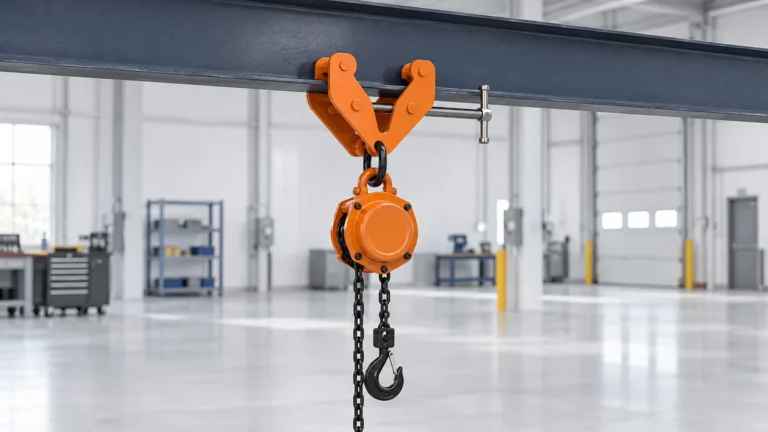
A fixed hoist only raises and lowers. A push trolley adds manual horizontal travel, a geared trolley uses a hand chain and an electric trolley uses a powered travel motor. A motorized trolley is useful for frequent or long travel, but its speed, duty, control and power requirements must also match the application.
For a trolley-mounted hoist, provide the beam type, flange width, flange thickness, tread shape, minimum curve radius, runway length and any slope or transition. Confirm wheel profile and adjustment range. A trolley that fits the flange width may still be wrong for the beam profile, curve, load or travel duty.
7. Exact Electrical Supply
State the measured or specified supply voltage, number of phases and frequency at the installation point. “Industrial power” is not enough. A 380 V, 50 Hz three-phase model is not automatically suitable for a 400 V, 50 Hz or 460 V, 60 Hz site. Confirm allowable tolerances with the manufacturer.
Provide information about cable run, festoon or conductor system, disconnect, protection and earthing. The electrical designer should check full-load current, starting behavior, voltage drop, breaker or fuse selection and local code requirements. Never solve a supply mismatch with an unapproved transformer, rewiring change or control modification.
8. Control Method
Common options include a suspended pendant, independent traveling pendant, radio remote control or controls integrated into a crane system. Define how many motions are required, whether speeds are single, dual or variable, the desired pendant length, emergency-stop arrangement and the operator’s safe viewing position.
Control voltage and main supply voltage are different specifications. Ask for both. Radio control can improve mobility, but it requires a managed transmitter, receiver, emergency-stop strategy, interference assessment and a safe method for taking the equipment out of service. It is not automatically the best choice for every site.
9. Working Environment
Identify indoor or outdoor use, ambient-temperature range, humidity, rain, dust, washdown, salt, chemicals, abrasive material, food-production restrictions and corrosive atmosphere. Also state whether the location is hazardous or classified because of flammable gas, vapor or combustible dust.
An ingress-protection rating addresses specified entry of solids and water; it does not by itself prove corrosion resistance, outdoor suitability or explosion protection. A standard industrial hoist must not be used in an explosive atmosphere unless the complete configuration is specifically designed, certified and documented for that classification.
10. Documentation and Compliance
List the destination country and required language for manuals and markings. Request the documents needed by the owner or project, which may include a declaration or certificate, test record, inspection documentation, wiring diagram, spare-parts list, maintenance instructions, dimensional drawing and material or component traceability.
Standards should be named precisely, including edition when the contract requires it. Ask the supplier to identify what is included, what is optional and what is not applicable. A logo or general statement on a website is not a substitute for documents covering the exact supplied unit.
How Duty Cycle Affects Selection
Duty is one of the most frequently underestimated selection factors. Two users can buy hoists with the same capacity and lift but impose very different thermal and mechanical demands.
Consider two simplified applications. The first raises a heavy component 3 m twice per shift for maintenance. The second repeatedly lifts smaller parts 1 m, pauses, lowers and immediately starts again throughout a production shift. The first may have the higher individual load, while the second can produce far more starts, brake operations and cumulative running time.
Collect the following operating profile before comparing duty ratings:
- maximum and typical load;
- number of complete lifting cycles during the busiest hour;
- average upward and downward powered travel per cycle;
- normal and slow lifting speeds;
- approximate motor on-time during the busiest period;
- number of starts or jogging commands per hour;
- operating hours per day and days per week;
- expected service life and unusual peak periods;
- trolley travel distance, speed and starts if a powered trolley is included.
Some manufacturers express duty as a percentage over a defined time period and separately limit starts per hour. Others provide an ISO, FEM or ASME classification based on load spectrum and operating time. The reference period and calculation method must come from the exact product documentation. For example, “50% ED” is incomplete unless the manufacturer’s defined cycle period and permitted starts are known.
Jogs matter because every start can heat the motor and operate the brake. Moving 100 mm through ten separate button presses is not necessarily equivalent to one continuous 1 m movement. If the process requires delicate repeated positioning, describe it explicitly and discuss dual-speed or variable-frequency control with the supplier.
Do not assume that a larger-capacity hoist automatically has a higher duty rating. Capacity, mechanism group, motor rating, brake design and control configuration are separate selection variables.
How to Choose Lifting Speed
Begin with process requirements rather than the fastest catalog value. Record the longest powered lift and the acceptable travel time, then identify how accurately the load must be positioned at pickup and landing.
Single-speed control is simple and can suit straightforward transfer work. Dual-speed control adds a lower approach speed and is useful where fixtures, molds or assemblies require controlled alignment. Variable-frequency control can offer smooth starting, stopping and adjustable speed when the hoist is designed for it. It should not be added as an unrelated field modification because the motor, brake, contactors, limits and control logic must operate as a system.
Very high speed can increase load swing and make landing more difficult. Very low speed can lengthen motor on-time and reduce throughput. For horizontal travel, consider trolley acceleration and stopping distance as well as nominal speed. A long runway may justify powered travel, while a short precision workstation may need slower movement.
Ask these questions:
- How many metres must the hook travel in the longest cycle?
- How many seconds or minutes are available for that movement?
- Does the operator need a slow approach speed?
- Will the load swing easily because of its shape or rigging length?
- Is coordinated crane travel required while lifting?
- Is the stated speed the same at every reeving or capacity configuration?
The answer may be a single-speed, dual-speed or variable-speed arrangement, but only the supplier’s model data can establish the available combinations.
Lift, Headroom and Suspension
Lift, headroom and suspension should be drawn together on a simple elevation sketch. Mark the underside of the supporting structure, beam height, highest hook-saddle position, lowest pickup, lowest landing point, load height and rigging length.
For a hook- or lug-suspended stationary hoist, verify the upper attachment and how the hoist will be prevented from unintended movement or side loading. For a trolley hoist, include the trolley and beam in the headroom dimension. For a low-headroom arrangement, confirm the exact envelope at the selected capacity because body, chain falls and hook-block dimensions can change between models.
The chain container also needs space. It must hold the unloaded chain at the ordered lift without interference. A very long chain can add weight and alter the container size. On a wire rope hoist, confirm drum, rope guide and hook-block clearances throughout travel.
The hoist should be positioned so the load line is vertical before lifting. Side pulling can damage the guide, chain, rope, hook and supporting system and can cause uncontrolled load movement. If the job is primarily pulling or tensioning rather than vertical lifting, use equipment specifically approved for that operating direction.
Power Supply and Controls
A complete electrical specification usually needs more than one voltage entry. Record:
- main supply voltage;
- single- or three-phase supply;
- supply frequency in hertz;
- available earthing and any neutral requirement stated by the design;
- desired control voltage;
- hoist and trolley motor current information;
- cable or conductor length and installation method;
- pendant, radio or crane-control interface;
- number of motions and number of speeds per motion;
- site electrical standard and enclosure requirements.
The nameplate and wiring diagram must match the delivered configuration. Before commissioning, a qualified person should verify supply, protective devices, phase sequence where applicable, direction commands, emergency stop, brakes and upper/lower travel limits. A direction error discovered under load can create an immediate hazard.
If a generator is proposed, provide its output characteristics and the starting demand of the complete hoist and trolley system. Nominal generator power alone may not guarantee acceptable voltage during motor starting. If a long mobile cable or festoon is used, voltage drop and mechanical protection also need review.
Protection Devices and Brakes
Protective devices support safe operation, but they do not change the rated load or replace correct operation.
An upper or lower travel limit is intended to prevent excessive hook travel within the design. It should not routinely be used as the operator’s normal stopping method unless the manufacturer explicitly permits that function. Repeatedly driving the hook block, chain stop or rope termination into the hoist can damage components even when a limit is fitted.
An overload limiter, friction clutch or electronic load device may reduce the chance of lifting an excessive load, but it is not a weighing scale and does not authorize overloading. Its setting, accuracy and test method are product-specific. If load weight is unknown, determine it using an appropriate method before lifting.
The hoist brake must control and hold the load within the manufacturer’s operating limits. Brake condition and function need inspection and testing according to the manual. Do not suspend a load indefinitely or leave it unattended because a brake appears to be holding.
Emergency stop, phase monitoring, thermal protection, limit switches and load protection may be standard on one configuration and optional on another. Put every required function in the RFQ and confirm it in the order acknowledgement and wiring documentation.
KKV Electric Hoist Starting Points
KKV’s current Electric Hoist category includes electric chain and electric wire rope designs. The table below is a starting point for discussion, not a substitute for a model-specific quotation and approved technical data.
| KKV series | Current product-page starting point | Applications to discuss | Details that still require confirmation |
|---|---|---|---|
| HHSY Electric Chain Hoist | Listed 0.5–5 t; stationary, motor-trolley and low-headroom forms | General industrial lifting where chain storage and configuration flexibility are useful | Exact duty, lift, speed, headroom, power, beam fit, protection and certificates |
| DHS Electric Chain Hoist | Listed 1–5 t, with 3 m and 6 m configurations and 380 V shown on the current page | Compact fixed or trolley-supported electric lifting | Destination supply compatibility, duty, speed, suspension and environment |
| VKL Electric Chain Hoist | Listed 0.5–5 t with different chain-fall and speed arrangements | Applications needing a compact chain hoist and defined control/safety options | Exact electrical option, control voltage, duty, included protective devices and trolley |
| CD1/MD1 Electric Wire Rope Hoist | Current listing covers multiple capacities and lifts; CD1 is presented as single speed and MD1 as normal plus low speed | Longer lift, higher-capacity or dual-speed wire-rope applications, subject to model | Reeving, headroom, duty, rope specification, trolley, beam, power and controls |
| HGS-B Mini Electric Wire Rope Hoist | Compact mini wire-rope product family | Light-duty applications where small size and available site power are important | Rated load in each reeving mode, duty, lift, supply, mounting and permitted use |
Published ranges and configurations can change. Confirm the selected model, rated load, lift, reeving or chain falls, speed, duty, dimensions, net weight, power supply and included features on the final quotation. Where a website value conflicts with an approved drawing or order document, resolve the discrepancy before manufacture or installation.
A Seven-Step Selection Process
Step 1: Describe the Load and Task
Record the maximum total suspended load, dimensions, centre of gravity, pickup method and below-the-hook equipment. State whether the load is stable, hot, fragile, hazardous or likely to snag. Describe whether the task is lifting, transferring, positioning or part of a production process.
Step 2: Draw the Required Movement
Measure the vertical hook travel and any horizontal trolley or bridge travel. Mark the highest and lowest hook positions, obstacles, landing areas and operator location. Note curves, switches or slopes in the runway.
Step 3: Calculate the Operating Profile
For the busiest hour, estimate cycles, powered travel time, average load and starts. Add normal hours per day, days per week and expected service life. Include the trolley profile separately if travel is powered.
Step 4: Choose Chain or Wire Rope and Suspension
Compare the available chain and wire-rope models against capacity, lift, headroom, speed and duty. Select fixed, push, geared or powered trolley suspension. Provide complete beam data rather than only the nominal beam size.
Step 5: Confirm Power, Control and Environment
State voltage, phase, frequency, control voltage and interface requirements. Define pendant or radio operation, speed control and emergency stop. Describe dust, water, temperature, corrosion and any hazardous-area classification.
Step 6: Confirm Protection, Standards and Documents
List required limits, overload protection, brake features, ingress protection, markings, certificates, tests, manuals and drawings. Use exact standard names and destination requirements.
Step 7: Review the Final Configuration
Before ordering, compare the quotation and approved drawing with the original application data. Check rated load, lift, speed, duty, headroom, trolley adjustment, beam fit, power supply, controls, chain or rope, hook dimensions, chain container, protection and documentation. Do not assume that an accessory discussed by email is included unless it appears in the final order.
Information to Include in Your RFQ
| RFQ field | Example format |
|---|---|
| Maximum total suspended load | 1,850 kg including 150 kg lifting fixture |
| Required rated load | Supplier to confirm suitable standard capacity |
| Load description | Steel assembly, stable centre of gravity, indoor handling |
| Required lift | 8 m hook travel |
| Available headroom | Beam underside to highest hook saddle: 620 mm maximum |
| Suspension | Motor trolley on existing I-beam |
| Beam information | Profile, flange width/thickness, tread and minimum curve radius |
| Hoist operating profile | 20 cycles/hour, 6 hours/day, 5 days/week |
| Load spectrum | Typical 900 kg; maximum 1,850 kg |
| Motion per cycle | 4 m up and 4 m down average |
| Positioning | Normal speed plus slow approach requested |
| Trolley travel | 18 m runway, powered travel, speed to be confirmed |
| Main electrical supply | 400 V, three phase, 50 Hz at installation point |
| Control | Pendant, low-voltage control, emergency stop |
| Environment | Indoor, dry, 5–35 °C; provide actual project limits |
| Required documents | Drawing, wiring diagram, manual, test and conformity documents |
| Destination | Country, city, delivery terms and required language |
Replace the examples with measured project data. If a value is unknown, mark it “supplier to review” and explain the application instead of guessing.
Common Selection Mistakes
Selecting by Tonnage Alone
A capacity match does not confirm duty, headroom, lift, speed, trolley fit, power or environment. Use a complete application sheet.
Ignoring Below-the-Hook Weight
Lifting beams, grabs, magnets, fixtures and rigging all load the hook. Include them in the maximum total suspended load.
Confusing Lift with Headroom
Lift is hook travel; headroom is the space occupied above the highest hook position. Verify both from an application drawing.
Describing Duty as “Occasional” or “Continuous”
Those words are subjective. Provide cycles, travel, loads, running time, starts and schedule so the supplier can assign a suitable duty classification.
Ordering the Wrong Voltage or Frequency
Country name is not an electrical specification. Confirm voltage, phase and hertz at the installation point and put them on the purchase order.
Assuming Every Feature Is Standard
Dual speed, radio control, upper and lower limits, overload protection, thermal devices and special enclosures vary by model. List required features and verify the delivered configuration.
Treating an IP Rating as Universal Environmental Approval
Ingress protection does not automatically cover corrosion, chemicals, outdoor exposure, food hygiene or explosive atmospheres. Define each environmental hazard separately.
Using the Load Chain as a Sling
Hoist load chain is part of a calibrated lifting mechanism. Do not wrap it around a load or replace it with Grade 80 lifting sling chain. Use approved below-the-hook rigging.
Using Travel Limits as Routine Stops
Stop with the operating control. A limit device is a protective boundary and must not be repeatedly used to compensate for poor operator positioning.
Planning to Lift with Two Independent Hoists
Using two hoists on one load can produce unequal sharing, skewing and overload even when the total capacity appears sufficient. Multi-hoist lifting needs an engineered plan and, where necessary, purpose-designed synchronized controls.
Pre-use and Installation Checks
Installation, commissioning, inspection and maintenance must follow the manufacturer’s manual and the rules applicable to the site. A competent or qualified person should complete the required checks before the hoist enters service.
Typical pre-use observations include:
- nameplate is present and the rated load matches the intended task;
- support, suspension, trolley and fasteners appear secure and undamaged;
- hooks, latches and hook rotation show no obvious damage or distortion;
- load chain is correctly seated, not twisted and properly stored, or wire rope is correctly reeved and seated on the drum;
- pendant, cable and strain relief are intact and controls return correctly;
- motion direction agrees with the button marking;
- brakes operate correctly and no abnormal drift is observed;
- upper and lower limits function using the manufacturer’s test method;
- chain, rope, sheaves, drum and guides show no obvious damage or obstruction;
- the travel path is clear and the operator has a safe view;
- required inspection and maintenance records are current.
Stop operation if there is unusual noise, vibration, heat, smell, brake slip, erratic motion, damaged chain or rope, a distorted hook, a malfunctioning control or any uncertainty about the load or support. Isolate the equipment and have it examined by an authorized person. Do not bypass a limit, bridge a safety circuit or make an unauthorized repair to return the hoist to service.
Do not exceed rated load, side pull, use the hoist chain as a sling, lift people, carry loads over people or operate a standard hoist in a flammable atmosphere. The exact prohibited practices and inspection intervals must come from the supplied manual and applicable site rules.
Frequently Asked Questions
What capacity electric hoist do I need for a 2-ton load?
First calculate the maximum total load on the hook, including the load, fixture, lifting beam, slings and other attachments. Select a hoist whose rated load is at least that total, then verify duty, lift, headroom, speed, suspension and power. A hoist rated exactly 2 t is not suitable if the complete suspended load exceeds 2 t.
Is an electric chain hoist or wire rope hoist better?
Neither is universally better. Chain hoists are often compact and convenient for workstations and moderate lift. Wire rope hoists may be available for longer lift, higher speed or larger capacity. Compare exact models using capacity, duty, lift, headroom, positioning, environment and maintenance requirements.
What does electric-hoist duty cycle mean?
It describes how intensively the mechanism can operate under defined conditions. Depending on the manufacturer and standard, it may consider motor on-time, starts per hour, load spectrum, cycles and total operating time. Always use the definition and table for the exact model.
Can I run a 380 V hoist on a 400 V supply?
Do not assume compatibility. Provide the measured site voltage, phase and frequency and ask the manufacturer to confirm the permitted range for the motor and controls. The nameplate, wiring, protection and order documents must match the approved supply.
Do I need single speed, dual speed or variable speed?
Single speed can suit straightforward transfers. Dual speed helps with slow approach and positioning. Variable speed may provide smoother control when designed into the hoist. Base the decision on travel time, positioning tolerance, duty and the available manufacturer configuration.
Why is headroom important?
Headroom determines how high the load hook can rise beneath the support. If the hoist and trolley consume too much vertical space, the load may not clear equipment or reach its required landing position even when there is enough lift.
Can an upper limit switch be used to stop every lift?
Normally, travel limits are protective devices rather than routine operating stops. The operator should release the control before reaching the limit unless the manufacturer explicitly specifies another operating method.
Can I add a radio remote control later?
Only through an approved design. The receiver, transmitter, contactors, emergency stop, control voltage, enclosure and risk controls must be compatible with the hoist. Request radio control before ordering where possible.
Can a standard electric hoist be used outdoors?
Only if the exact configuration is approved for the site’s rain, dust, temperature, humidity, corrosion and storage conditions. An IP code alone does not answer every environmental question. Covers, heaters or special finishes may be required, but they must be selected by the supplier.
Can two electric hoists lift one long load together?
This is an engineered lifting application. Independent hoists may not share the load equally, and small speed differences can overload one unit or tilt the load. Provide the load geometry and required control method to a qualified lifting-system designer.
Can Grade 80 sling chain replace worn electric-hoist load chain?
No. Hoist load chain is calibrated to the load sheave and specified for that hoist. Replacement chain must be approved by the hoist manufacturer and installed and tested according to its instructions.
How often should an electric hoist be inspected?
Pre-use observations and periodic inspections should follow the manufacturer, service conditions and applicable regulations. Severe or unusual service may require shorter intervals. Keep inspection, testing and maintenance records required by the owner and jurisdiction.
When should I choose a manual hoist instead?
A manual hoist may suit infrequent lifting, sites without suitable power or jobs where portability is more important than cycle time. Compare the complete task using the manual chain hoist selection guide and the manual chain hoist vs lever hoist guide.
Specify the Application, Not Just the Tonnage
The most reliable electric-hoist quotation begins with a complete operating profile: total suspended load, lift, headroom, speeds, cycles, starts, average load, suspension, beam, trolley travel, power supply, controls, environment, standards and documents.
KKV can compare electric chain and wire rope configurations against those requirements. Final suitability depends on the approved model and project data, so technical values should be confirmed in the quotation and drawing rather than inferred from a category-page summary.
For selection support, email sales@kkvhoist.com with the completed RFQ information above.
Safety note: This article is a general product-selection guide, not a substitute for the manufacturer’s instructions, an engineered lifting plan, inspection by a qualified person or the laws and standards applicable at the worksite. Never exceed rated load, lift people, work beneath a suspended load or use equipment outside its approved configuration.