How to Choose a Ratchet Tie Down Strap: LC, STF, Length and Hooks
Knowing how to choose a ratchet tie down strap starts with the restraint method, not the largest number on a sales listing. The assembly must suit the cargo, vehicle anchor points, required force, strap route and operating conditions. For an EN-labelled lashing system, LC and STF describe different performance characteristics; neither is a direct statement of how many tonnes of cargo one strap can secure.
A useful purchasing specification identifies the complete assembly, fixed and adjustable lengths, end fittings, label information and intended application. This guide explains what to ask for before ordering cargo-lashing straps and how to avoid confusing them with lifting slings.
Quick answer: Define the cargo and load-securing arrangement first. Specify the required LC for the lashing system and, for top-over frictional lashing, the required STF. Then confirm length, ratchet access, hook-to-anchor compatibility, webbing material, readable identification and applicable documentation. Have the restraint arrangement and strap quantity checked separately; do not divide cargo weight by the strap’s advertised breaking strength.
Table of contents
- What a ratchet tie-down strap is designed to do
- LC, STF, SHF and breaking strength explained
- Top-over lashing versus direct lashing
- Choose the complete assembly and ratchet
- Select total length and fixed-end length
- Match hooks to rated anchor points
- Check width, material and working conditions
- Read the label and request documentation
- A six-step selection process
- Pre-use checks, journey checks and release
- Information to include in an RFQ
- Frequently asked questions
- References and application scope
What a Ratchet Tie-Down Strap Is Designed to Do
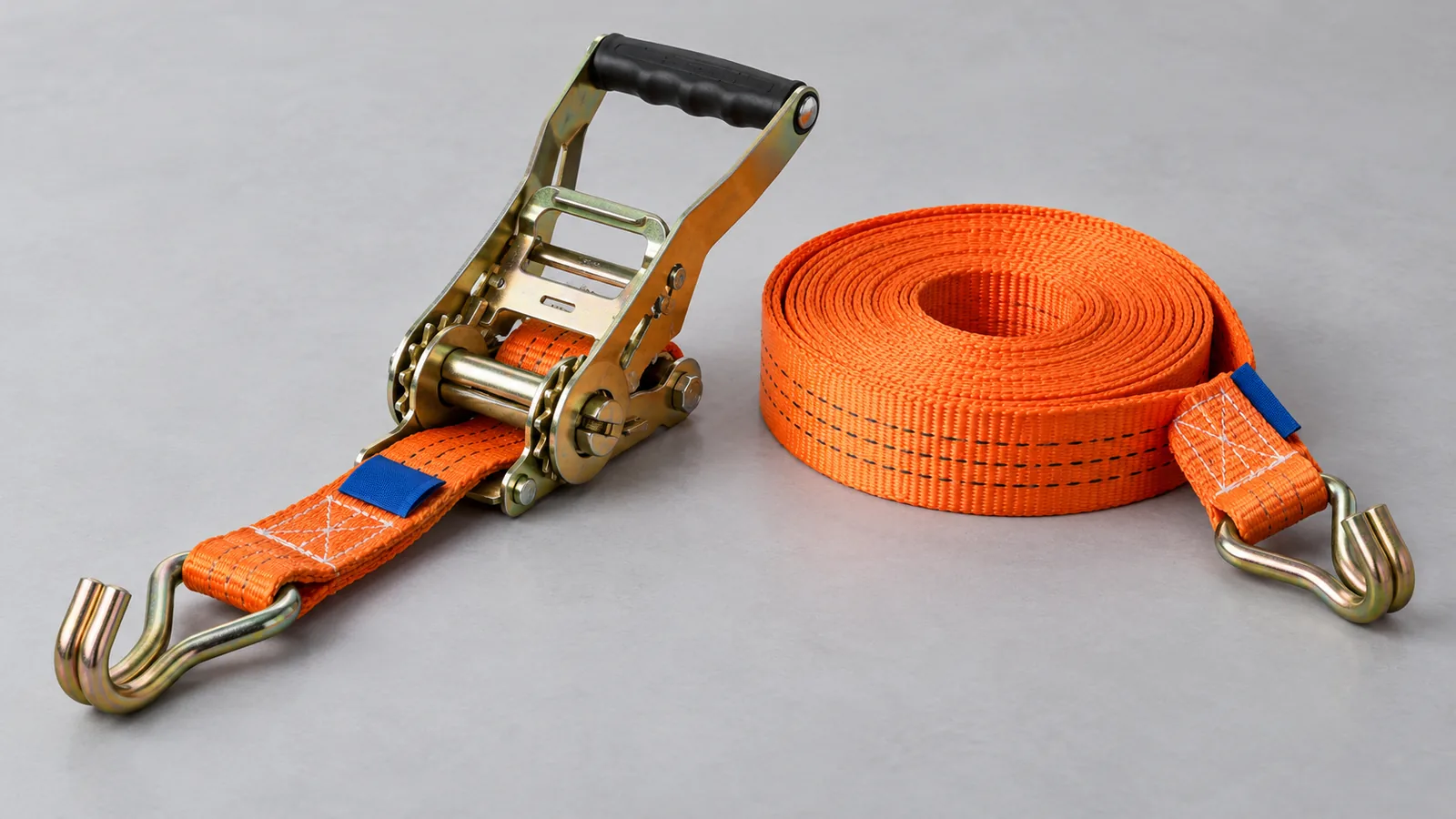
A ratchet tie-down is cargo-restraint equipment. Its job is to help prevent cargo movement during transport in an approved securing arrangement. The ratchet tensions the webbing; the end fittings connect the assembly to suitable attachment points.
A common two-part assembly has a short fixed end containing the ratchet and an end fitting, plus a longer adjustable end with its own fitting. One-part endless assemblies are a different configuration. Specify which construction the application requires rather than ordering by webbing width alone.
Cargo restraint and overhead lifting are different applications. Do not use a cargo ratchet strap as a lifting sling or substitute it for a rated recovery or towing system. For the differences between actual lifting sling types, see Flat Webbing Sling vs Round Sling. That guide is about lifting equipment, not transport-lashing capacity.
Before comparing quotations, record whether the cargo is packaged, palletised, wheeled or fitted with dedicated transport lashing points. Also note whether securing must remain effective after part of the consignment is unloaded.
LC, STF, SHF and Breaking Strength Explained
These terms answer different questions. The following table is a reading guide, not a method for calculating an acceptable cargo mass.
| Marking | Meaning | Purchasing relevance |
|---|---|---|
| LC | Lashing Capacity: the permissible force for the lashing in straight pull | Required input for direct-lashing selection and calculations |
| STF | Standard Tension Force: specified retained pre-tension generated by the tensioner under the stated conditions | Important when selecting equipment for top-over frictional lashing |
| SHF | Standard Hand Force: the specified hand force associated with the tensioner’s performance | Helps compare tensioners and understand the operating instructions |
| MBS or breaking strength | A failure-test rating, subject to its stated definition and test basis | Not an allowable operating force or a substitute for LC |
| WLL | Working Load Limit, used within the rating system stated by the supplier | Do not assume it is identical to an EN-labelled LC value |
LC and STF have different roles in the DVSA guidance on load-securing methods. Manufacturers also distinguish SHF from the resulting STF; see Dolezych’s tensioner guide.
Force is not cargo mass
A decanewton, written daN, is a unit of force: 1 daN = 10 N. Kilograms and tonnes describe mass. An LC marking of 2,500 daN does not, by itself, mean one strap can secure a 2,500 kg cargo.
Ask what the advertised number represents: complete-assembly LC, a working rating under another system, or breaking strength. Also ask whether it refers to straight pull or another stated configuration. Do not compare quotations until their rating basis is clear.
The label matters more than a shorthand sales name
Terms such as “heavy duty” or “5-ton strap” are incomplete specifications. Request a clear label photograph and the corresponding technical sheet. A large breaking-strength claim should not obscure an absent LC or STF value needed for the intended method.
Top-Over Lashing Versus Direct Lashing
The restraint method determines which performance data deserve the closest attention.
| Arrangement | Basic principle | Important selection inputs |
|---|---|---|
| Top-over or frictional lashing | Pre-tension presses the cargo against the supporting surface, increasing frictional restraint | STF, contact friction, strap angle, cargo compressibility and protection |
| Direct lashing | The lashing connects cargo attachment points to vehicle anchors and resists movement through its geometry | LC, attachment strength, directions, angles and cargo stability |
| A combined arrangement | Approved blocking and lashings work together | Verified capabilities of each element and the complete restraint plan |
A higher LC does not automatically make a tensioner more effective for top-over lashing. Likewise, the force a strap can withstand does not describe how effectively an unfavourable lashing direction restrains movement. The DVSA method guidance distinguishes these selection inputs.
For a quotation, provide a route sketch or photographs showing where the strap contacts the load and where it attaches. State whether blocking or verified anti-slip material is included. Do not treat shrink-wrap, a pallet or an ordinary side curtain as an established restraint capability without the relevant evidence.
The responsible load-securing planner should determine the required arrangement and quantity using the applicable calculation method. Buying an EN 12195-2-labelled strap does not itself demonstrate that a particular load is adequately secured.
Choose the Complete Assembly and Ratchet
Order a defined assembly, not a collection of separately advertised components. Ask the supplier to identify the webbing, sewn terminations, ratchet and end fittings included in the quoted rating.
Two assemblies with the same LC may have different STF values. For example, Dolezych lists a standard tensioner and a long-lever version at LC 2,500 daN, with STF values of 300 and 600 daN respectively at SHF 50 daN. These are Dolezych product examples, not KKV specifications and not a recommendation to halve the number of straps.
When comparing a standard and long-handle ratchet, request:
- LC and, where relevant, STF for the quoted assembly.
- The SHF used for the stated tensioner performance.
- Handle movement and clearance requirements.
- Locking and release instructions.
- Approved replacement-component information, if replacement is offered.
Do not use an added pipe or improvised lever to obtain more tension. Select an appropriate tensioner instead.
How to use the KKV CL/RTD specification page
The KKV CL/RTD Ratchet Tie-Down Strap page lists model widths, WLL, MBS and end lengths. It does not currently publish model-specific LC or STF values.
Use it to identify the model range, then request the exact label and confirmed application data. Do not calculate LC or STF from its published WLL/MBS figures. Where a contract requires a particular rating system, make that requirement explicit before accepting the quotation.
Select Total Length and Fixed-End Length
“Eight metres” is not a complete length specification. Confirm whether the figure means the total assembly length or only the adjustable portion, and ask how the manufacturer measures usable length between the fittings.
As one clearly identified example, pewag’s two-part strap 7000114 is specified with a total length of 8,000 mm. Do not assume another supplier uses the same convention for every advertised length.
Measure the actual strap route
Record the path between attachment points through the intended arrangement, rather than measuring only the cargo width. Consider the height, edge protection and expected variation in load dimensions.
Then discuss threading allowance and the ratchet’s permitted winding arrangement with the supplier. An excessively long strap is not automatically more versatile if surplus webbing interferes with the mechanism or leaves loose tails.
Position the ratchet before selecting the fixed end
The fixed-end length determines where the tensioner will sit. Mark a location where the operator can reach the handle, move it through its required stroke and release it safely.
A useful order description separates three fields: total length, fixed-end length and adjustable-end length. Add a drawing if a fitting must face a particular direction. Confirm that the ratchet will not be forced against a cargo corner.
Follow the manual for the exact model’s webbing routing and permitted wraps. Different ratchet constructions can have different instructions; there is no universal wrap count to apply to every product.
Match Hooks to Rated Anchor Points
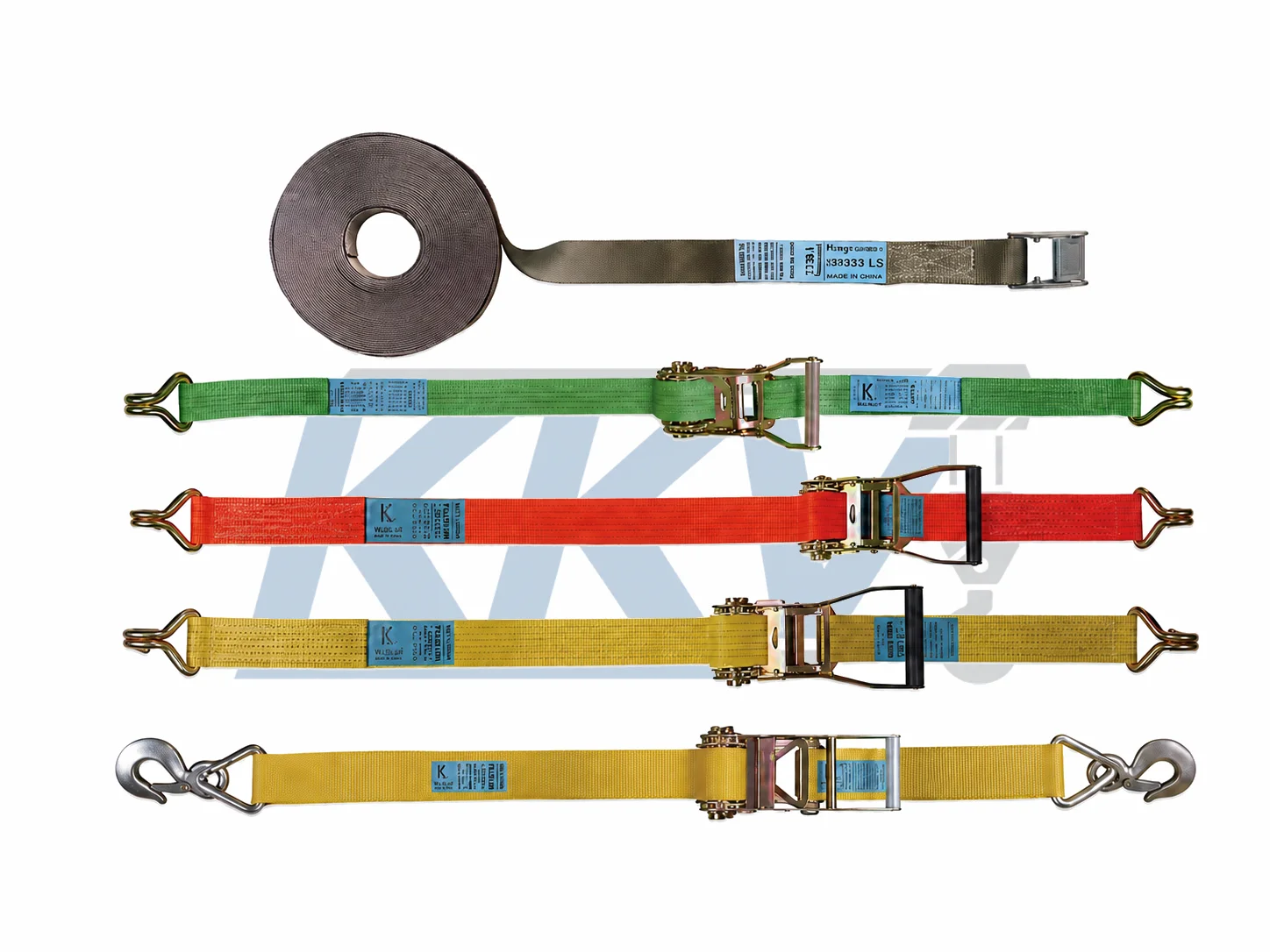
A hook name alone does not establish compatibility. Double J hooks, flat hooks, S hooks and track fittings require the correct mating attachment, bearing geometry and rating.
Ask for the hook’s dimensions and an anchor-point drawing or photograph. Check whether the fitting can seat as intended without its tip carrying the force, and whether the connection remains appropriate throughout the planned strap direction. Flat hooks need support across their intended bearing width, as described in the Yale/CMCO operating instructions.
The attachment must be rated and suitable, not merely large enough to accept the hook. Do not use a sheet-rope hook, an unverified rail or a convenient opening as a substitute for an approved vehicle anchor.
For repeat orders, include an end-fitting drawing or part reference in the purchase specification. “Same hook as last time” is harder to verify when several similar-looking fittings are in use.
If a supplier proposes an alternative hook, review its fit and the complete assembly rating before approval. A fitting substitution is a configuration change, not just a cosmetic change.
Check Width, Material and Working Conditions
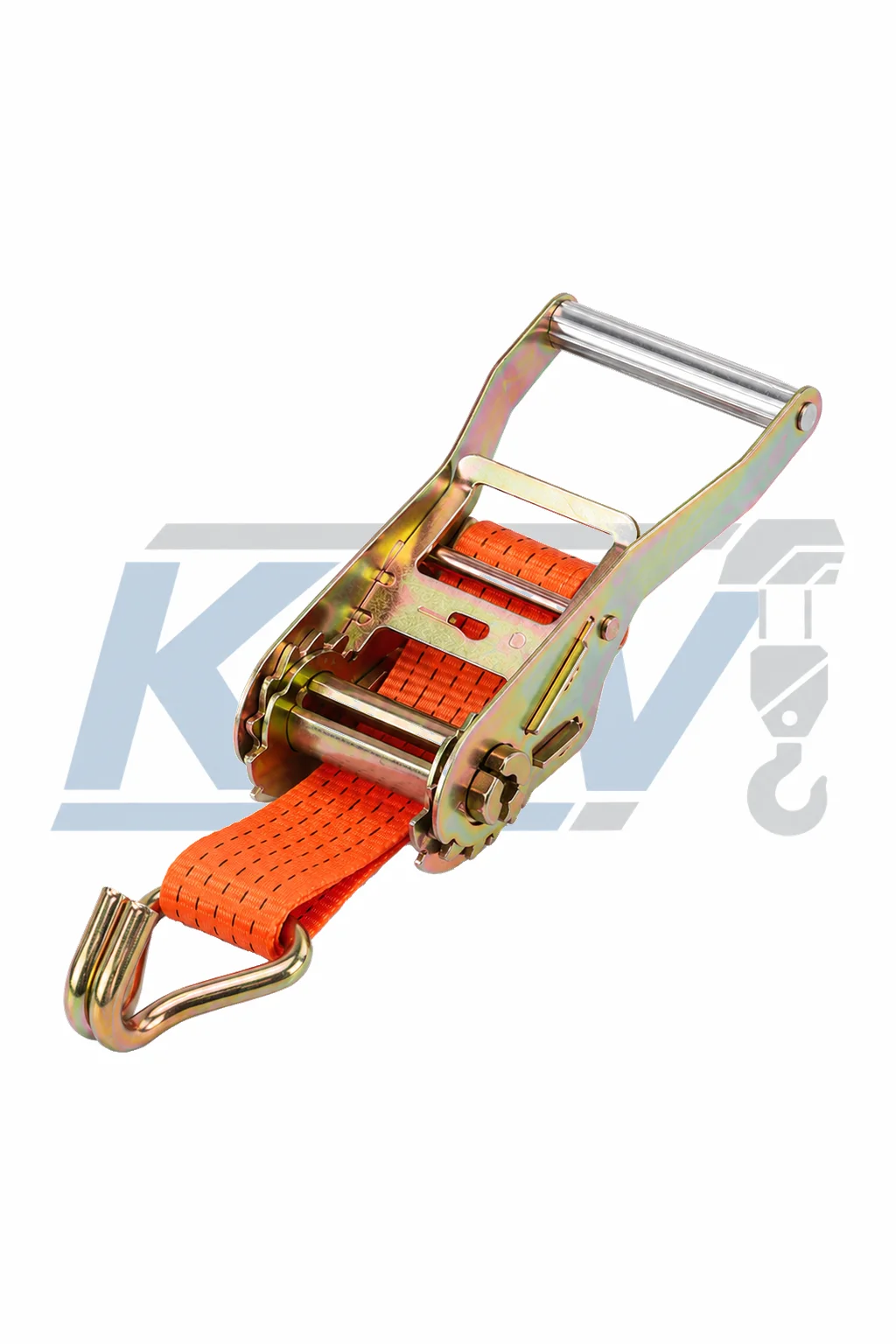
Webbing width is a dimensional choice, not an independent capacity statement. Specify the rated assembly that fits the application instead of assuming that every 50 mm strap performs alike.
Ask the supplier to identify the textile material and relevant restrictions. Do not infer material, chemical resistance or temperature limits from orange webbing or a familiar-looking label.
Record exposure to chemicals, heat, outdoor storage and abrasive cargo surfaces in the inquiry. For sensitive packaging, also provide the areas where pressure can be applied without damaging the goods.
Use suitable protection for intact webbing where the planned route presents sharp edges or abrasion. Protection does not make an already cut strap serviceable. The Yale/CMCO instructions address both edge protection and material-related exposure.
Include required sleeves or corner protectors as separate quotation items. This makes it clear whether the offered price covers the accessories assumed in the restraint plan.
Read the Label and Request Documentation
Before ordering, agree on what must identify the delivered assembly. For an EN-based specification, request the relevant rating information, manufacturer identity, material, length and traceability, with STF and SHF where applicable to the selected tensioner and method.
Compare a proposed label photograph with the technical sheet and order line. Check that the model, configuration, units and ratings refer to the same product. Do not approve a generic sample label as proof of every model in a catalogue.
Readable identification must remain available during service. Missing or illegible labels and damaged components are withdrawal conditions in the SpanSet operating instructions; consult the instructions for the assembly actually supplied.
Separate product documents from the securing plan
Product documentation answers what the assembly is and how it may be used. The load-securing plan answers whether the selected arrangement is adequate for the actual consignment.
For UK road transport, DVSA identifies BS EN 12195-1 for securing-force calculations and BS EN 12195-2 for synthetic-web lashing equipment. See the DVSA load-securing basics. Other destinations or transport modes may require different provisions.
Ask which standard and edition the proposed product documentation addresses. Avoid a vague request for “all certificates”; specify the documents required by the purchaser, destination and application.
A Six-Step Selection Process
Step 1: Describe the cargo and transport
Provide maximum cargo mass, dimensions, packaging, centre-of-gravity information and the intended vehicle. State the destination and whether the route includes other transport modes.
Step 2: Establish the restraint arrangement
Have the responsible planner identify the securing method, required forces, directions, strap quantity and any blocking or friction assumptions. Record these requirements rather than asking the seller to guess from a cargo weight.
Step 3: Define the assembly ratings
Specify the applicable rating system, required LC and required STF where relevant. Request the associated SHF and an exact label sample. Resolve unclear units or definitions before comparing prices.
Step 4: Measure the route and check access
Determine total and fixed-end lengths, fitting orientation and ratchet position. Check the operating and release space, not only whether the strap reaches the anchors.
Step 5: Confirm fittings and accessories
Match hooks to the vehicle and cargo attachment points. Specify protection and other accessories included in the approved arrangement.
Step 6: Close the documentation gaps
Approve the model-specific technical sheet, identification, operating instructions and required conformity documentation. Verify a delivered sample against the purchase order before releasing a batch into service.
Pre-Use Checks, Journey Checks and Release
Selection is only the first control. The following is a screening checklist to use alongside the supplied instructions, not a complete inspection standard.
| Check area | What to check | Response to a problem |
|---|---|---|
| Identification | Readable label and traceability match the required assembly | Do not use an unidentified or inadequately rated assembly |
| Webbing and stitching | Cuts, tears, broken fibres/seams, melted or glazed areas and signs of chemical damage | Withdraw from use; do not conceal damage with a sleeve |
| Ratchet and fittings | Cracks, deformation, significant wear/corrosion and reliable operation | Quarantine for competent assessment or replacement |
| Route and connections | Correct seating, intact protection, no knots/twists; model-specific threading/winding and ratchet positively locked | Correct the arrangement before dispatch |
| Cargo and vehicle | Suitable attachment points and the specified restraint arrangement | Resolve the securing-plan issue; adding a strap is not a diagnosis |
The damage checks are consistent with the Yale/CMCO instructions.
Plan checks during the journey and after changes to the load. Cargo may settle, and removing part of a consignment can change the securing arrangement. The HSE guidance on securing loads emphasises considering changes through delivery and preventing movement during transport.
Before release, establish that the cargo will remain stable without the lashing. Keep people clear of potential cargo movement and released tension. Use the model-specific release procedure; staged release is not a feature of every ratchet.
Repairs or component replacements must follow manufacturer-authorised procedures. Do not restore a damaged assembly by improvised stitching or by combining unidentified spare parts.
Information to Include in an RFQ
A complete inquiry is easier to evaluate than “quote your best 5-ton strap.” Use this checklist to make missing information visible.
| RFQ field | Information to provide |
|---|---|
| Cargo | Description, maximum mass, dimensions and packaging |
| Stability | Centre of gravity, dedicated lashing points and any restrictions |
| Transport | Vehicle type, destination and road/rail/sea requirements |
| Restraint plan | Top-over/direct method, arrangement drawing and specified quantity |
| Required ratings | Applicable system, LC and STF where relevant; units stated explicitly |
| Tensioner | SHF information, preferred operation and available handle clearance |
| Lengths | Total, fixed-end and adjustable-end dimensions; measurement convention |
| End fittings | Type, drawing/dimensions, orientation and mating anchor details |
| Webbing/environment | Width, material requirement, exposure and pressure-sensitive cargo |
| Accessories | Corner protectors, sleeves and other specified protection |
| Documentation | Label sample, technical sheet, manual and required conformity evidence |
| Supply | Quantity, sample approval, packing, delivery destination and schedule |
If the calculation inputs are not yet known, mark them as pending and identify who will provide them. Do not replace an unknown requirement with an assumed rating simply to complete the form.
For repeat purchases, keep the approved assembly reference and label sample with the buying record. Review changes to cargo, vehicle, fittings or route before treating an earlier specification as reusable.
Frequently Asked Questions
Does a 5-ton breaking-strength label mean I can secure 5 tonnes of cargo?
No. Breaking strength is not an allowable lashing force, and cargo mass cannot be assigned from that number alone. Request the working rating and the restraint plan’s requirements.
Is LC the same as STF?
No. LC describes permissible lashing force; STF describes the specified tensioner’s pre-tension performance. Check both when the application requires them.
How many ratchet straps do I need?
The responsible planner must determine this from the cargo, restraint method, geometry, contact conditions, attachment points and applicable rules. Do not use cargo weight divided by breaking strength.
Are all 50 mm ratchet straps equivalent?
No. Width does not identify the assembly’s LC, STF, fittings, material or operating limits. Compare complete model-specific specifications.
Should I order the longest strap available?
Not automatically. Specify enough length for the intended route and correct ratchet use, while checking surplus-webbing management and fixed-end positioning.
Can I combine a spare ratchet with another strap?
Only where the manufacturer authorises the exact combination and confirms the resulting identification and performance. Similar dimensions do not establish an approved assembly.
Can a cargo strap replace a flat webbing lifting sling?
No. Select equipment designed and rated for the application. Cargo ratchet tie-downs must not be used to lift suspended loads.
What should I request if the catalogue shows WLL and MBS but not LC or STF?
Ask for the exact product label and the rating basis required by your application. Request missing LC/STF information where relevant; do not infer it by converting the catalogue figures.
References and Application Scope
The linked regulator guidance and manufacturer instructions support the terminology and selection checks above. Manufacturer examples illustrate differences; their ratings and operating details are not specifications for KKV products.
- DVSA: Ways to secure a load — UK road-transport methods and terminology.
- DVSA: Load securing basics — UK calculation and equipment-standard references.
- Dolezych: Available tensioners — independently specified LC, STF and SHF.
- pewag: Two-part strap 7000114 — an attributed assembly and total-length example.
- SpanSet: Lashing instructions, Rev06 — English section, printed pages 12–21.
- Yale/CMCO: Textile-lashing instructions — handling, fitting and damage checks.
- HSE: Securing loads — transport and delivery planning.
Apply the requirements for the destination and transport mode. This article does not certify a load-securing arrangement or replace the operating instructions.
Specify the Restraint System, Not Just the Strap Width
Start with the cargo, securing method and attachment points. Then define the assembly ratings, length, ratchet position, fittings and documents that the purchasing team can verify.
Explore the KKV CL/RTD cargo-lashing range, and send KKV your application details for confirmation of available configurations. The quotation should identify the exact model and any information still requiring confirmation.
For help preparing a ratchet tie-down specification: Contact KKV or email sales@kkvhoist.com with your cargo details, securing-plan requirements, lengths, fitting information and quantity.
Safety note: Cargo ratchet straps are not lifting slings or towing equipment. Use only suitable, identifiable and undamaged assemblies. Product selection and the complete load-securing arrangement must be checked by competent personnel using the applicable rules and manufacturer instructions.