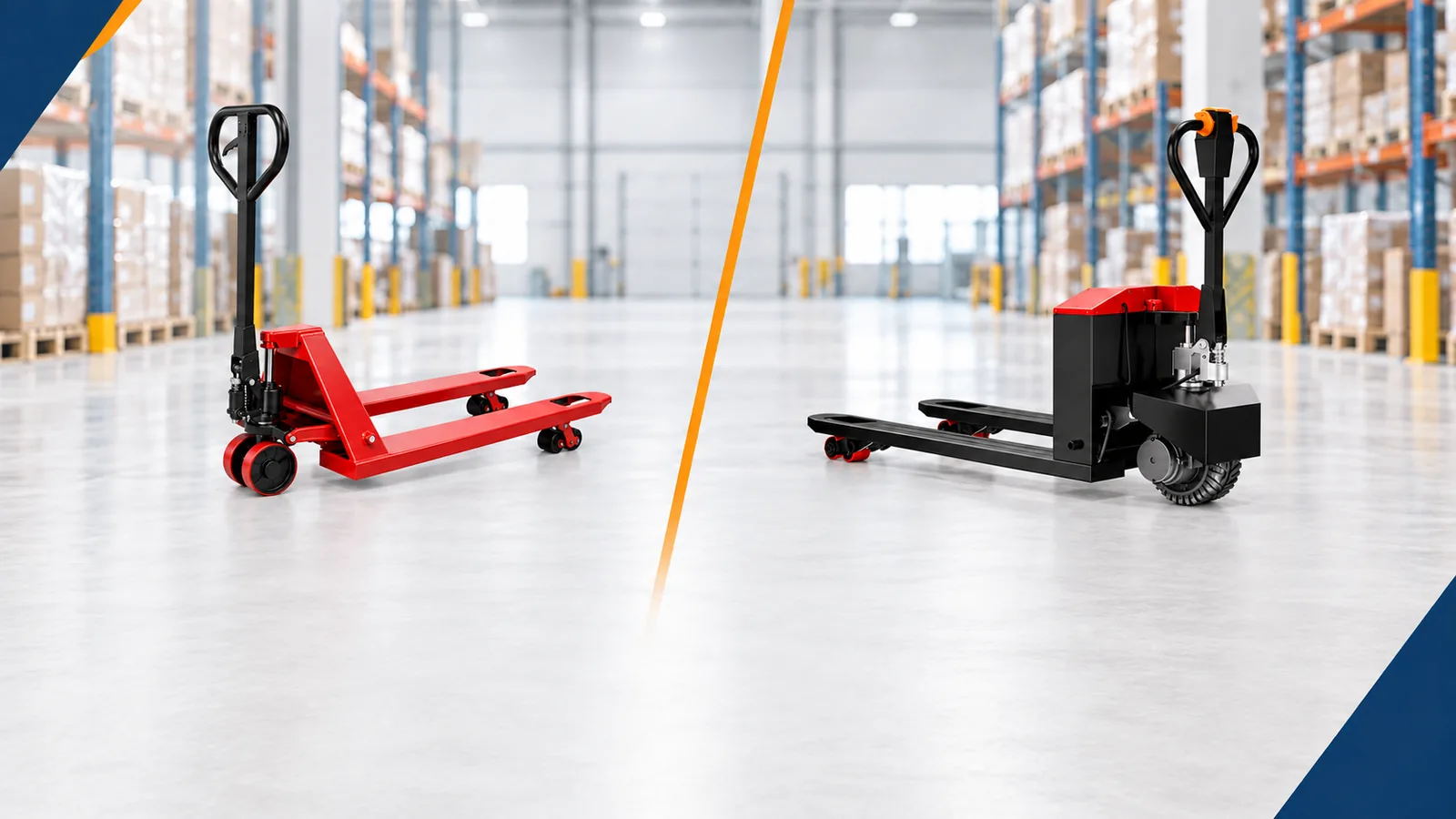
Manual Pallet Truck vs Electric Pallet Truck: Key Differences and How to Choose
Choosing between a manual pallet truck and an electric pallet truck requires more than comparing purchase prices or nameplate capacity. The truck must fit the pallet, support the complete load, travel through the actual route and sustain the required number of movements without creating avoidable handling problems. Fork dimensions, floor condition, gradients, aisle space, operator effort, charging facilities and maintenance support can matter as much as rated capacity.
This guide compares manual pallet truck vs electric pallet truck operation for warehouses, factories, logistics centres and loading areas. It focuses on pedestrian low-lift trucks used for horizontal pallet transport. It does not set a universal distance or moves-per-shift threshold because the correct choice depends on the combined load, route, frequency, environment and local requirements.
Quick answer: Choose a manual pallet truck for relatively short, occasional moves on a smooth, level route when the load can be started, steered and stopped safely by the operator. Choose an electric pallet truck when pallet movements are frequent, travel distances are longer, throughput matters or manual push-pull effort is becoming excessive. Before ordering either type, verify the complete load, pallet entry, fork length and width, lowered fork height, wheel arrangement, floor, thresholds, turning space and gradients. For an electric model, also confirm battery and charger compatibility, expected duty, operator training, braking and service support.
Table of contents
- What is a manual pallet truck?
- What is an electric pallet truck?
- Manual vs electric pallet truck comparison
- Capacity and operator effort
- Travel distance, frequency and throughput
- Pallet and fork compatibility
- Floor, ramps, aisles and working environment
- Battery, charging and maintenance
- Purchase price and total operating cost
- Compare the current KKV manual and electric models
- A seven-step selection and RFQ process
- Inspection, training and common mistakes
- Frequently asked questions
What Is a Manual Pallet Truck?
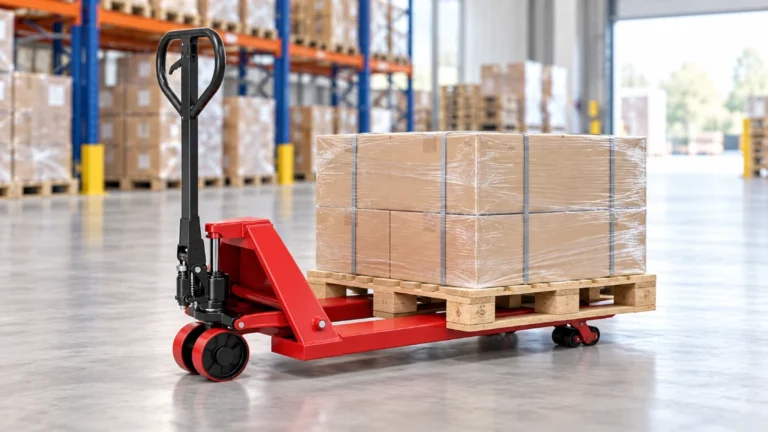
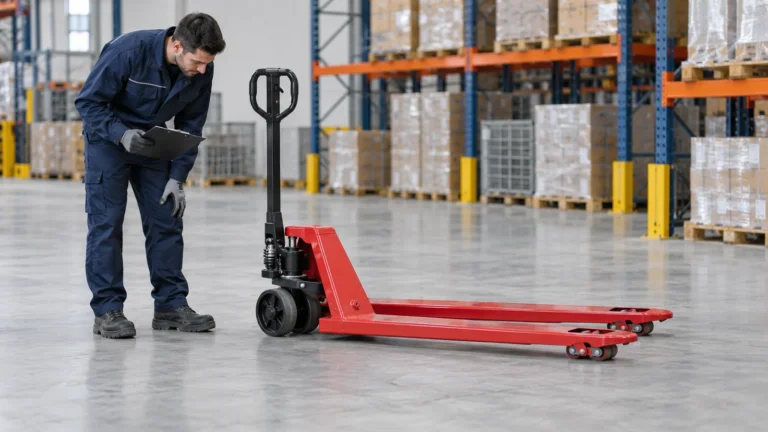
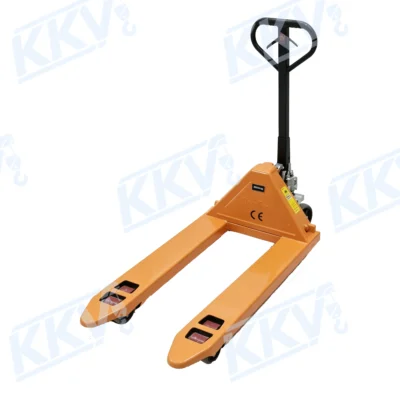
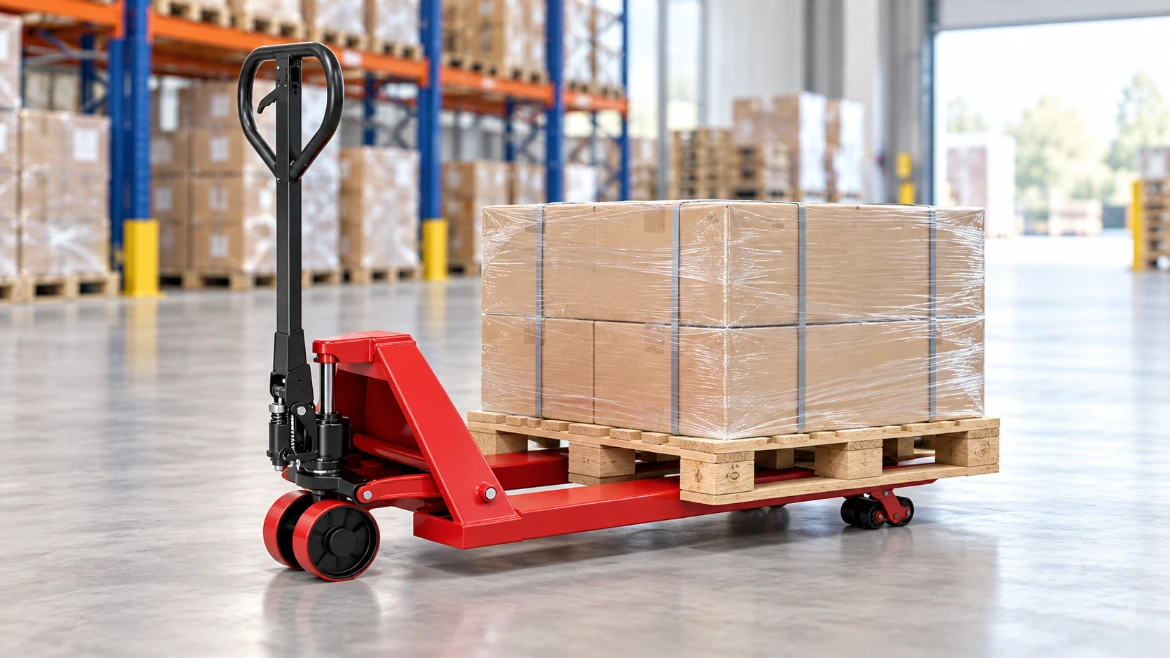
A manual pallet truck, also called a hand pallet truck or manual pallet jack, is a low-lift truck moved and steered by the operator through a drawbar handle. Pumping the handle operates a hydraulic system that raises the forks enough to clear the floor. The operator then pulls or pushes the truck to transport the pallet.
Its main systems normally include the forks and frame, hydraulic pump, drawbar and release control, steering wheels, load rollers and mechanical linkage. It has no traction motor, traction battery or charger. That simple arrangement can make a manual truck practical for occasional receiving work, short transfers near a machine, small storage areas and backup use.
Simple does not mean effortless or maintenance-free. The operator must start the loaded truck, keep it moving, steer it and stop it. Small wheels, damaged bearings, uneven floors, heavy loads and gradients can greatly increase the required force. The UK’s Health and Safety Executive guidance on pushing and pulling advises assessing the load, equipment, environment and individual factors rather than treating wheeled movement as risk-free manual handling.
The current KKV Manual Hydraulic Pallet Truck uses manual travel and hydraulic lifting. KKV positions it for short-distance pallet transport and offers several capacities, fork sizes and wheel configurations. Those published options are compared later in this guide; the exact ordered configuration still needs written confirmation.
What Is an Electric Pallet Truck?
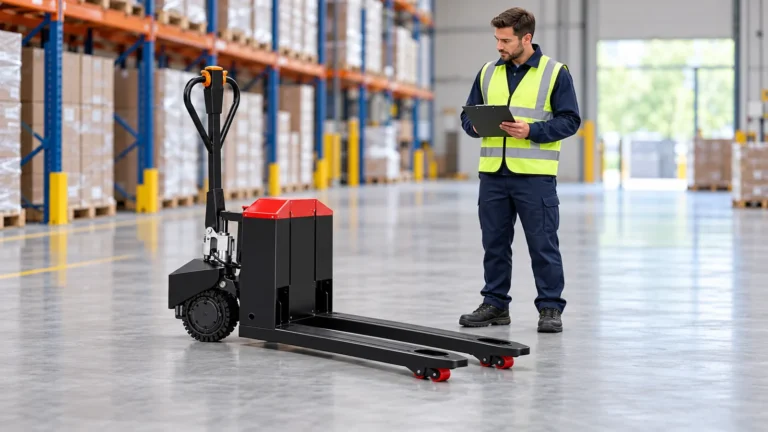
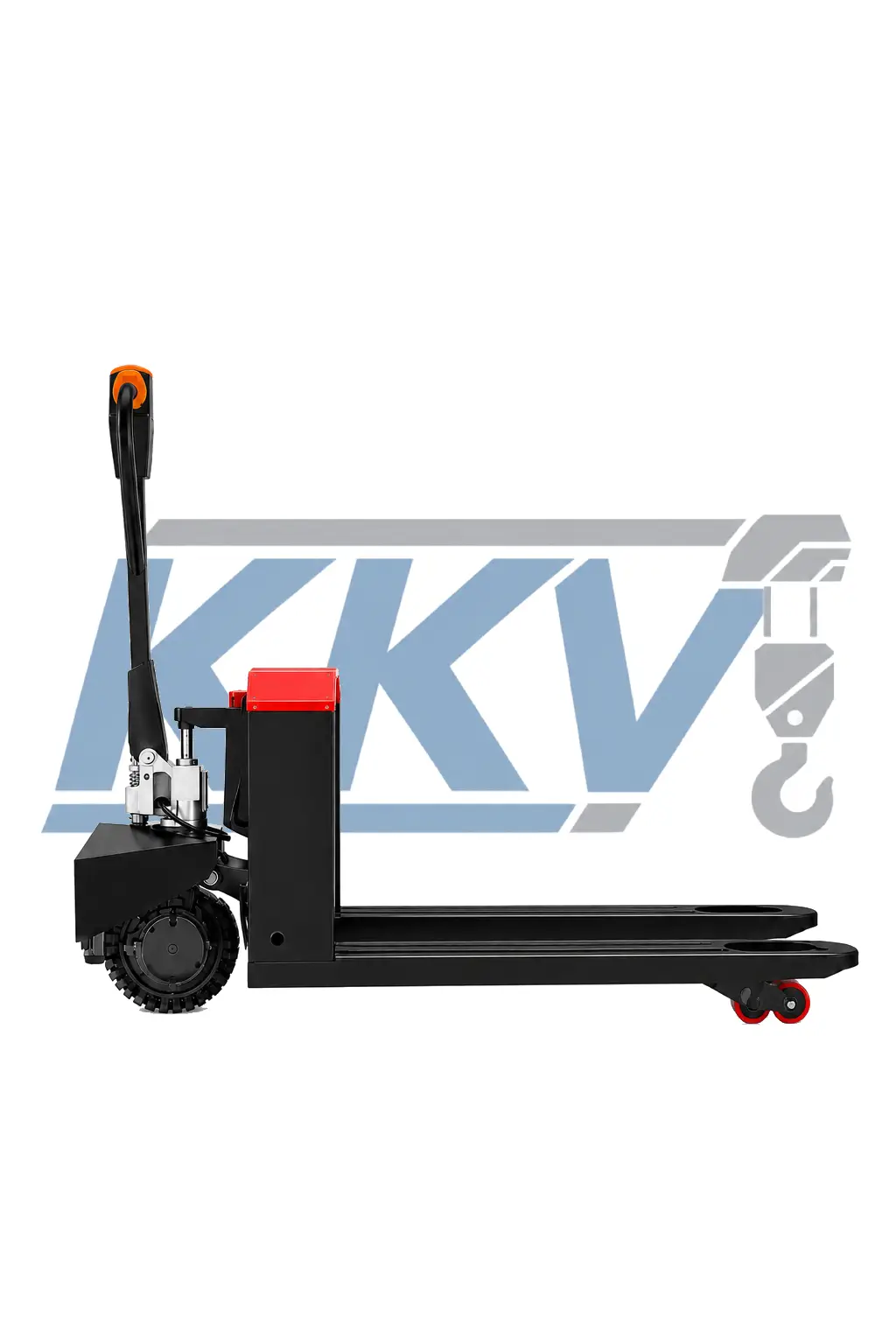
An electric pallet truck is a powered low-lift truck. The operator may walk behind it, stand on a platform or ride in a dedicated position, depending on the design. This article focuses on compact pedestrian or walkie models because they are the closest functional alternative to a manual pallet truck.
A fully electric walkie truck normally provides powered travel and powered lifting. It adds a traction motor, battery, charger, controller, brake and electrical controls to the basic pallet-truck structure. Some products described as semi-electric power only travel or only lifting, so the quotation must state exactly which functions are powered.
Powered travel can reduce the physical effort required to move pallets and can support a higher movement frequency. It also introduces questions that do not apply to a basic hand truck: battery capacity, charging time, input voltage, brake behaviour, control response, water or dust exposure, operating temperature, diagnostic support and availability of replacement batteries and electronic parts.
The current KKV EPT Lithium Electric Pallet Truck is a pedestrian model with electric travel and electric lifting. Its published equipment includes a removable lithium-ion battery, electromagnetic braking, an emergency reverse button and low-speed turtle mode. These statements apply to the identified EPT product page, not to every electric pallet truck.
Manual vs Electric Pallet Truck Comparison
The table below is a selection guide, not a substitute for model data. Actual performance depends on the exact truck, load, battery, wheels, floor and operating route.
| Selection factor | Manual pallet truck | Electric pallet truck |
|---|---|---|
| Travel power | Supplied by the operator | Supplied by an electric drive motor |
| Fork lifting | Usually manual hydraulic pumping | Usually powered on a fully electric model; verify the exact configuration |
| Typical workload | Short, occasional pallet movements | Repetitive, higher-frequency or longer-distance movement |
| Operator effort | Higher when starting, turning and stopping a loaded truck | Lower propulsion and lifting effort, although walking and steering demands remain |
| Initial purchase cost | Usually lower | Usually higher |
| Energy and charging | No traction battery or charging plan | Requires a compatible battery, charger and charging schedule |
| Maintenance | Wheels, rollers, bearings, frame, controls and hydraulic system | Mechanical and hydraulic systems plus battery, motor, brake, controller, wiring and charger |
| Downtime planning | Fewer powered systems, but wheel, frame or hydraulic defects can still stop work | Battery depletion or electrical faults can stop work without charging and service planning |
| Training | Site instruction, route control and manual-handling assessment remain necessary | Powered-truck training and evaluation may be legally required |
| Tight spaces | Compact, but the operator needs room to walk and swing the handle | Compact walkie models can be manoeuvrable, but the drive unit and tiller sweep add length |
| Gradients | Can be difficult to start, hold or stop; use only where assessed and permitted | Use only within the exact manufacturer’s loaded and unloaded gradient limits |
| Best economic case | Low-use applications where simplicity is valuable | Higher-use applications where reduced effort and throughput can justify additional cost |
Neither type is automatically safer, faster or cheaper in every application. A powered truck can reduce manual force but introduces moving powered equipment and different training needs. A manual truck avoids battery management but can become unsuitable when load, distance, floor resistance or repetition makes push-pull effort excessive.
Capacity and Operator Effort
Rated capacity is the maximum load the manufacturer permits under stated conditions. It is a necessary selection check, but it does not describe the force needed to move the loaded truck. A manual truck can have a higher nameplate capacity than a particular electric model and still be less suitable for a frequent or demanding route.
Record the maximum total load applied to the forks, including:
- goods and packaging;
- pallet, stillage or container;
- attachments or fixtures carried with the load;
- any load overhang or offset that can affect support and stability.
Then examine how the task feels and behaves in the real workplace. Starting force is often higher than the force needed to keep a truck rolling. Turning from rest, crossing a threshold or stopping on a slight slope may be the most demanding part of the cycle. A smooth demonstration with an empty truck is not evidence that the loaded task is acceptable.
Important contributors to manual effort include:
- load weight and distribution;
- wheel and bearing condition;
- wheel material and diameter;
- floor roughness, joints, contamination and debris;
- gradient and travel direction;
- turning angle and frequency;
- handle position and operator posture;
- number of repetitions and recovery time.
The HSE assessment guidance recommends considering actual push-pull force where needed. Do not create a purchasing rule such as “manual below a certain weight, electric above it” without evaluating the route. The same pallet may move easily on polished level concrete and become difficult on a rough floor with joints.
An electric truck reduces propulsion effort, but its rated capacity, load-centre rules and stability limits still apply. Power must never be treated as permission to move an unstable, poorly supported or overloaded pallet.
Travel Distance, Frequency and Throughput
Travel distance and movement frequency are usually more useful than purchase price when deciding whether powered travel is justified. One short move each morning is different from continuous transfers between receiving, production and dispatch.
Measure the actual work rather than relying on descriptions such as “short distance” or “busy warehouse.” Record:
- loaded distance per movement;
- empty return distance;
- movements per hour and per shift;
- number and length of shifts;
- typical and maximum load;
- peak-period demand;
- waiting time at pickup and deposit points;
- seasonal or production-related variation.
A manual truck is often reasonable when movements are short, infrequent and performed on a suitable level floor. As distance or repetition increases, walking time and cumulative push-pull effort also increase. Fatigue can reduce consistency, especially near the end of a shift or during peak periods.
An electric truck becomes a stronger candidate when pallets repeatedly cross a warehouse, supply a production line or form part of a time-sensitive loading process. Powered travel can improve consistency, but the truck’s duty and battery must support the planned workload. Runtime changes with load, distance, acceleration, gradients, floor resistance, ambient temperature and operator behaviour.
There is no universal number of metres or pallets per day at which an electric truck becomes mandatory. Build a route-and-duty record, then ask the supplier to confirm the exact model. If practical, conduct a controlled trial with the actual pallet, maximum normal load and full route.
Pallet and Fork Compatibility
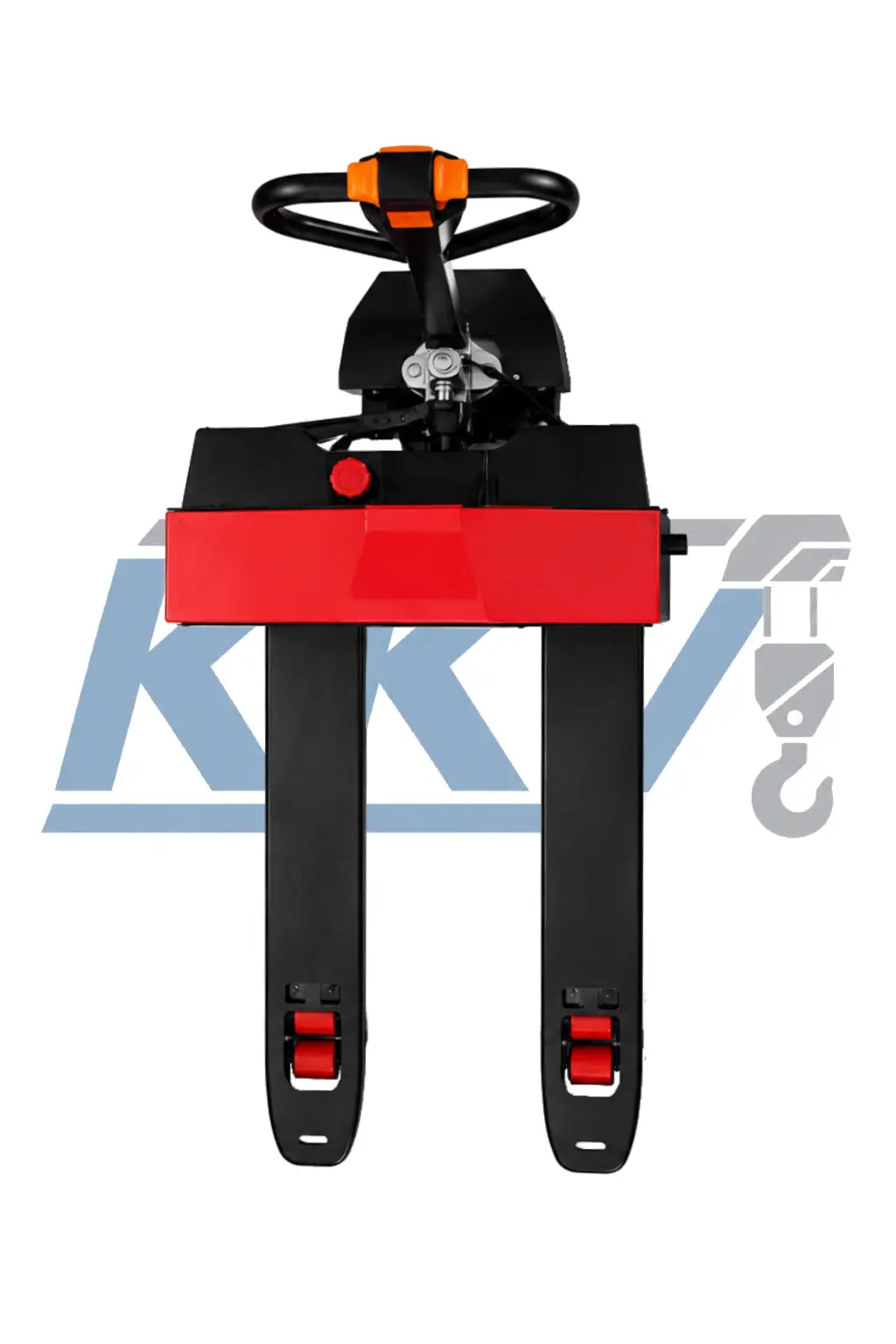
Do not assume an electric pallet truck will enter every pallet currently handled by a manual truck. Products aimed at the same nominal pallet type can have different overall fork widths, lowered heights, fork lengths and load-roller positions. The pallet bottom can also vary by block, stringer and deck-board arrangement.
Measure the actual pallet’s entry height, clear width, length and bottom structure. Compare those dimensions with both candidate trucks and allow for pallet wear and floor variation. Forks must support the load without projecting into adjacent goods, and the load rollers must travel through the pallet bottom without becoming trapped.
The existing KKV guide, How to Choose a Hand Pallet Truck, provides a deeper explanation of fork sizes and wheel selection. Use that article for manual-truck configuration after deciding whether a manual truck is the correct equipment category.
Floor, Ramps, Aisles and Working Environment
Inspect the complete floor route
Pallet-truck wheels are small relative to the load they carry. A joint or threshold that appears minor to a pedestrian can create high rolling resistance, impact or loss of control for a loaded truck. Walk the complete pickup-to-deposit route and record cracks, expansion joints, drainage channels, dock plates, thresholds, rough concrete, debris, wet areas and uneven transitions.
Wheel material affects rolling resistance, noise, floor marking, traction and wear, but no wheel is best for every site. A harder wheel may roll efficiently on a smooth floor and transmit more vibration. A softer wheel may behave differently on noise, grip and wear. If the route is fundamentally too rough for the wheel size and clearance, changing wheel material alone may not solve the problem.
Treat ramps and dock areas separately
A loaded manual pallet truck can be difficult to start, hold or stop on a slope. An electric truck can provide powered travel and braking, but it must still be approved for the measured gradient, surface and direction of travel. Never assume a truck is suitable because the ramp looks shallow.
For every incline, provide the supplier with:
- gradient percentage and length;
- loaded and unloaded travel direction;
- surface and contamination condition;
- stopping and turning space;
- pedestrian exposure;
- dock-edge or trailer hazards.
Dock plates, bridge plates, trailers, lifts and tail lifts require their own capacity and space checks. The supporting equipment must carry the combined truck and load weight, plus the operator where applicable.
Measure manoeuvring space with the pallet
Do not compare only truck width. Measure clear aisle width, door openings, cross-aisles, trailer interiors, lifts, turns and space around racks. Include the pallet, load overhang, tiller sweep and operator position. An electric drive unit can increase overall length; a manual handle also needs space to swing and control the load.
State environmental conditions
Tell the supplier about cold stores, outdoor yards, wet loading areas, food production, washdown, dust, chemicals, corrosion, non-marking wheel requirements or potentially explosive atmospheres. A standard truck must not be assumed suitable for moisture, freezing temperatures, hazardous areas or rough outdoor service. Model-specific protection, materials and approvals must be confirmed.
Battery, Charging and Maintenance
A manual pallet truck avoids battery and charger management, but it still requires inspection and maintenance. Forks, frame, hydraulic system, release control, steering wheels, load rollers, bearings, axles and fasteners can wear or become damaged.
An electric truck adds battery, charger, motor, controller, electrical wiring, switches and an electromagnetic or mechanical braking system. The truck, battery and charger should be treated as one approved system. Do not substitute an unrelated charger or alter the battery arrangement without written manufacturer approval.
Ask these questions before ordering an electric model:
- What battery chemistry, voltage and usable capacity are supplied?
- Is the battery removable, and how is it handled safely?
- Is the charger built in or separate?
- What input voltage, frequency, plug and circuit are required at the destination?
- What charging time and operating runtime are expected for the stated duty?
- Is opportunity charging permitted, and is a spare battery supported?
- What temperature limits apply during use, charging and storage?
- What inspections, storage state and long-term maintenance are required?
- What battery, charger and electronic spare parts are available locally?
- What fire-safety, ventilation or charging-area rules apply at the site?
Do not accept “runs all day” as a technical answer. Provide the load, route, gradients, floor, moves per hour and shift length, then request a written duty evaluation. KKV’s current EPT page publishes battery voltage and capacity for EPT-15 and EPT-20, but it does not publish a universal runtime, charging time or gradeability figure. Those values must be confirmed for the ordered configuration and duty.
Purchase Price and Total Operating Cost
A manual pallet truck usually has a lower initial price. An electric truck usually costs more because it includes a battery, charger, powered drive, controls and brake. Purchase price alone does not show which option is less expensive over the planned service period.
For the manual option, consider:
- equipment price;
- wheels, rollers, bearings and hydraulic service;
- inspection and repair labour;
- downtime and backup equipment;
- operator time per pallet movement;
- consequences of excessive manual effort or an unsuitable route.
For the electric option, add:
- battery and charger;
- electricity and charging infrastructure;
- replacement battery planning;
- drive wheel, load roller, brake, motor and controller service;
- operator training and authorisation;
- diagnostic and spare-part support;
- downtime caused by charging or electrical faults.
Compare cost per completed movement or per year of expected work. Estimate loaded and empty cycle time, annual cycles, labour time, scheduled maintenance, consumables and likely downtime. An electric truck may justify its higher initial price when it improves sustained throughput or reduces an unacceptable push-pull task. A manual truck can remain the better economic choice for low-use applications.
Do not publish or accept a universal payback period. Labour cost, utilisation, battery life, service quality and local pricing differ greatly. Use an application trial and site-specific calculation where the investment decision is material.
Compare the Current KKV Manual and Electric Models
The following figures were taken from the current KKV product pages checked for this guide. They describe the published KKV configurations, not all pallet trucks. Confirm the final quotation, drawing and manual because product specifications and available options can change.
| Published selection item | KKV ORM-HP manual truck | KKV EPT-15 electric truck | KKV EPT-20 electric truck |
|---|---|---|---|
| Travel and lift | Manual travel, manual hydraulic lift | Electric travel and electric lift | Electric travel and electric lift |
| Rated capacity | 2,000 / 2,500 / 3,000 kg options | 1,500 kg | 2,000 kg |
| Standard fork length | 1,100 / 1,200 mm options | 1,150 mm | 1,150 mm |
| Overall fork width | 550 / 685 mm options | 560 / 685 mm options | 560 / 685 mm options |
| Lowered fork height | 75 / 85 mm options | 82 mm | 85 mm |
| Wheel information | Nylon, rubber or polyurethane options; product page lists single/double “front wheel” configurations, so confirm the steering-wheel and fork-end load-roller arrangement | Polyurethane drive wheel and tandem PU load wheels; single load-wheel option available | Polyurethane drive wheel and tandem PU load wheels; single load-wheel option available |
| Battery | Not required | 24 V / 20 Ah removable lithium-ion battery | 48 V / 20 Ah removable lithium-ion battery |
| Published control features | Manual handle and hydraulic lowering control | Electromagnetic braking, emergency reverse and turtle-speed mode | Electromagnetic braking, emergency reverse and turtle-speed mode |
This comparison demonstrates why capacity alone is misleading. The manual range includes a published 3,000 kg option, while the current EPT range is published at 1,500 kg and 2,000 kg. That does not make the manual truck the better choice for a high-frequency 2,000 kg route. It means the buyer must evaluate both structural capacity and the human or powered effort needed to complete the work.
The narrow fork options also differ: the manual page lists 550 mm, while the EPT page lists 560 mm. Do not assume both trucks enter the same pallet because their nominal application is similar. Measure the pallet.
KKV states that CE conformity documentation is available for applicable configurations and offers OEM or ODM options. Request the EU Declaration of Conformity and verify that it identifies the exact ordered model and applicable legislation. The European Commission’s CE-marking guidance explains that the manufacturer is responsible for conformity assessment, technical documentation and the declaration; a general website statement is not the complete compliance file.
A Seven-Step Selection and RFQ Process
Step 1: Define the load
Record maximum and typical total weights, including pallet and packaging. Note dimensions, stability, centre-of-gravity position and any overhang.
Step 2: Measure the pallet
Measure entry height, clear width, pallet length, bottom boards, blocks and load-roller path. Include photographs and a dimensioned sketch.
Step 3: Map the complete route
Measure loaded and empty travel distance, aisles, doors, turns, thresholds, gradients, dock plates, lifts and floor defects. Record traffic and visibility constraints.
Step 4: Quantify the duty
State movements per hour and per shift, shift length, peak demand and average load. For an electric truck, show available charging periods and the site’s electrical supply.
Step 5: Assess operator effort and training
Review actual manual push-pull demands or powered-truck training requirements. Include pedestrians, docks, ramps and site rules in the assessment.
Step 6: Compare lifetime support
Compare maintenance capability, wheels, hydraulic parts, battery availability, charger support, electronic service, expected downtime and backup arrangements.
Step 7: Obtain written configuration confirmation
Ask the supplier to state model, capacity, fork dimensions, wheel configuration, turning data, permitted gradients, battery and charger, environment limits, included controls, documents and spare parts. Verify the received truck against that approval before use.
| RFQ field | Information to provide | Why it matters |
|---|---|---|
| Load | Maximum and typical weight including pallet; dimensions and stability | Confirms capacity and load-support requirements |
| Pallet | Entry height, clear width, length, bottom construction and entry direction | Confirms forks and load rollers can enter and travel correctly |
| Route | Loaded/empty distance, turns, doors, thresholds, docks, lifts and gradients | Reveals effort, clearance, braking and manoeuvring requirements |
| Work frequency | Moves per hour, hours per shift, shifts per day and peak demand | Determines whether manual effort or electric duty is appropriate |
| Floor | Material, roughness, joints, debris, moisture and contamination | Influences rolling resistance, traction and wheel selection |
| Space | Aisles, cross-aisles, trailer or lift dimensions and operator clearance | Confirms turning and tiller space with the actual pallet |
| Environment | Temperature, indoor/outdoor exposure, dust, water and chemicals | Identifies model, material and protection restrictions |
| Electric supply | Voltage, frequency, plug, charging location and available charging time | Confirms battery and charger compatibility |
| Documents | Destination, applicable requirements, manual, declaration and certificates | Ensures documentation matches the supplied configuration |
| Commercial details | Quantity, delivery address, required date, OEM needs and spare parts | Allows a complete quotation and support plan |
Inspection, Training and Common Mistakes
Inspect before work
Follow the exact manufacturer’s manual and workplace procedure. A manual truck should be checked for fork or frame damage, hydraulic leakage, abnormal raising or lowering, damaged wheels and rollers, restricted steering, loose parts and an unreadable capacity marking. An electric truck requires those checks plus battery condition, controls, horn where fitted, emergency reverse, brake, tiller return, wheels, electrical damage and charger condition.
For US general-industry workplaces within the standard’s scope, OSHA’s Powered Industrial Trucks standard, 29 CFR 1910.178 covers motorized hand trucks. It requires examination before service and at least daily; where trucks operate on a round-the-clock basis, they must be examined after each shift. Trucks with safety-affecting defects must not be placed in service. OSHA also publishes a sample daily checklist, which must be adapted to the truck and workplace rather than copied as a complete manufacturer checklist.
Match training to the equipment and site
Powered pallet-truck operators may be subject to formal training and evaluation requirements. Training should address truck controls and capacity, inspection, battery and charging, braking, pedestrian traffic, visibility, narrow aisles, ramps, docks and the conditions of the actual workplace.
A manual truck may not fall under the same powered-truck rule, but that does not eliminate instruction. Workers still need guidance on capacity, stable loading, safe fork entry, route restrictions, feet and hands clear of wheels and load, parking with forks lowered, defect reporting and prohibited uses.
Avoid these common mistakes
- choosing only by the largest capacity number;
- assuming a powered truck automatically suits every ramp or outdoor area;
- comparing fork width without checking pallet bottom construction and load-roller position;
- estimating travel distance and gradient instead of measuring them;
- treating operator struggle as normal manual work;
- buying an electric truck without a charger, electrical-supply and battery-duty plan;
- ignoring parts and service availability;
- using a low-lift pallet truck for stacking, personnel lifting or another unapproved task;
- continuing to use a truck with damaged forks, failed controls, leaks or unsafe wheels;
- importing another manufacturer’s runtime, gradeability or safety feature into the KKV specification.
If the task requires lifting pallets into racking, use equipment designed for that purpose. See How to Choose a Pallet Stacker and compare the required lift height, residual capacity, aisle and pallet support arrangement.
Frequently Asked Questions
Is an electric pallet truck always better than a manual pallet truck?
No. An electric truck can reduce propulsion effort and support frequent movement, but it costs more, requires charging and adds controls and maintenance. A manual truck may be more practical for short, occasional work on a suitable level route. Choose from the complete task, not from the power source alone.
Can manual and electric pallet trucks have the same capacity?
Yes, models can have similar ratings, but equal capacity does not mean equal application suitability. Distance, repetition, floor, gradient, pallet fit, turning space and operator effort still need evaluation. The current KKV manual and EPT ranges also have different published capacity options.
When should I change from a manual truck to an electric truck?
Consider electric travel when movements are frequent, routes are longer, throughput is constrained or the manual push-pull task is difficult. Do not use a universal pallets-per-day threshold. Measure the actual route, frequency, load, floor and effort, then conduct an application assessment.
Can I use a manual pallet truck on a ramp?
Only where the manufacturer permits it and a site assessment confirms the loaded truck can be controlled safely. A manual truck can be difficult to hold or stop on a gradient. Measure the slope and include surface, direction, stopping space and dock hazards in the decision.
Does an electric pallet truck require operator training?
Requirements depend on jurisdiction. In the United States, powered pallet trucks generally fall within OSHA’s powered-industrial-truck requirements, including training and evaluation. Elsewhere, follow applicable law, the manufacturer’s instructions and site rules.
Will an electric pallet truck fit the same pallets as my manual truck?
Not automatically. The current KKV manual and EPT ranges have different narrow fork-width and lowered-height options, and load-roller positions can also differ. Measure the pallet entry and bottom structure, then compare both exact drawings rather than assuming interchangeability.
Does a higher manual-truck capacity make it better for repeated heavy loads?
No. Capacity confirms a structural rating under stated conditions; it does not measure operator force, travel time or cumulative workload. A higher-capacity manual truck can still be unsuitable for frequent heavy moves if starting, steering and stopping effort is excessive.
Which truck is cheaper over its working life?
It depends on utilisation. A manual truck usually costs less to buy and avoids battery costs. An electric truck can reduce travel effort and cycle time in a busy operation. Compare equipment, maintenance, battery, charging, training, labour time, downtime and annual movements instead of relying on purchase price alone.
Can a KKV electric pallet truck operate outdoors or in a cold store?
Do not assume so from the standard product page. Ask KKV to confirm temperature, moisture protection, surface, gradient, traction, corrosion and battery performance for the exact configuration. Special conditions may require another model or option.
Can a pallet truck place loads into warehouse racking?
A standard low-lift pallet truck normally raises the pallet only enough for horizontal transport. It is not a pallet stacker. If the task requires rack placement or stacking, specify the required lift height and evaluate a suitable stacker or forklift.
Choose for the Complete Route, Not Only the Price
The correct pallet truck is the one that fits the pallet, supports the load, travels safely through the available space and sustains the required workload. A lower purchase price cannot correct an unsuitable route, excessive manual effort or incompatible forks. Electric power cannot correct an unstable pallet, poor visibility or a truck used outside its approved conditions.
Choose a manual pallet truck when travel is short, use is limited and the load can be controlled safely on a smooth, level route. Choose an electric pallet truck when repeated movement, longer distance, throughput or push-pull effort makes powered travel valuable. If the route includes gradients, dock edges, rough floors, low temperatures or unusual pallets, make those conditions part of the specification from the beginning.
For an application-based recommendation, email sales@kkvhoist.com or contact KKV with the maximum and typical load, pallet drawing, fork requirements, travel distance, movements per shift, floor, gradients, aisle dimensions, environment, charging supply, quantity and destination. Compare the KKV manual pallet truck and KKV electric pallet truck before requesting the final configuration.
Safety note: This article is general equipment-selection guidance, not a workplace risk assessment or substitute for the manufacturer’s manual. A competent person must assess the load, route, gradients, traffic and operating environment under applicable law and site procedures. Never exceed the marked capacity, carry people, place hands or feet beneath the load, use a damaged truck or operate powered equipment without the required training and authorisation.