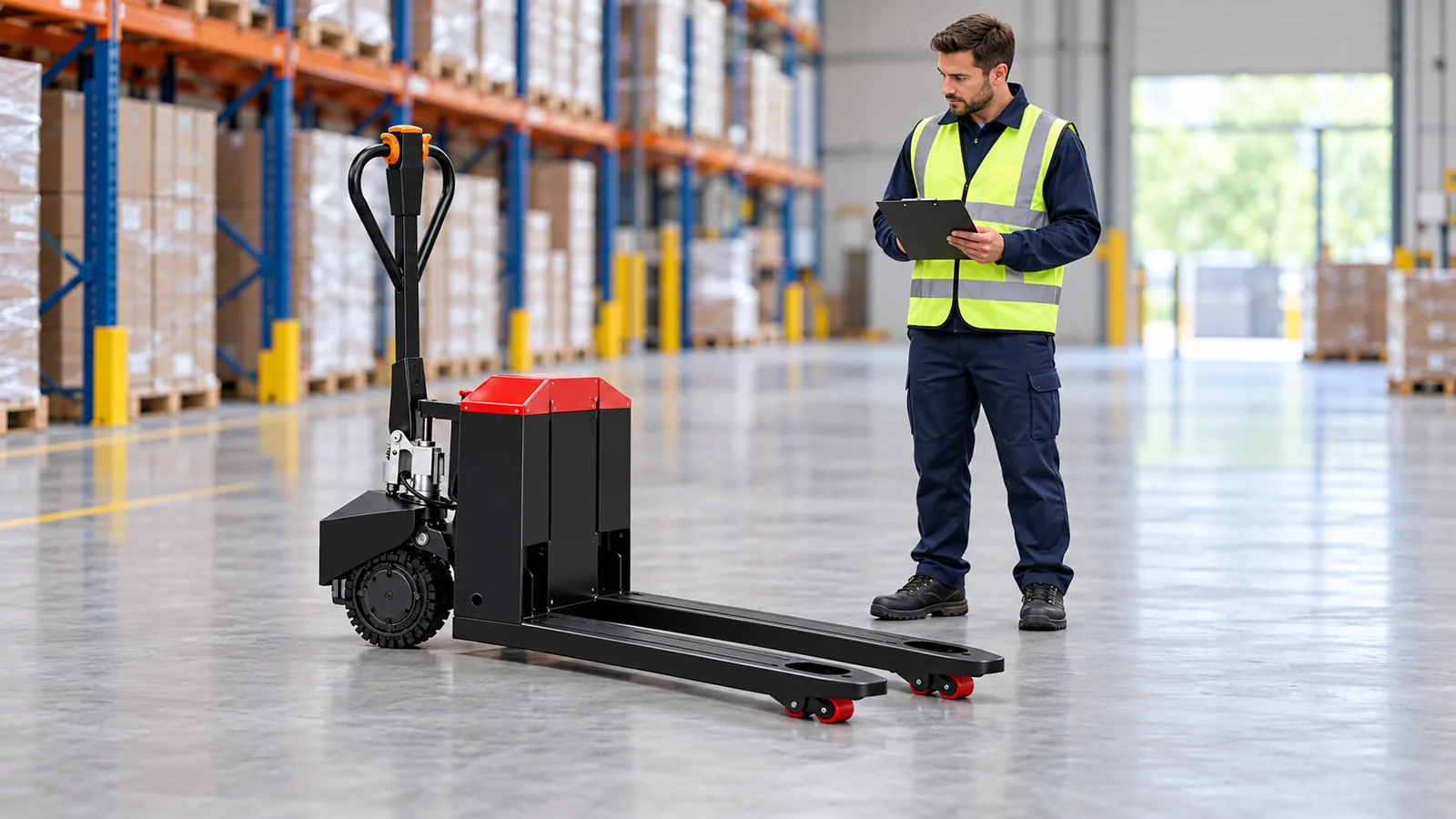
Electric Pallet Truck Inspection Checklist: Battery, Wheels, Brakes and Controls
An electric pallet truck inspection checklist should establish whether the truck is ready for the intended task, not simply whether its forks rise. Battery condition, powered travel, steering, braking and protective controls need attention alongside the forks, wheels and hydraulic system.
A truck that lifts normally can still have an unreliable travel control or damaged battery connection. Likewise, a charged battery does not prove that a brake, emergency reverse function or warning device works. Separate the visible-condition check from the manufacturer’s prescribed functional checks, and record anything that could not be checked.
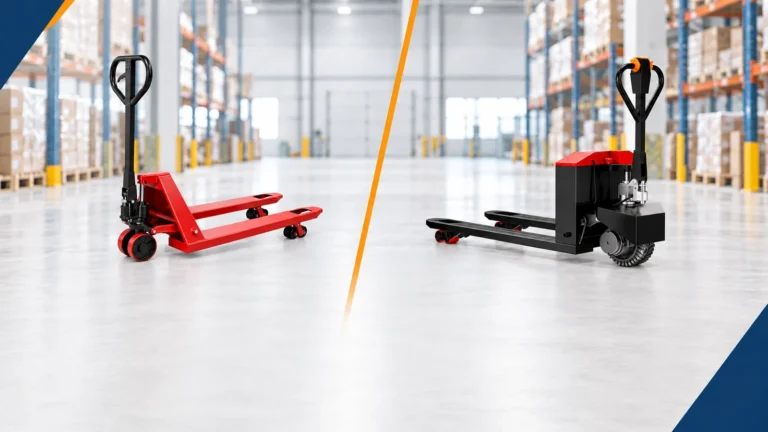
This guide is for pedestrian, low-lift electric pallet trucks, also called electric walkie pallet jacks. It is not a checklist for a hand pump truck, a pallet stacker or a ride-on truck. Adapt it to the exact truck, battery, charger and site procedure before use.
Quick answer: Check identification and previous defects, inspect the unloaded truck’s forks, frame, wheels, accessible battery and connections, then perform the exact manual’s checks for steering, travel, braking, lift/lower and fitted protective controls in a suitable clear area. Stop for damage, abnormal operation or an unresolved safety-critical check. Record the defect and prevent further use until an authorized assessment and release.
Table of contents
- Define the inspection scope and preparation
- Use a practical pre-use checklist
- Check the battery and charger identification
- Inspect forks, frame, wheels and rollers
- Check the tiller, travel and fitted controls
- Treat braking and emergency reverse separately
- Check lift, lower and hydraulic condition
- Match the checklist to the KKV EPT configuration
- Know when to stop and report a defect
- Keep an inspection and release record
- Frequently asked questions
- Manufacturer references and limits
Define the Inspection Scope and Preparation
Use the exact operating manual, battery instructions and inspection procedure for the supplied configuration. An operator checklist does not replace training, scheduled service, repairs or any inspection required for the particular workplace.
For example, the Vestil EPT-XXXX-33 handbook, printed pages 13–14, calls for pre-shift checks with the load removed and forks lowered. Its list includes structure, wheels, visible wiring, braking and lifting functions. Those are examples of inspection categories, not permission to copy its control sequence into another truck.
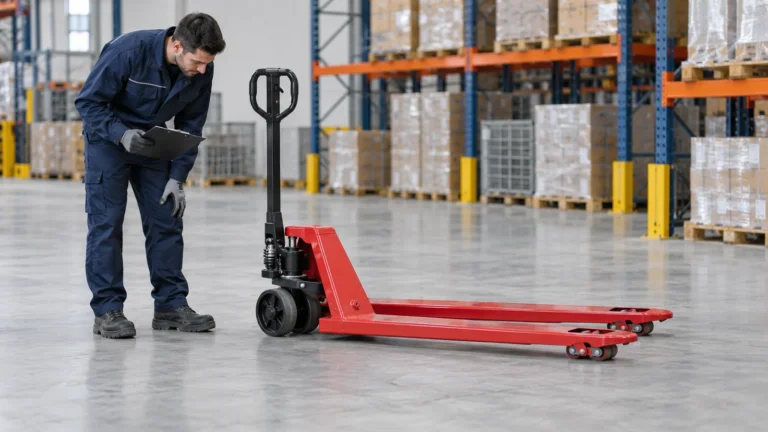
Begin with the truck parked and secured as its manual requires, without a pallet or load. Carry out the initial visual check with the power state specified for that check. Only proceed to a powered check when the manual permits it, the truck’s visible condition is acceptable and a trained, authorized person can conduct the check safely.
Read the previous defect entry first. If a truck has been held out of service, a fresh checklist is not a substitute for its authorized release. After an impact, suspected battery problem or new malfunction, follow the reporting process rather than waiting for the next routine check.
The work area is part of preparation: provide adequate space, visibility and a suitable surface, with other people clear of the check area. Do not use a dock edge, ramp, loaded pallet or a person’s body to demonstrate that a protective function works.
Use a Practical Electric Pallet Truck Pre-Use Checklist
Use separate results for Pass, Fail, Not Checked and Not Applicable. A blank field is not a pass. N/A is appropriate only when the feature is genuinely absent and not required for that supplied configuration; it is not a way to record an inaccessible or malfunctioning feature.
| Area | Item to verify using the applicable instructions | Stop or escalate when |
|---|---|---|
| Identification and records | Correct truck, readable identification and previous defects resolved | Truck identity or authorized release is uncertain |
| Forks and frame | Accessible structure has no concerning damage or deformation | A crack, bend, loose structural part or suspect repair is found |
| Wheels and rollers | Visible condition, retention and unobstructed movement are acceptable | Damage, dragging, looseness or abnormal rolling is observed |
| Battery and accessible cables | Correct battery identification, secure installation and no visible damage | Case, cable, connector or retention condition is suspect |
| Charger readiness | Approved battery/charger combination and undamaged accessible equipment | Charger identity, compatibility or condition is uncertain |
| Tiller and travel controls | Prescribed response, return and steering checks are normal | A control sticks, steering binds or movement is unexpected |
| Braking | Each applicable brake-related check meets the manual’s criteria | Stopping or holding response is abnormal or unverified |
| Protective controls | Fitted emergency reverse, stop, warning and speed functions checked as prescribed | A required function fails or cannot be verified |
| Lift and lower | Prescribed unloaded response and accessible hydraulic condition are normal | Motion is irregular, unintended or accompanied by suspect leakage |
| Pallet and route | Planned pallet, load and route suit the truck and site conditions | The handling task is unsuitable even if the truck itself appears sound |
This is a record framework, not a list of universal acceptance tolerances. Add the exact manufacturer’s limits, required checks and site-specific items before issuing it to operators.
Check the Battery and Charger Identification
Identify the installed battery rather than assuming that every truck in a fleet uses the same pack. Record its type, nominal voltage and relevant identification. Compare the approved equipment information, not only connector shape, colour or the fact that a plug fits.
Inspect the accessible exterior without dismantling the pack or exposing electrical parts. Report damage to the case, cable insulation, connector housing or retention arrangement. Do not bridge contacts, probe terminals, repair a cable or remove a cover as part of this operator checklist.
If there is suspected battery damage, an abnormal heat warning, smoke, leakage or another unusual condition, stop use and charging and follow the site’s battery emergency and escalation procedure. Keep people away where required; do not handle a suspect pack merely to complete the form. Linde’s lithium-ion rescue guide treats battery incidents separately from routine operation; its rescue and battery-removal procedures are not part of this operator checklist.
For a lithium-ion configuration, do not add a lead-acid electrolyte or watering task. Conversely, an optional lead-acid installation requires its own approved instructions. A generic battery icon or a percentage reading does not replace the identification and condition check.
The Vestil handbook, printed pages 17–19, assigns battery work to qualified personnel and requires an appropriate charger for its installed battery. For the KKV truck, obtain the actual battery and charger instructions. This article does not prescribe a charging connection order, temperature range or charging duration.
Include the charger in the reporting process even if it is shared between trucks. Check accessible condition and identification when it is safe to do so; damaged equipment or an unidentified substitute charger should not be put into use simply because the truck is needed for the next job.
Inspect Forks, Frame, Wheels and Load Rollers
Look at the accessible fork blades, tips, heels, frame and visible supporting parts. Record the location of any bend, crack, distortion, impact mark or apparently altered component. Do not straighten, grind or weld a damaged structural part to make it pass an operator check.
Inspect visible drive-wheel and load-roller surfaces for damage, debris and abnormal wear. Check the accessible retention condition and note dragging, vibration or a wheel that does not roll normally during the permitted check. Keep hands clear of pinch points and moving parts; do not reach under a raised truck or pallet to clear an obstruction.
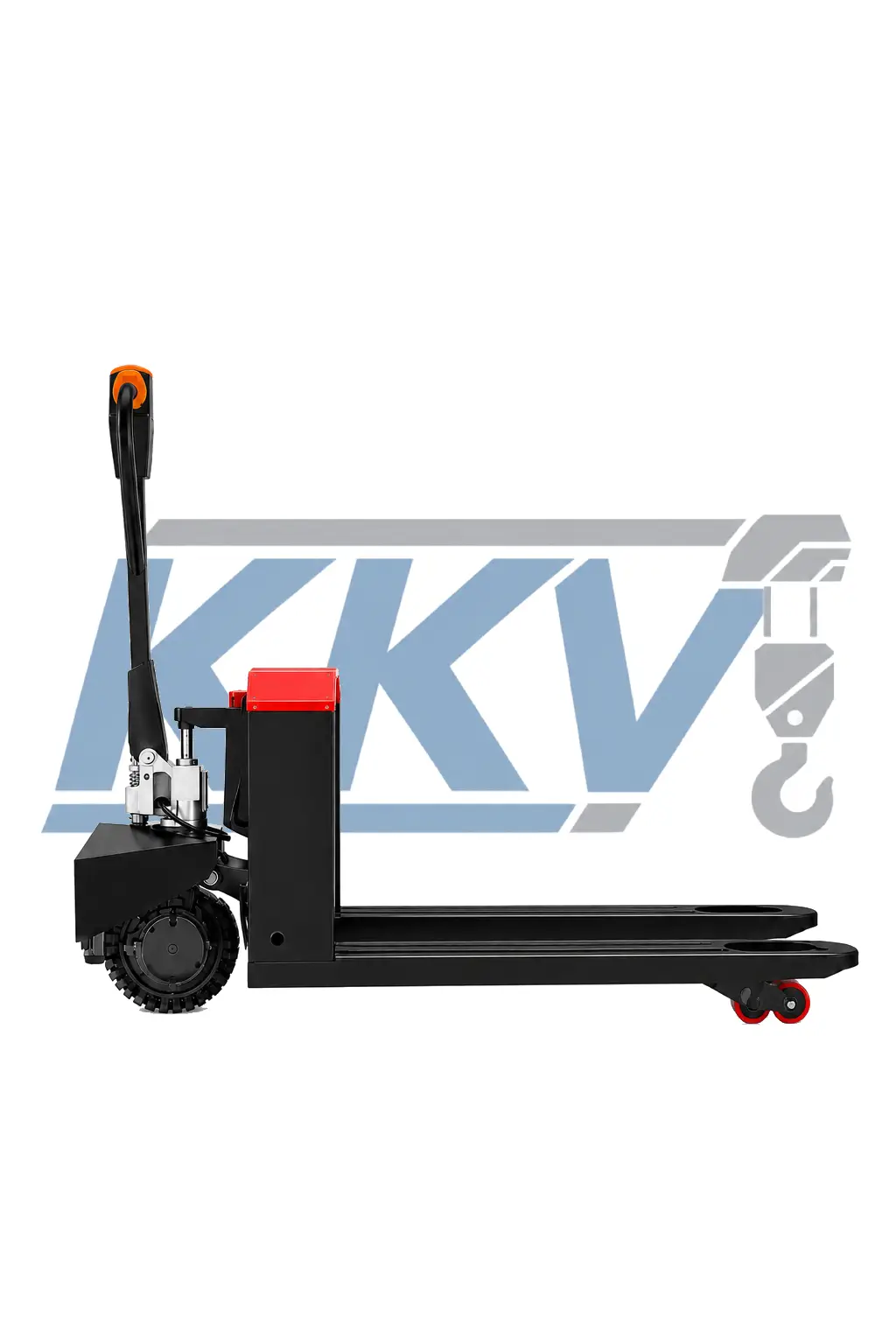
A useful report separates the observation from the suspected cause. For example, write that the right fork-end roller dragged during the permitted unloaded check, rather than declaring a bearing failure without assessment. Record any wrapping material or visible damage without attempting an unsafe removal.
Repeated wheel problems may also involve the route or pallet entry conditions. Document where they occur so the responsible person can assess both the equipment and the task. Fitting a different wheel material is not an operator’s shortcut around that assessment.
Check the Tiller, Powered Travel and Fitted Controls
Identify the controls fitted to the actual truck and the expected response described in its instructions. Photograph or label the control layout in a site procedure if helpful, but do not assume that a control in the same position has the same function on a different model.
An authorized functional check should establish that the relevant travel inputs respond as prescribed, steering is normal and the truck does not behave unexpectedly. Stop if an input sticks, movement is erratic or the expected stopping response does not occur. Do not keep experimenting to decide whether the symptom is intermittent.
Separate the result for each fitted function. A horn sounding does not establish that the emergency reverse works; a low-speed mode working does not verify the service brake. The checklist should name the function and the prescribed method rather than simply asking whether the handle is OK.
Where the configuration includes a horn, emergency stop, tiller-related interlock or other device, obtain its specific check from the manual. The current KKV public product page is not a complete control-test procedure. Do not mark a feature as confirmed merely because it appears in another manufacturer’s handbook.
Do not bypass an interlock, hold a switch in place, change a controller parameter or disconnect a protective device to get a truck moving. If normal operation cannot be verified with the approved method, record that result and withhold the truck for assessment.
Treat Braking and Emergency Reverse as Separate Checks
Identify the actual braking functions and how each is checked. Do not invent a universal tiller angle, stopping distance or brake-adjustment value. A correctly completed check records the expected response from the applicable instructions and the response actually observed.
The Vestil handbook discusses braking and its belly-button function separately on printed page 16. It also notes that braking performance depends on load and surface conditions. Therefore, an unloaded observation in a clear test area is not proof of performance for every loaded route.
Emergency reverse is a protective control, not a substitute for keeping the operator clear of trapping points. Use only its prescribed test method. Never put a person between the truck and a wall, rack or other object to demonstrate the function, and do not rely on the button as a normal stopping method.
If a brake or protective-control check fails, stop the inspection at that point. Do not add a load, drive onto a slope or increase speed to make the fault easier to reproduce. Record the conditions already observed and follow the site’s hold-out-of-service procedure.
Check Lift, Lower and Hydraulic Condition
Inspect accessible areas for suspect hydraulic leakage before starting the permitted functional check. Do not search for a pressurized leak with a hand or loosen a fitting. If access requires lifting the truck, removing a guard or entering a pinch area, that is outside this general operator checklist.
During the manual’s unloaded check, observe the response to the prescribed lift and lower inputs, including whether movement is normal and controlled. Note unexpected motion, unusual noise or a failure to respond. Keep people and body parts clear of the fork and linkage areas.
An unloaded check is not a rated-capacity test, a hydraulic pressure test or proof that the truck will hold every permitted pallet. If a problem appears later under normal use, stop and report it rather than loading the truck again to investigate.
Record what happened and when: lifting or lowering, loaded or unloaded, any displayed warning and the observed location of leakage. Leave decisions about adjustments, internal faults, replacement parts and return-to-service testing to authorized personnel.
Match the Checklist to the KKV EPT Configuration
The current KKV electric pallet truck page publishes the following standard configuration information. Use it to prepare questions and identify documents, not to override the nameplate or actual supplied equipment.
| Item | EPT-15 | EPT-20 |
|---|---|---|
| Rated capacity | 1,500 kg | 2,000 kg |
| Operator and functions | Pedestrian; electric travel and lift | Pedestrian; electric travel and lift |
| Standard removable Li-ion battery | 24V / 20Ah | 48V / 20Ah |
| Listed portable off-board charger | 24V / 5A | 48V / 10A |
| Listed control features | Electromagnetic brake, emergency reverse, turtle/creep mode | Electromagnetic brake, emergency reverse, turtle/creep mode |
| Standard wheels | PU drive wheel and tandem PU load wheels | PU drive wheel and tandem PU load wheels |
The two listed battery systems differ. Do not interchange chargers from the table on the basis of physical fit. Confirm the approved battery/charger pairing for the exact supplied configuration, including any agreed customization.
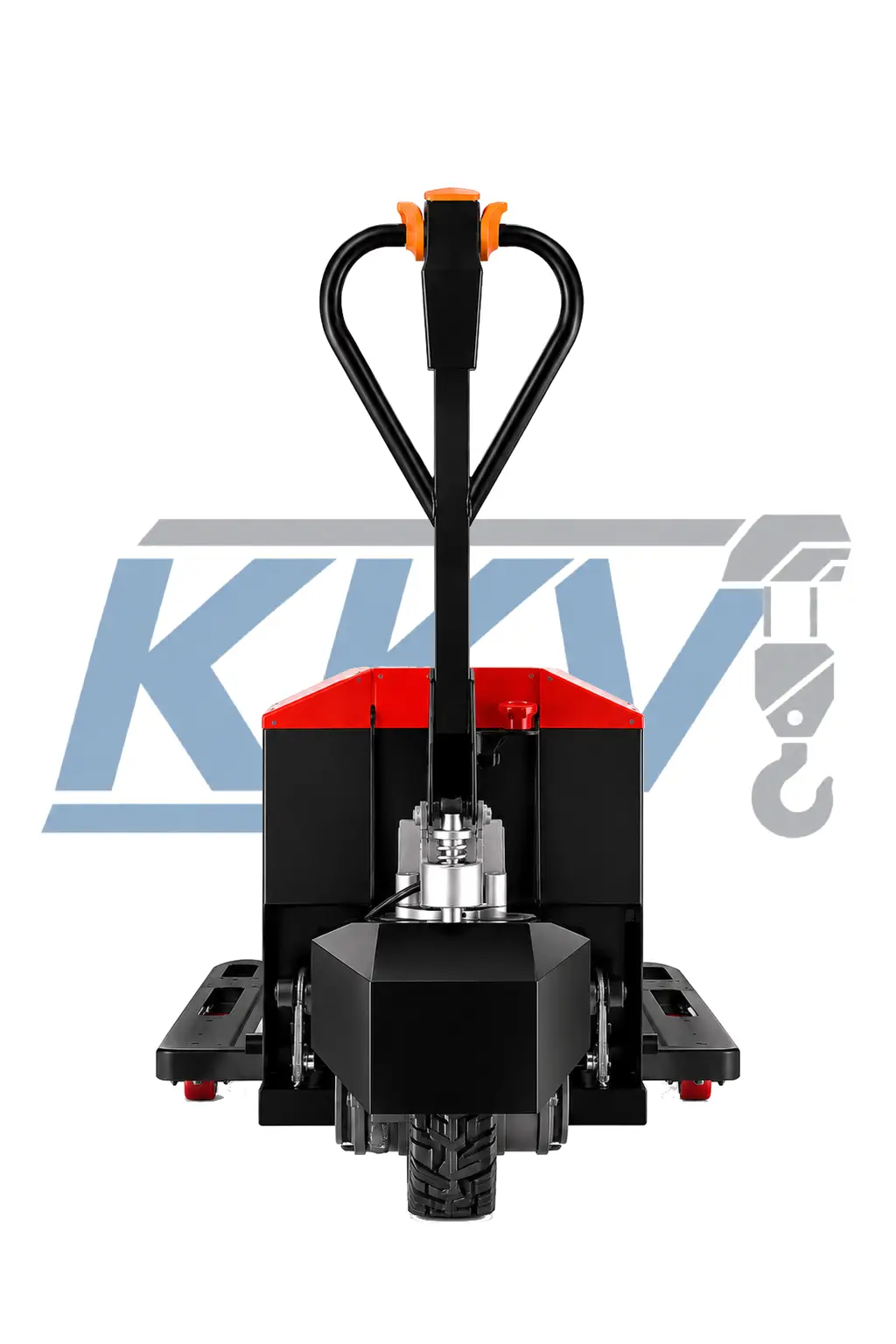
Before creating a fleet checklist, obtain the exact-model operating manual, battery and charger instructions, fitted-control descriptions, inspection criteria and defect-reporting arrangements. The product page alone does not establish the detailed brake test, emergency-stop layout or maintenance interval.
Know When to Stop and Report a Defect
Hold the truck out of service for a safety-related defect, abnormal response or unresolved condition that prevents the required check from being completed safely. The decision is not limited to whether the truck can still move one more pallet.
Examples requiring escalation include suspect structural damage, damaged accessible wiring, insecure battery retention, abnormal steering or travel, an unreliable brake or a failed required protective function. If a battery incident is suspected, follow the emergency procedure rather than an ordinary maintenance workflow.
Use the manufacturer’s and site’s method for securing and identifying the truck against further use. Do not drag, tow or manually release its brake unless an authorized procedure specifically covers the situation. Tell the responsible person where the truck is and what was observed.
| Observation | Useful report | What not to assume |
|---|---|---|
| Travel control did not return normally | Truck ID, input, unloaded condition and observed response | That a restart makes the fault acceptable |
| Brake check gave an unexpected response | Prescribed check used, surface and response already observed | That loading the truck will clarify the problem safely |
| Warning appeared after battery exchange | Battery ID, truck ID and exact displayed message | That any pack with the same plug is compatible |
| One roller dragged | Side, visible condition and when dragging occurred | That the operator should reach in to free it |
| Charger cable or case was damaged | Charger ID, location and visible condition from a safe position | That low current or brief use makes it acceptable |
The person reporting a defect and the person authorizing return to service may be different. Make that distinction clear in the record so a completed form does not accidentally become a repair approval.
Keep an Inspection and Release Record
A useful record identifies one truck and one inspection event. It should show both the result and any limitations, then link defects to an accountable follow-up rather than leaving them in a general shift notebook.
| Record field | Information to keep |
|---|---|
| Equipment identity | Asset number, model, serial number and relevant configuration |
| Inspection event | Date, time, inspector and shift or handover context |
| Power system | Installed battery ID/type and charger identity when relevant |
| Visual results | Forks, frame, wheels, accessible electrical condition and retention |
| Functional results | Each prescribed travel, steering, brake, lift/lower and fitted-control check |
| Uncompleted items | What could not be checked and why; not silently marked passed |
| Defect and containment | Observation, location, hold-out-of-service status and person notified |
| Service follow-up | Work reference and assessment by authorized personnel |
| Return to service | Responsible authorization and required verification recorded separately |
For recurring problems, compare observations rather than guessing a cause from one entry. The same symptom across several shifts may help the service team understand a problem, but it is not a reason to keep operating an unresolved truck.
Keep the inspection scope separate from service tasks. Linde’s pedestrian-truck training description treats daily operational checks, correct charging, care and servicing as training topics. A published checklist is a practical record aid, not a substitute for those competencies.
Frequently Asked Questions
How often should an electric pallet truck be checked?
Follow the exact manual and site requirements for pre-use or pre-shift checks, plus reporting after damage or abnormal operation. Do not wait for a scheduled service appointment to report a new fault.
Is a charged battery enough to show that the truck is ready?
No. The charge indication does not verify the forks, wheels, travel controls, steering, braking or protective devices. Complete the applicable checks and resolve previous defects.
Can the same checklist be used for a manual pallet truck?
Only some visible-condition items overlap. A hand pallet truck checklist does not cover the powered travel, battery and control checks needed here. Use a configuration-specific form.
Should emergency reverse be tested against a person’s body?
No. Use the manufacturer’s prescribed method in a suitable clear area. Never use a person as the test obstruction or create a trapping situation to demonstrate the control.
Can an EPT-15 charger be used with an EPT-20 battery?
Do not assume so. The published standard systems have different voltages. Confirm the exact approved combination from the truck, battery and charger instructions rather than relying on connector fit.
Should operators open the lithium battery for inspection?
Not as part of this general pre-use checklist. Limit the check to the authorized accessible inspection. Damage, warnings or suspected abnormal battery behaviour require the appropriate escalation, not pack disassembly or terminal probing.
What if a truck passes unloaded but develops a fault with a pallet?
Stop and report the new condition. The earlier check does not override an observed fault, and the pallet should not become a tool for repeated troubleshooting. Follow the applicable procedure for securing the situation.
Does a completed checklist replace scheduled maintenance?
No. It records the prescribed checks for that inspection event. Scheduled service, authorized repairs and return-to-service verification remain separate requirements.
Manufacturer References and Their Limits
The configuration comparison uses the current KKV EPT product page. Confirm the actual supplied equipment and instructions before applying it to a particular truck.
The Vestil EPT-XXXX-33 handbook, version 09/2018, printed pages 13–19, supports the explicitly attributed examples of pre-shift inspection, control distinctions and battery/charger instructions. Its numerical limits and control sequences are not adopted as KKV settings. Linde’s training information supports the distinction between a checklist and trained operational, charging and servicing competence. Its lithium-ion rescue guide, version 07/2025, is cited only to distinguish battery-incident escalation; this article does not reproduce its emergency procedures.
Make the Check Specific to the Truck, Battery and Task
The most useful electric pallet truck checklist joins visible condition, prescribed powered checks, a clear defect decision and accountable follow-up. It should make an incomplete check visible rather than convert uncertainty into a pass.
For a KKV EPT fleet, start with the supplied model, battery and charger documents, confirm the fitted controls and adapt the record to the workplace. Keep the inspection concise enough to complete carefully, but specific enough to identify the truck and the function that needs attention.
For help identifying an EPT configuration and requesting the relevant product documents, contact KKV or email sales@kkvhoist.com with the model, serial information and enquiry details.
Safety note: This is a general inspection-planning guide, not a substitute for the exact operating manual, training, battery instructions or site procedure. Do not perform repairs, bypass protections, open battery packs or use people or loads to investigate faults. Stop for unsafe or uncertain conditions and obtain authorized assessment.