Flat Webbing Sling vs Round Sling: Key Differences and How to Choose
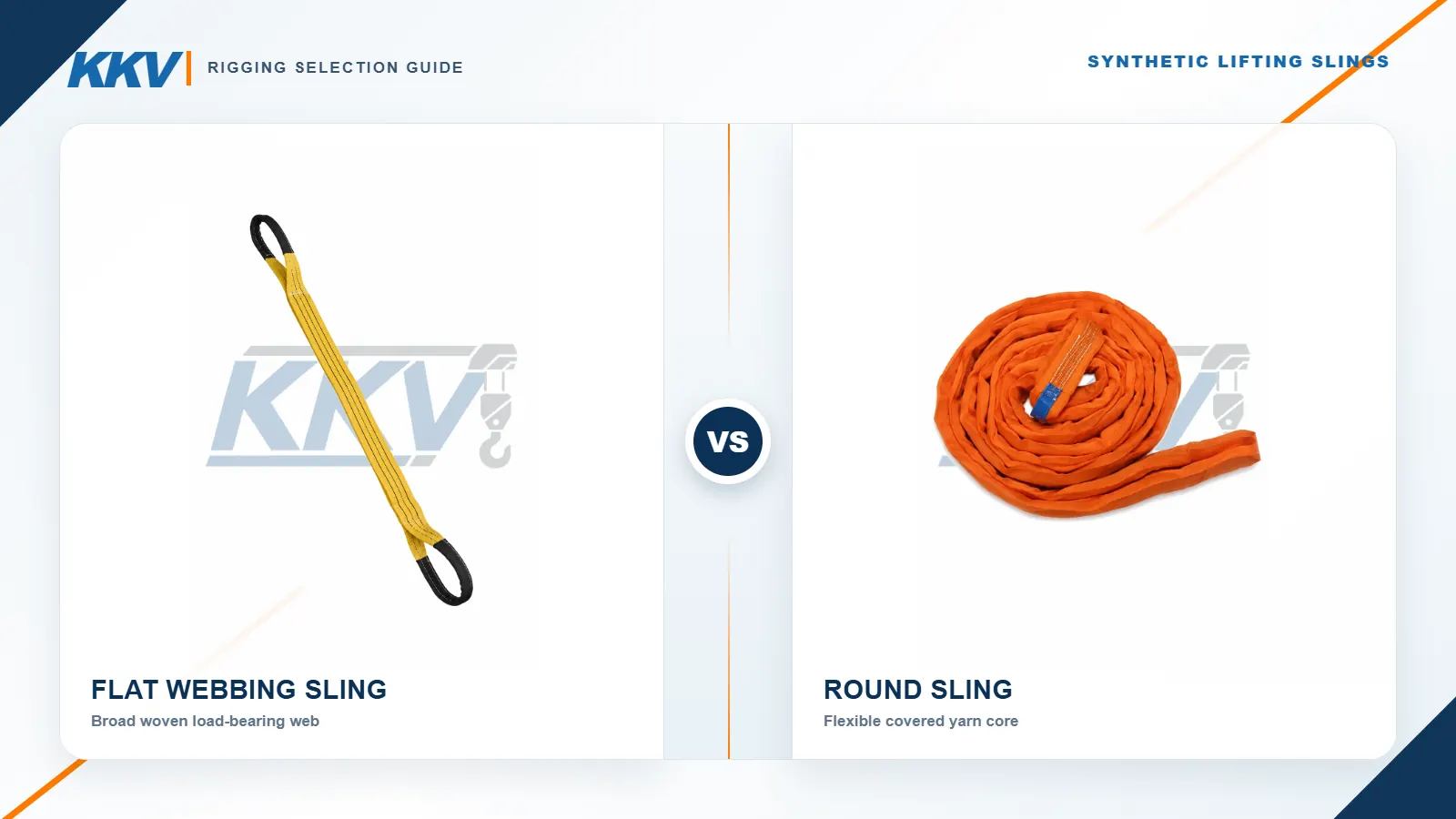
Flat webbing slings and round slings are both lightweight synthetic lifting slings, but they are not the same product in a different shape. A flat sling carries the load through woven webbing that is normally visible along the body. A typical polyester round sling carries the load through continuous load-bearing yarn protected by a tubular outer cover. That difference changes how each sling contacts the load, fits into hooks or shackles, responds to abrasion, and must be inspected.
The correct choice cannot be made from colour, width, apparent thickness, or catalogue capacity alone. Start with the maximum load, centre of gravity, attachment points, intended hitch, sling angle, contact radius, edges, environment and inspection plan. Then confirm the working load limit shown on the identification tag for the exact configuration. If the lift is asymmetric, non-routine, chemically exposed, unusually hot, or otherwise difficult, have a competent or qualified person plan it.
Quick answer: Choose a flat webbing sling when a broad, flat bearing surface and direct visibility of the load-bearing web suit the load and hardware. Choose a round sling when a flexible, conformable body suits the load path and fittings, while remembering that its load-bearing core is concealed. Neither type is automatically stronger or safer. Select the exact tagged sling for the hitch and angle, provide suitable edge protection, and inspect the complete lifting arrangement before use.
Table of contents
- Flat Webbing Sling vs Round Sling: The Short Answer
- What Is a Flat Webbing Sling?
- What Is a Round Sling?
- Flat Webbing Sling vs Round Sling: Side-by-Side Comparison
- WLL, Hitch Type and Sling Angle
- Load Shape, Contact Area and Surface Protection
- Edges, Abrasion, Heat, Chemicals and Environment
- Inspection and Removal from Service
- How to Choose the Right Sling
- Information to Include in Your RFQ
- Frequently Asked Questions
Flat Webbing Sling vs Round Sling: The Short Answer
The most visible distinction is construction. A flat webbing sling uses flat woven tape, often in one or more plies, with sewn eyes, fittings or an endless form. Its load-bearing material is exposed for inspection. A round sling normally contains many turns of load-bearing yarn inside a protective sleeve. The sleeve helps contain and protect the core, but it is not a substitute for correctly selected edge protection.
This construction difference creates practical selection tendencies rather than absolute rules. A flat sling can spread contact across a broad area and may sit neatly against a flat or wide surface. Its orientation is easy to see, but it can twist, fold or bunch if a fitting is too narrow. A round sling is soft and flexible, conforms readily around many shapes, and can be rotated so wear is not always concentrated at one point. However, the core is hidden, so inspection must include both visual and tactile checks through the cover.
Do not turn those tendencies into a simple statement that one type is better. A 2-ton flat sling and a 2-ton round sling may both be suitable for one vertical lift, yet only one may seat correctly in the available hook, provide the required contact area, or permit adequate inspection after exposure. Conversely, two slings that look similar may carry different rated loads because their material, construction, length, hitch rating, bend conditions or certification differ.
The decision is therefore a system decision. Check the sling, load, hook or shackle, lifting point, edge protection, hoist, supporting structure and planned movement together. KKV supplies both EA polyester round slings and EB flat webbing slings, but the final quotation should be based on the complete application rather than the product family name alone.
What Is a Flat Webbing Sling?
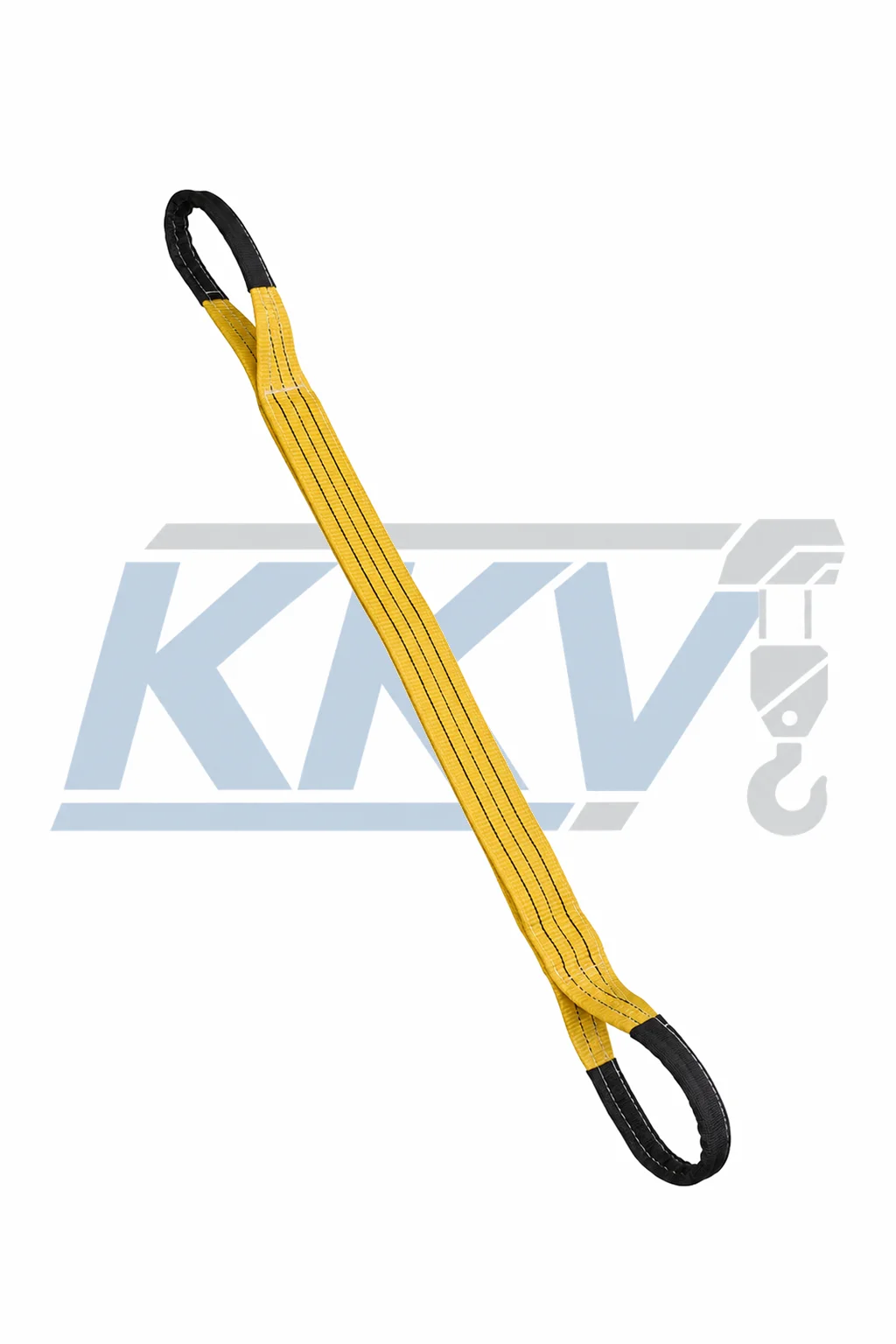
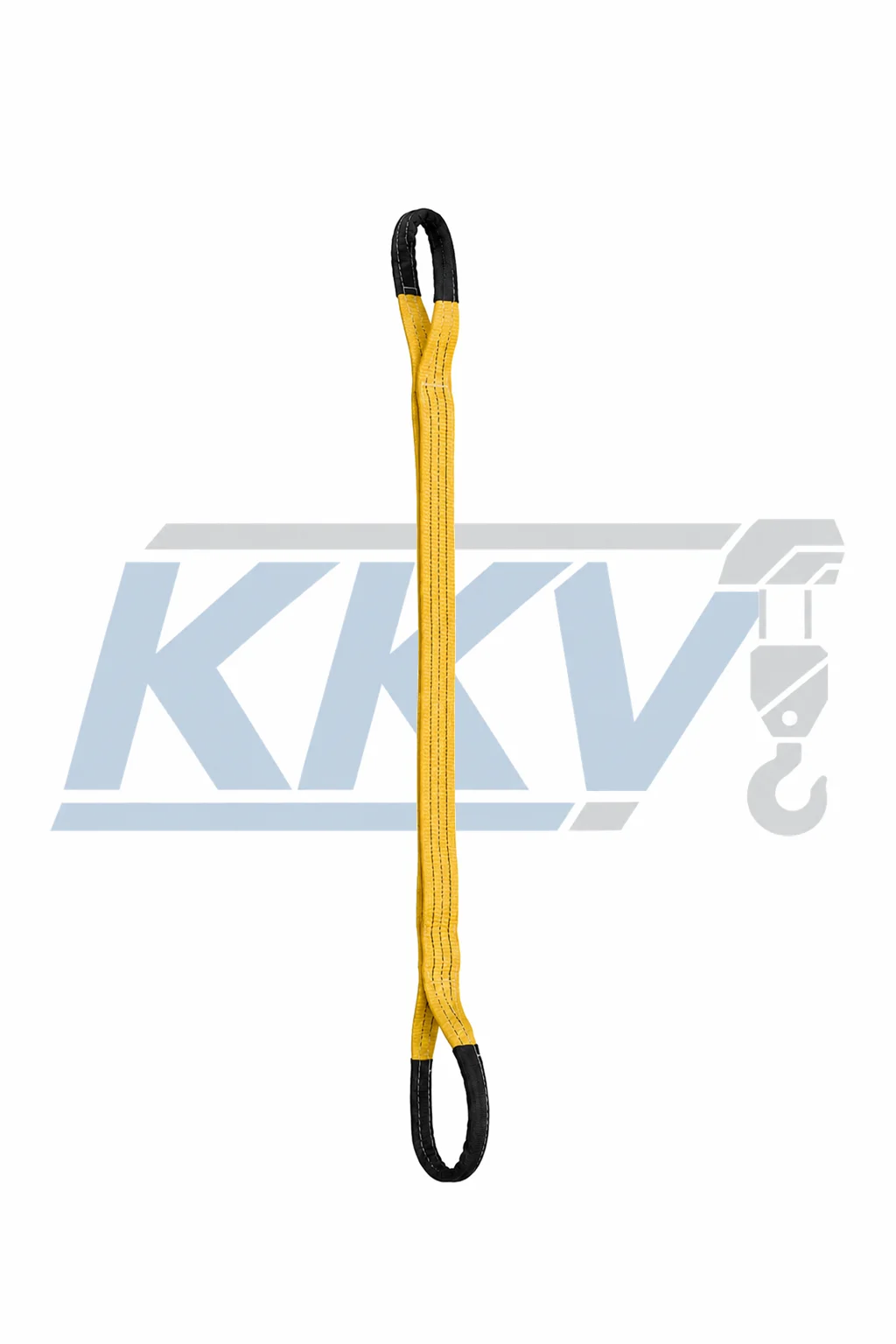
A flat webbing sling is made from woven synthetic webbing assembled into a lifting sling. Common constructions include eye-and-eye slings with flat or twisted eyes, endless slings, and versions with end fittings. One or more plies may be used. The sling body is relatively thin and wide compared with a round sling of similar nominal capacity, so it can provide a broad bearing surface where the load geometry permits.
The web itself carries the load. This makes cuts, tears, abrasion, heat damage and damaged load-bearing stitching comparatively accessible during inspection. It does not make inspection optional or guarantee that every defect is obvious. Dirt can conceal damage, chemical exposure may change the fibres, and wear can occur inside an eye or at a repeated bearing point.
Flat webbing is often useful when:
- a broad contact area is desirable;
- the sling needs to lie flat against a suitable load surface;
- the operator wants direct visual access to the load-bearing web;
- an eye-and-eye arrangement matches the hook, shackle or lifting point;
- specified wear sleeves or edge protectors can be positioned and retained correctly; and
- storage space and sling weight are important.
The wide shape also creates limitations. If the hook bowl, shackle pin or connecting fitting is too small or narrow, the web can bunch, crease or carry unevenly. The sling should not be knotted, twisted to shorten it, or forced into hardware that cannot support its width. If a flat sling is used in a choker, the eye and body must pass and seat as intended, and the actual choker rating on the identification tag must be followed.
KKV’s EB flat webbing sling is the relevant product family for this construction. The product page lists polyester material, eye-and-eye construction options and rated capacities, but the tag and order confirmation for the supplied sling remain the controlling references for its usable configuration.
What Is a Round Sling?
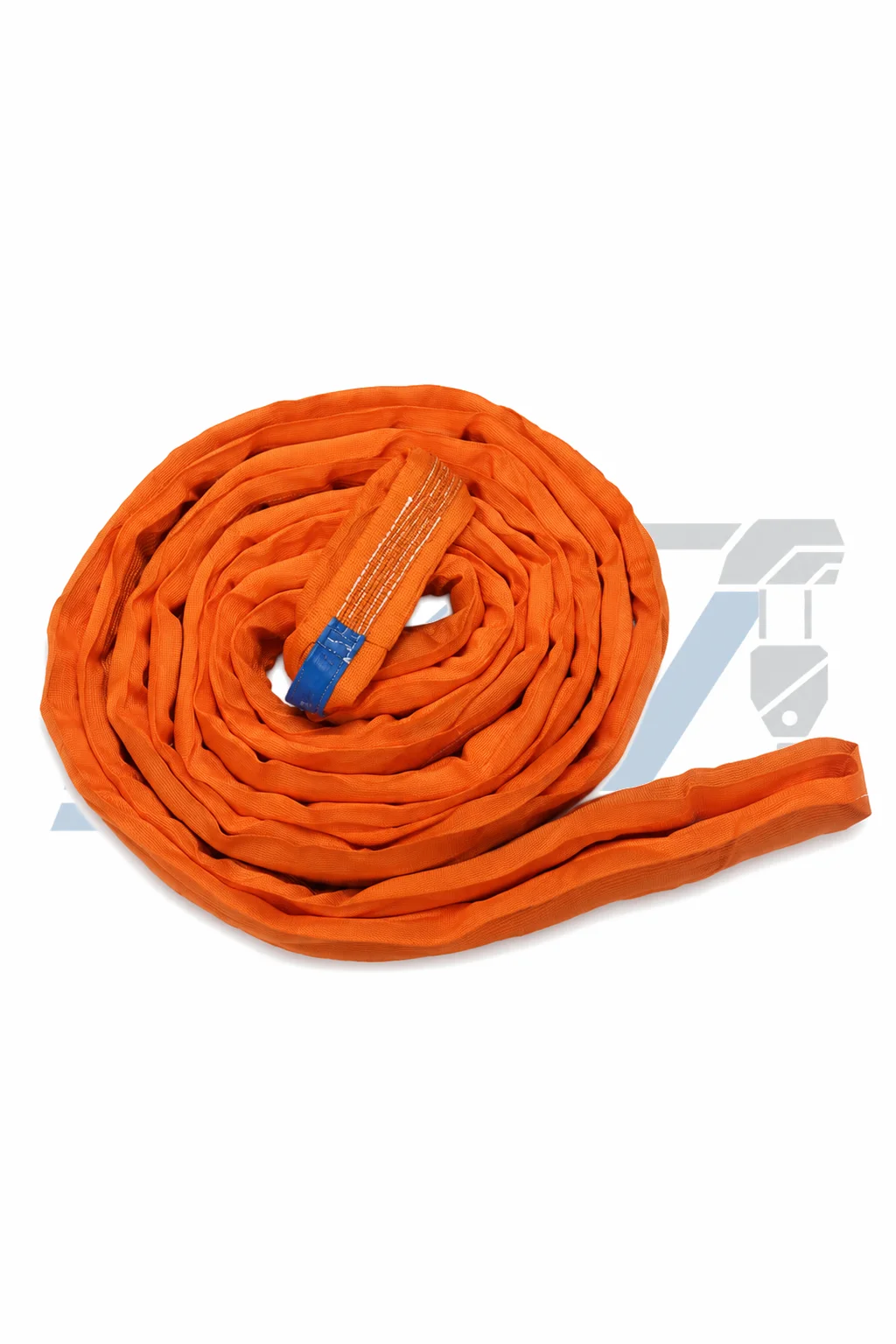
A typical polyester round sling has a continuous loop of load-bearing yarn enclosed within a woven tubular cover. The internal yarn carries the load. The cover keeps the yarn together and provides a first layer of protection from handling and abrasion, but it is not normally the principal load-bearing member.
This form is highly flexible. It can conform around suitable curved surfaces and can be paired with properly sized hooks, shackles or other fittings. Because the body is not a wide flat tape, it can be easier to route where space is limited. An endless round sling may also be rotated between uses so the same part of the cover is not always at the bearing point, subject to the manufacturer’s instructions and site procedure.
Round slings are often useful when:
- a soft, flexible sling must conform to the load path;
- the available fittings provide an adequate bearing shape and radius;
- an endless construction is preferred;
- a compact sling body is helpful around a suitable lifting point; and
- the inspection programme accounts for a concealed load-bearing core.
The concealed core is the key inspection difference. A cover that looks generally clean does not prove that the core is sound. Inspectors should look for cover damage, heat or chemical effects, contamination, knots, damaged fittings, and any abnormal bunching, hard areas, lumps or differences in feel. If the cover exposes the core, the core yarn is damaged, or the sling’s condition creates doubt, the sling should be removed from service and evaluated under the applicable instructions.
The KKV EA polyester round sling represents this product family. Its colour and body size are convenient visual identifiers, but capacity must be taken from the readable tag and confirmed for the actual hitch. Never order or approve a round sling solely because its colour resembles one already in use.
Flat Webbing Sling vs Round Sling: Side-by-Side Comparison
The following table is a selection overview, not a capacity chart. It describes typical construction and handling differences. The correct WLL, hitch rating, length, fitting compatibility and environmental limits must still be confirmed from the supplied sling’s identification and documentation.
| Selection point | Flat webbing sling | Round sling |
|---|---|---|
| Load-bearing construction | Flat woven webbing, commonly one or more plies | Continuous or multiple wraps of load-bearing yarn inside a tubular cover |
| Inspection visibility | Load-bearing web and stitching are generally visible | Load-bearing core is concealed; inspect and feel through the cover |
| Contact profile | Broad and flat when correctly seated | Flexible and conformable around suitable shapes |
| Common forms | Eye-and-eye, fitted and endless | Commonly endless, with some specialized assemblies available |
| Behaviour in narrow hardware | May fold or bunch if the fitting is too narrow | May also bunch or pinch if the fitting opening or radius is unsuitable |
| Wear pattern | Wear can concentrate at eyes, edges, folds and repeated contact zones | Cover can be rotated to redistribute contact, but core damage may be hidden |
| Edge protection | Required wherever edges or abrasion can damage the web | Required wherever edges or abrasion can damage the cover or core |
| Best inspection advantage | Direct view of much of the load-bearing material | Flexible body, but requires careful cover and tactile inspection |
| Identification | Use the tag; do not select by width or colour alone | Use the tag; do not select by colour or apparent diameter alone |
| Governing EN product standard | EN 1492-1 for general-purpose flat woven webbing slings | EN 1492-2 for general-purpose round slings |
Neither column establishes a winner. The same load may favour a flat sling at one contact point and a round sling at another. A wide machined component, for example, may benefit from the distribution of a flat web sling, provided the sling is protected from edges and cannot slide. An irregular casting may suit a flexible round sling, provided its cover, core, bearing radius and stability are adequately controlled.
Standards also must be kept in context. EN 1492-1 and EN 1492-2 address different sling constructions. ASME B30.9 covers multiple sling types, including synthetic webbing and polyester fibre yarn slings within protective covers. OSHA’s general-industry rule explicitly addresses synthetic web slings, while OSHA publishes separate guidance for synthetic round slings. A supplier should therefore quote the requested standard and documentation for the actual product rather than implying that every standard is interchangeable.
WLL, Hitch Type and Sling Angle
Working load limit is the maximum load assigned to a sling for defined conditions. It is not the same as minimum breaking force, proof-test load or design factor. None of those values gives permission to exceed the WLL. The WLL shown for a vertical hitch also cannot automatically be transferred to a choker, basket or multi-leg arrangement.
Begin with the maximum total load applied to the sling system. Include the item being lifted and any lifting beam, spreader, fixture, below-the-hook device or other rigging whose weight is carried by the sling. Confirm the centre of gravity and determine how the load will be shared. If the load is not rigid and symmetrical, equal load sharing should not be assumed.
Then identify the exact hitch:
- A vertical hitch uses a sling as a single straight leg. The load must be stable and unable to rotate or slip out of the arrangement.
- A choker hitch tightens around the load. Capacity depends on the tagged choker rating, choke angle, contact diameter and whether the body can form the hitch without crushing or bunching.
- A basket hitch supports the load with both sides of the sling. Its rating depends on leg orientation, balance, contact radius and containment. A basket does not automatically double capacity in every field arrangement.
- A multi-leg assembly introduces load-sharing and angle effects. The assembly rating, master link, connectors and each leg must be considered together.
| Capacity question | What to verify | Why it matters |
|---|---|---|
| What is the maximum suspended mass? | Load, fixtures and all below-the-hook equipment | Omitting accessory weight understates the required capacity |
| Which hitch will be used? | Vertical, choker, basket or multi-leg as shown on the tag | The same sling can have different ratings for different hitches |
| What is the sling angle? | State whether the angle is measured from horizontal or vertical | Leg tension increases as the sling becomes flatter |
| Is the centre of gravity central? | Actual centre of gravity and attachment-point locations | Unequal geometry can load one leg more than another |
| What is the contact diameter or radius? | Load surface, hook bowl, shackle pin and other fittings | Tight bends, pinching and poor seating can reduce performance |
| Can the load shift or rotate? | Stability before, during and after lift-off | A sling can slide, roll or unload one side even when nominal capacity is adequate |
| Is the label readable? | Manufacturer, material and WLL for relevant hitches | Colour, width and apparent size are not reliable capacity evidence |
Sling angle deserves special attention. When two sling legs are inclined, each leg must carry both a vertical component and a horizontal component of force. As the angle measured from horizontal becomes smaller, leg tension rises. OSHA guidance advises against horizontal sling angles below 30 degrees unless recommended by the manufacturer or a qualified person. Always state the angle convention in a lift plan because a value measured from vertical means something different.
Published tables sometimes show a choker at about 80 percent of vertical rating or a true vertical-leg basket at about 200 percent. Treat those values as conditional examples, not universal field multipliers. A choke angle below the stated threshold, a shallow basket angle, small bend radius, poor seating, asymmetric load or product-specific construction changes the permitted capacity. The sling tag, manufacturer’s chart and approved lift plan take precedence.
Load Shape, Contact Area and Surface Protection
After capacity, examine how the sling touches the load. Synthetic slings are soft compared with chain or wire rope, but they can still mark sensitive surfaces, and the load can easily damage the sling. Paint, polished finishes and thin sheet material may require a clean protective interface. At the same time, any protection must not make the arrangement unstable or allow the sling to slide.
A flat webbing sling usually presents a wide surface when it lies flat. This can distribute pressure over a larger area than a compact round sling. That benefit disappears if the web folds over an edge, wrinkles under the load, or is squeezed into a narrow hook. The whole width should be supported as intended, with the load centred and no trapped debris beneath the sling.
A round sling conforms readily to many curves and irregular shapes. Its flexibility does not mean it can be bent over any radius. A small pin, tight corner or narrow hook can concentrate force, pinch the cover and stress the core. The bearing surface must match the sling manufacturer’s recommendations, and the body should seat naturally without being compressed against side plates or latch components.
Also check the route through the hardware. Crosby’s synthetic-sling guidance warns against folding, bunching or pinching web and round slings in hooks, shackles or similar fittings. When a round sling is connected with a shackle, guidance commonly places it in the bow rather than crowding it against the pin and ears, subject to the shackle and sling manufacturers’ instructions. Flat sling eyes likewise need sufficient width and radius so they do not curl or carry at one edge.
Surface protection serves two different purposes. One is protecting the load finish from the sling. The other, more critical purpose, is protecting the sling from the load. A soft packing material that prevents paint marks may not resist a sharp metal edge. Use purpose-selected edge protection or wear protection that is rated and positioned for the specific contact, motion, pressure and edge geometry.
Edges, Abrasion, Heat, Chemicals and Environment
Both sling types can be cut rapidly by an unprotected edge. An edge does not need to feel razor sharp to damage a tensioned synthetic sling. Corners, burrs, weld spatter, rough cast surfaces, protrusions and relative movement can all create cutting or abrasion. Protect the sling wherever it contacts a damaging surface, and ensure the protector remains in place as the load is taken and moved.
Do not assume the outer jacket of a round sling is built-in edge protection. The cover helps protect and contain the core during normal handling, but an edge can cut through it and reach the load-bearing yarn. Similarly, a reinforced eye on a flat sling is designed for its intended bearing zone; it does not make the rest of the sling resistant to cutting.
Abrasion and contamination require planning even when there is no obvious edge. Dragging a sling across a floor, pulling it from under a landed load, or storing it with grit can abrade fibres. Keep synthetic slings off the ground where practicable, do not pull them from beneath a resting load, and store them clean, dry, ventilated and away from sunlight, heat and chemical exposure in accordance with the manufacturer.
Temperature limits differ by material, product and governing rules. For example, the US OSHA general-industry rule gives an upper limit of 180 degrees Fahrenheit for nylon and polyester web slings, while OSHA’s round-sling guidance and EN product standards use different ranges. Do not merge these into one universal polyester limit. State the required operating temperature in the RFQ and use the lowest applicable limit from the sling documentation, site rule and governing standard.
Chemical compatibility also cannot be inferred from the words “polyester sling.” Chemical identity, concentration, temperature, exposure duration, fibre, cover, stitching, fittings and cleaning method all matter. OSHA prohibits polyester web slings in the presence of caustic fumes, liquids, sprays or mists under its general-industry rule. For any chemically active environment, give the supplier full exposure information and obtain product-specific written guidance.
Other environmental checks include ultraviolet exposure, moisture, freezing conditions, sparks, hot work, welding spatter and contaminated storage. A sling used outdoors may need more frequent inspection and protected storage. If hot work will occur nearby, isolate the sling from heat and spatter or select another approved lifting method.
Inspection and Removal from Service
Inspect the sling, tag, eyes, cover, stitching and fittings before use. Inspection must be performed by a person with the competence required by the applicable workplace rules. Periodic examination intervals should be set from the law, standard, service severity, manufacturer and site procedure; there is no single inspection interval that is correct in every country and service condition.
For a flat webbing sling, spread the sling out in adequate light and inspect both faces, both edges, the full length, eyes, wear pads, load-bearing seams, label and any fittings. Look and feel for cuts, tears, snags, holes, abrasion, damaged stitching, burns, melting, glazing, stiffness, discolouration, chemical attack, knots, embedded particles and distorted hardware. Pay extra attention to repeated contact and bearing areas.
For a round sling, inspect the entire cover and label, then feel along the body for uniformity. Look for holes, cuts, tears, abrasion, exposed core, heat or chemical damage, weld spatter, knots, damaged fittings, and unusual hard areas, bunching or lumps. Do not open the cover or attempt to redistribute a questionable core in the field. A normal-looking section of cover does not prove the entire concealed core is sound.
| Condition found | Flat webbing sling action | Round sling action |
|---|---|---|
| Identification missing or unreadable | Do not use until positively identified under an approved process | Do not use until positively identified under an approved process |
| Cut, tear, puncture or severe abrasion | Remove from service under applicable criteria | Remove when cover damage exposes or may have damaged the core, or when condition creates doubt |
| Heat damage, melting or charring | Remove from service | Remove from service and evaluate any possible core damage |
| Chemical burn, brittleness or unexplained stiffness | Remove and follow manufacturer/site procedure | Remove and follow manufacturer/site procedure |
| Broken or worn load-bearing stitching | Remove from service | Inspect any sewn components and remove if their integrity is affected |
| Exposed or damaged load-bearing material | Remove from service | Remove from service when core yarn is exposed or damaged |
| Knot in sling body | Remove from service; never lift with a knot | Remove from service; never lift with a knot |
| Bent, cracked, gouged or distorted fitting | Remove the complete assembly from service | Remove the complete assembly from service |
| Condition is uncertain | Quarantine and obtain competent evaluation | Quarantine and obtain competent evaluation, including concealed-core concerns |
Under OSHA’s synthetic web-sling provisions, acid or caustic burns, melting or charring, snags, punctures, tears or cuts, broken or worn stitches, and distorted fittings are specific removal conditions. OSHA’s synthetic round-sling guidance additionally highlights missing identification, core exposure or damage, knots, heat and chemical effects, damaged fittings, and any condition that causes doubt.
Do not field-patch, sew, knot or temporarily repair either type. Any permitted repair must be carried out by the manufacturer or an appropriately qualified entity and then identified and proof tested as required. Many damaged synthetic components are not repairable. Quarantine prevents a rejected sling from returning to the work area by mistake.
How to Choose the Right Sling
Use the following sequence for a repeatable selection rather than starting with a catalogue photo.
Step 1: Define the Load and Lift Path
Record the maximum total suspended mass, dimensions, centre of gravity, rigidity, surface condition and available lifting points. Describe where the load starts, where it will land, the required clearance and whether it may rotate, tilt or shift. Include the weight of beams, fixtures and other below-the-hook equipment.
Step 2: Select the Hitch and Number of Legs
Choose vertical, choker, basket or a designed multi-leg arrangement based on stability and attachment points. Do not choose a hitch only to obtain a larger number in a capacity table. Confirm that the load cannot slide out, tip, roll or collapse as tension is applied.
Step 3: Calculate the Required Rated Capacity
Determine the highest force expected in any leg, including angle and unequal sharing. Select a sling whose tagged WLL covers that force in the actual hitch. For asymmetric or complex lifts, obtain a lift plan or calculation from a qualified person instead of assuming even distribution.
Step 4: Compare Contact Profile and Hardware Fit
Choose a flat sling if its broad profile lies correctly against the load and inside the fittings without folding. Choose a round sling if its flexible body follows the planned path and seats on a suitable radius without pinching. Verify the usable bearing width, hook bowl, shackle size and other connector dimensions.
Step 5: Specify Edge and Wear Protection
Map every point where the sling contacts the load or hardware. Identify edges, corners, burrs, rough surfaces and possible sliding. Specify protectors for the real edge geometry and expected pressure, and confirm that they will remain positioned during lift-off and movement.
Step 6: Check Environment and Documentation
State temperature, chemicals, outdoor exposure, moisture, contamination, hot work and inspection regime. Confirm the requested material, applicable standard, tag information, declaration or certificate, operating instructions and traceability. Do not claim certification until it is supported by the supplied product documents.
Step 7: Plan Inspection, Handling and Storage
Define who inspects the sling before use, the periodic examination schedule, the quarantine process, and where the sling will be stored. Provide racks or clean storage that prevents crushing, contamination and prolonged exposure. A suitable sling can still fail prematurely if it is dragged, trapped, knotted or stored badly.
In many ordinary lifts, both product types can work when correctly sized and protected. The better choice is the one that gives a controlled load path, correct seating, reliable inspection and practical handling for that specific task. If those conditions cannot be achieved, revise the rigging arrangement rather than forcing the available sling to fit.
Information to Include in Your RFQ
A clear request for quotation reduces the risk of receiving the right nominal capacity in the wrong construction or length. Include:
- product type requested, or ask the supplier to recommend flat webbing versus round sling;
- maximum total load and whether it includes lifting fixtures;
- required WLL and the hitch in which it is required;
- number of sling legs and sling-angle convention;
- effective working length and how it is measured;
- flat sling eye type, eye length and ply if applicable;
- round sling endless construction or any required end components;
- load dimensions, centre of gravity and attachment-point spacing;
- hook, shackle, master link and fitting dimensions;
- edge radii, surface condition and required protection;
- temperature range, chemical exposure, outdoor use and contamination;
- applicable product standard, documentation and marking requirements;
- quantity, destination, packaging and inspection documents; and
- photographs or a drawing showing the complete lifting arrangement.
For a KKV EB flat webbing sling, confirm construction, width, eye arrangement, effective length and required hitch WLL. For a KKV EA round sling, confirm WLL, effective length, intended hitch and the required contact protection. If the sling connects to a hook or shackle, check the relevant eye hook with latch or D shackle dimensions rather than assuming compatibility from capacity alone.
The RFQ should not ask only for “one red sling” or “a 50 mm sling.” Colours and dimensions may help identify a family, but they are not a substitute for a readable tag, exact product data and configuration-specific capacity. If replacement is for an existing sling, provide a clear photograph of the complete label and explain the actual use; do not rely on the old sling’s appearance if its identification is missing.
Frequently Asked Questions
Is a round sling stronger than a flat webbing sling?
Not as a general rule. Strength and WLL depend on the specific product, construction, material, length, hitch, angle and bend conditions. Compare the tagged WLL for the intended configuration. A physically smaller round sling may have the same nominal rating as a wider flat sling, but that does not make every round sling stronger.
Which sling is better for protecting a finished surface?
Both are softer than bare chain or wire rope, but neither guarantees a mark-free lift. A flat sling offers broad contact when it lies flat; a round sling conforms to many shapes. Cleanliness, trapped grit, pressure, movement and protective material matter. Test the contact plan on a non-critical area where appropriate.
Can I choose a synthetic sling by colour?
No. Colour systems can help identify certain product ranges, but colour can fade, become contaminated or differ across standards and manufacturers. Read the permanent identification tag for material and WLL in the applicable hitch. A missing or unreadable tag is a reason not to use the sling.
Does a basket hitch always double the vertical WLL?
No. Some rated tables show twice the vertical capacity for a true basket with vertical legs and suitable conditions. Angled legs, poor balance, small contact radius, pinching, unequal loading and product-specific limits can reduce capacity. Use the tag or manufacturer’s table for the real arrangement.
Does a choker hitch always have 80 percent of vertical capacity?
No. Approximately 80 percent appears in some tables when the choke angle is at least the specified value, commonly 120 degrees. Smaller choke angles and other unfavourable conditions require a lower rating or qualified evaluation. Use the exact product guidance.
Do round slings need edge protection?
Yes, whenever an edge, corner, protrusion or abrasive surface could damage the cover or core. The normal tubular cover is not universal cut protection. Select and position protection for the actual edge radius, pressure and possible movement.
Can a flat sling be used in a narrow hook?
Only if the hook or connecting fitting supports the eye and sling as required without folding, bunching, pinching or side loading. A hook with adequate tonnage may still be geometrically unsuitable. Verify the bearing width, radius and seating with both manufacturers’ instructions.
How often should synthetic slings be inspected?
Inspect them before use and arrange competent periodic examinations at intervals required by local law, the applicable standard, service severity, manufacturer and site procedure. Severe or unusual service generally requires more frequent attention. Do not apply one universal interval across every jurisdiction and application.
Can a cut or damaged synthetic sling be repaired on site?
No field patching, knotting, sewing or temporary repair should be used. Quarantine the sling. Where repair is permitted, it must be performed and proof tested by the manufacturer or an appropriately qualified entity under the applicable rules. Many forms of web or core damage require disposal rather than repair.
What details should I send KKV for a sling quotation?
Send the total load, hitch, number of legs, angle, effective length, lifting points, load dimensions, hardware sizes, edge condition, environment, requested standard, documents, quantity and destination. Photographs or a drawing of the load path are very helpful. Use the webbing sling category to review options, then contact KKV with the application.
Choose the Sling for the Complete Lifting Arrangement
The useful question is not whether flat webbing or round slings are universally better. It is which tagged sling fits the load, hitch, angle, bearing surfaces, fittings, environment and inspection system for this lift. Verify every component in the load path and resolve edges, stability and hardware fit before ordering.
For visible load-bearing web and a broad flat contact profile, review the KKV EB flat webbing sling. For a flexible endless body with a protected yarn core, review the KKV EA polyester round sling. Final selection still depends on the supplied tag, documentation and application details.
For sling selection or a quotation, contact KKV or email sales@kkvhoist.com and send the maximum load, hitch, angle, effective length, load drawing, fitting dimensions, edge conditions, environment and required documents.
Safety note: This article is general product-selection information. It is not a lift plan, engineering calculation, inspection certificate or substitute for the sling manufacturer’s instructions, applicable law, site procedure or a competent person’s assessment. Never exceed the tagged working load limit, and remove any sling of doubtful condition from service.