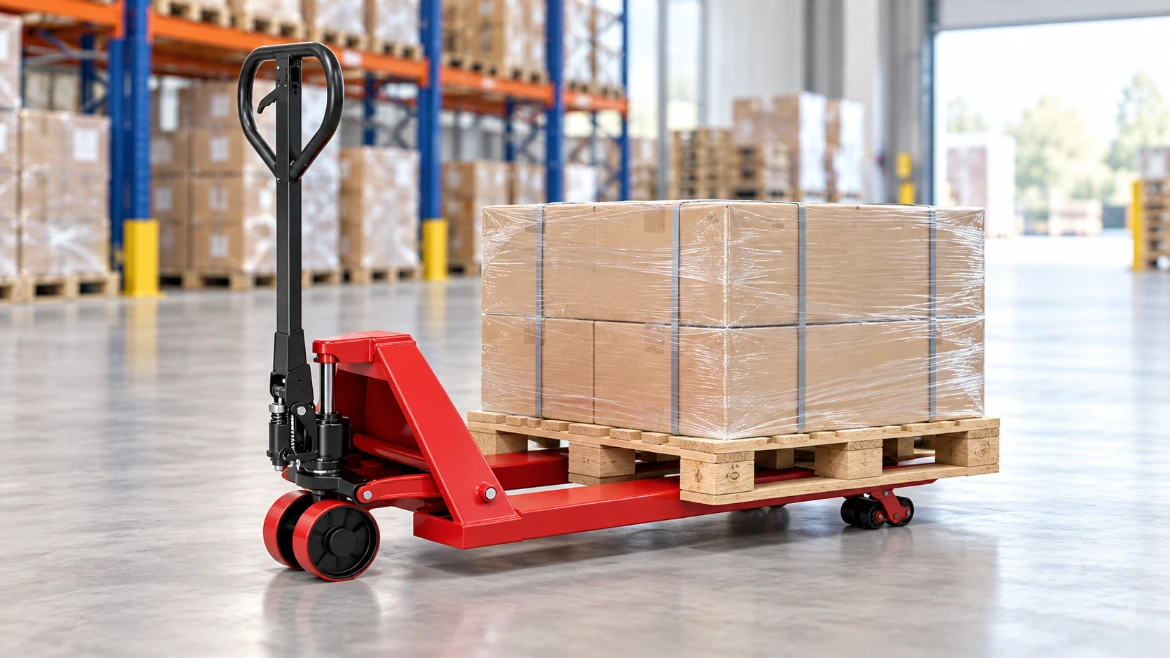
How to Choose a Hand Pallet Truck: Capacity, Fork Size, Wheels and Working Conditions
Choosing a hand pallet truck involves more than matching the pallet weight to the capacity shown on a nameplate. The truck must enter the pallet correctly, support the load over a suitable fork length, roll on the actual floor surface, turn within the available aisle and remain practical for the distance and frequency of the job.
A correctly rated truck can still be a poor choice if its lowered forks are too high for the pallet opening, its outside fork width does not match the pallet, its wheels struggle across joints or debris, or the route requires more manual force than operators can safely apply. This guide explains how to choose a hand pallet truck and prepare a complete quotation request.
Quick answer: Start with the heaviest complete pallet and confirm how its weight is distributed. Measure the pallet entry openings, fork pockets and direction of entry. Then select a rated capacity, outside fork width, fork length and lowered fork height that match both the load and pallet. Choose the steering-wheel and load-roller material for the floor, check single or tandem load rollers against thresholds and pallet geometry, measure aisle and turning space, and assess travel distance, frequency and gradients. If manual pushing would be excessive, compare a powered pallet truck instead of simply selecting a higher-capacity manual model.
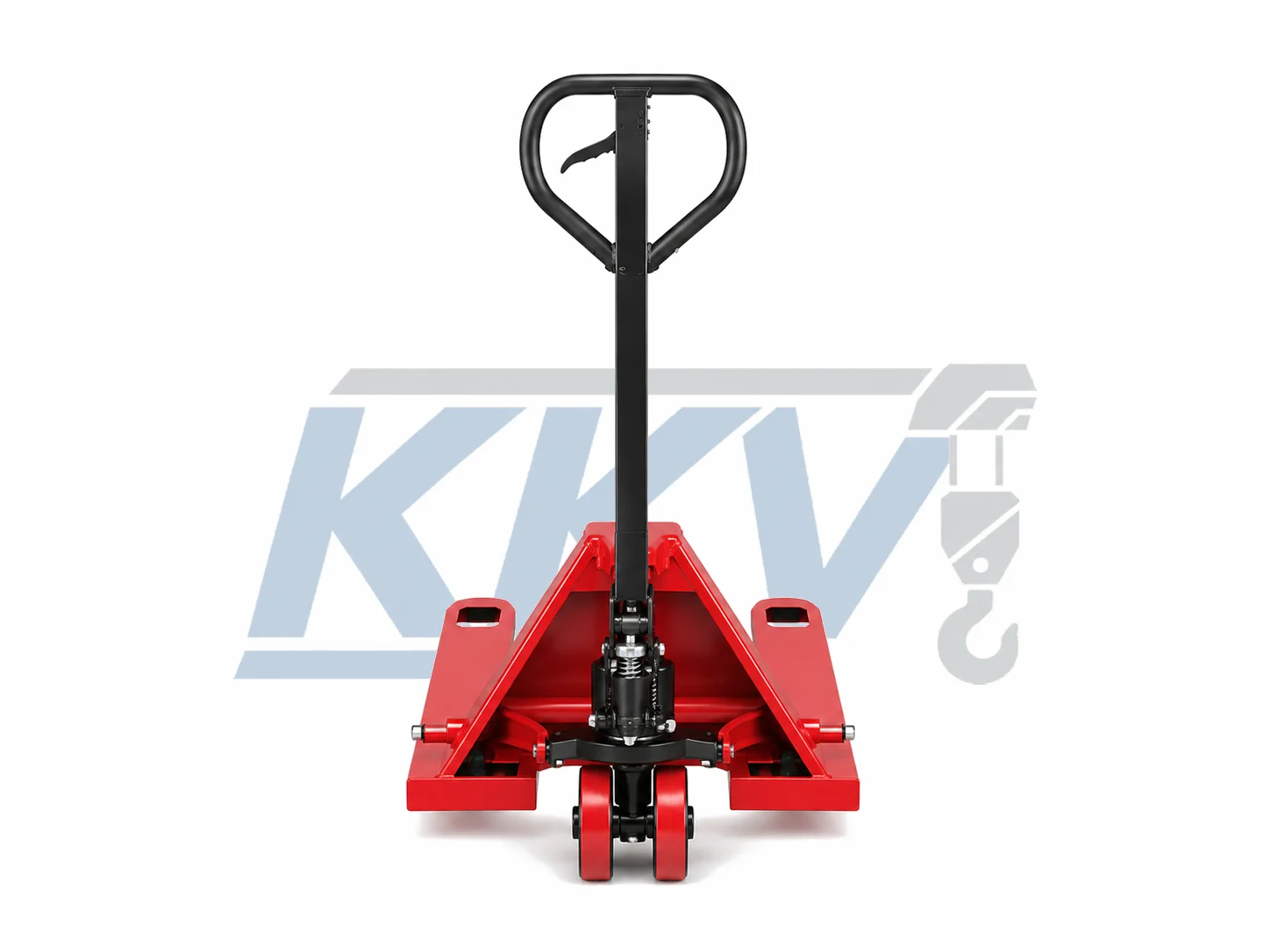
Table of contents
- What is a hand pallet truck?
- When is a manual pallet truck suitable?
- Define the load, pallet and route first
- Eight factors to check before ordering
- How to choose wheel material
- KKV manual pallet truck configurations
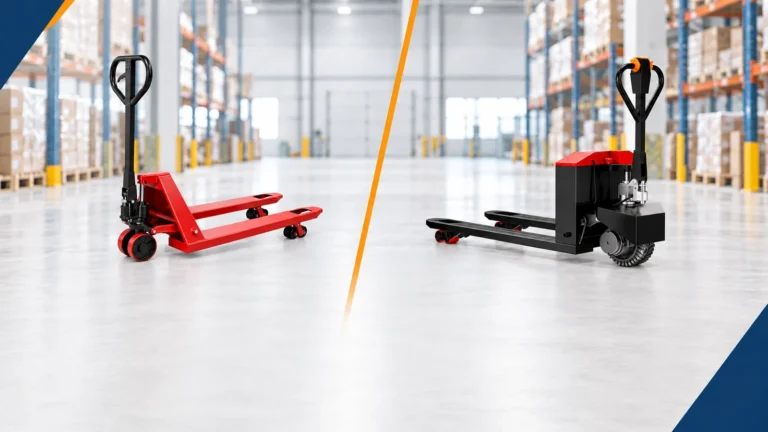
- Manual or electric pallet truck?
- Worked selection example
- Seven-step selection process
- Information to include in your RFQ
- Common selection mistakes
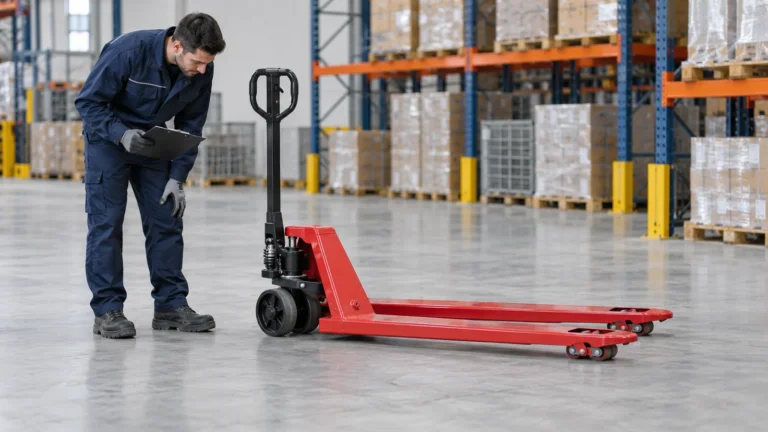
- Pre-use inspection and operating basics
- Frequently asked questions
What Is a Hand Pallet Truck?
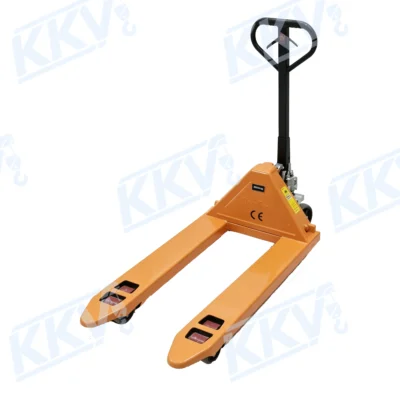
A hand pallet truck is a pedestrian-operated device used to raise a pallet slightly clear of the floor and move it horizontally over a short distance. It is also commonly called a manual pallet truck, manual pallet jack, hydraulic pallet truck, pump truck or pallet trolley.
The operator steers the truck with a tiller handle. Repeated handle strokes operate a hydraulic pump and raise the forks. A lowering control releases hydraulic pressure so the pallet can be placed back on the floor. Horizontal travel remains manual: the operator pushes, pulls and steers the truck without a drive motor.
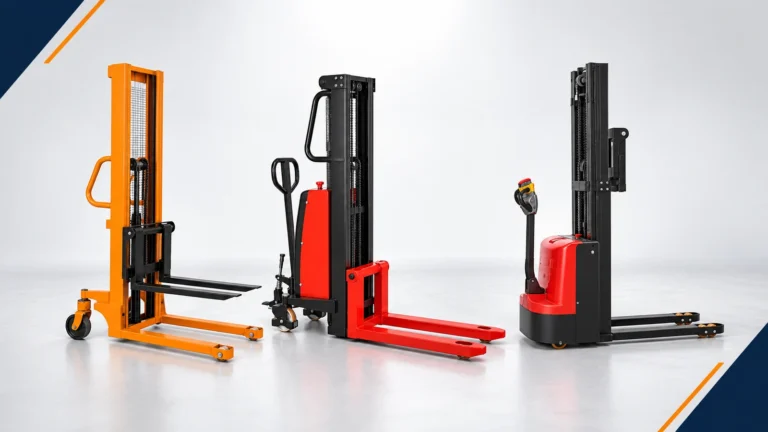
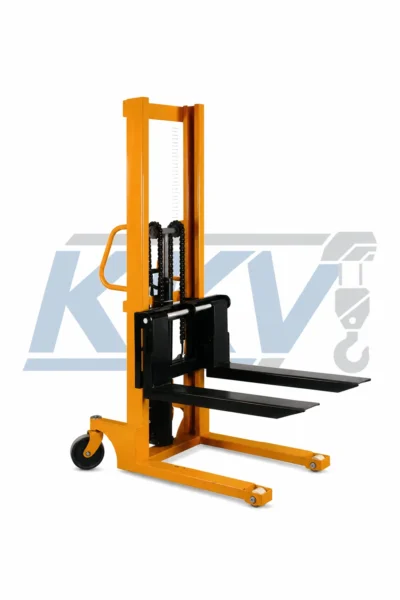
This is different from a pallet stacker. A hand pallet truck provides only the low lift needed for floor transport; it is not designed to raise pallets to racking or stack one load above another. If the application requires significant lifting height, evaluate the KKV pallet stacker range or a forklift designed for that function.
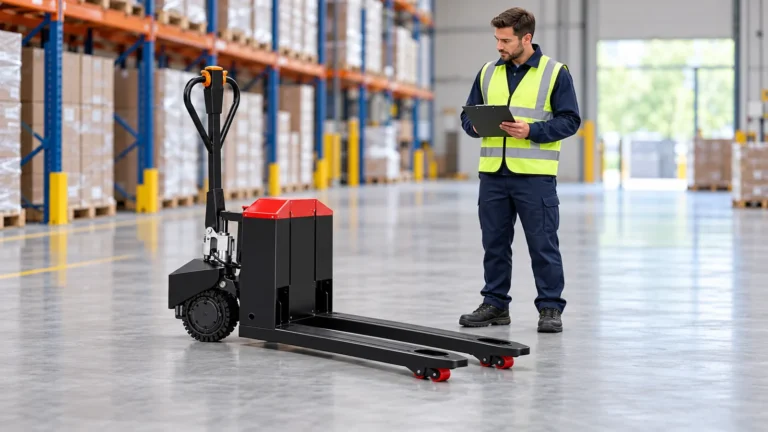
It is also different from a powered pallet truck. An electric pallet truck uses a drive motor for travel and normally powers the lifting function as well. Power can reduce operator effort in frequent, long-distance or higher-throughput work, but it adds battery, charger, control, braking, training and maintenance considerations.
When Is a Manual Pallet Truck Suitable?
A manual hydraulic pallet truck is often a practical starting point when:
- pallet movement is occasional or intermittent;
- travel distances are short;
- the route is level, hard, clean and in good condition;
- pallets have compatible fork-entry openings;
- loads are stable, palletized and within rated capacity;
- aisle and turning space allow pedestrian operation;
- the task does not require stacking or elevated placement;
- electricity, charging space or battery management is undesirable;
- simple operation and relatively straightforward maintenance are priorities.
A manual truck is not automatically the best choice merely because it can carry the stated load. Starting and stopping a heavy pallet, changing direction, crossing a joint or controlling the truck on a gradient can require substantial force. Floor condition, wheel material, route length and operator exposure may matter more than the capacity number alone.
Consider a powered solution when pallet movements are repeated throughout a shift, routes are long, throughput is important or a manual-handling assessment indicates excessive pushing and pulling. Gradients, loading docks and ramps require particular attention: use only equipment specifically approved for the route and operating conditions.
Define the Load, Pallet and Route First
The most reliable selection process begins with the application, not a catalogue model. Record three groups of information before comparing trucks.
The complete load
Confirm the maximum gross pallet weight, not only the weight of the goods. Include the pallet, containers, packaging and any fixtures that remain on the truck. Identify concentrated, liquid, unstable or offset loads because they may not behave like an evenly distributed unit load.
Rated capacity assumes the truck is used within the conditions specified by its manufacturer. A capacity label is not permission to carry the same mass in every position or distribution. If the center of gravity is unusual or the load extends far beyond the pallet, provide a drawing and obtain written confirmation from the supplier.
The pallet
Record the pallet length, width, entry direction, entry height and internal spacing. Check whether it is two-way or four-way entry and whether it has closed bottom boards, blocks, stringers or other features that can interfere with fork tips and load rollers.
Measure the actual pallet population, including damaged or non-standard pallets, rather than relying only on a nominal regional pallet size. The outside fork width must fit between or around the relevant pallet members, the lowered fork height must pass beneath the deck, and the load rollers must travel through the pallet without striking the base boards.
The complete route
Walk the route from pickup to set-down. Measure aisle width, doorway width, turning corners, lift entrances and staging space. Note floor joints, thresholds, drainage channels, dock plates, debris, surface damage, moisture, oil, temperature and any gradient.
The route should be assessed in both directions and under realistic traffic conditions. A truck may turn inside an empty aisle but become difficult to use when racks, guards, stored goods or other pedestrians reduce the available space.
Eight Hand Pallet Truck Selection Factors
1. Rated capacity and load distribution
Choose a truck whose rated capacity is not below the maximum complete pallet load. Never plan routine operation above the nameplate rating, and do not treat a relief valve as additional usable capacity.
Capacity is only the first screening value. Also confirm:
- the maximum gross pallet weight;
- the position of the combined center of gravity;
- whether the load is evenly distributed or concentrated;
- whether the load is stable and restrained where necessary;
- the manufacturer’s specified load center and operating limits;
- the condition and rated suitability of the pallet itself.
Avoid selecting by average weight. If most pallets weigh 800 kg but some reach 1,800 kg, the selection must address the actual maximum or the heavier loads must be kept out of that workflow by a reliable control.
Choosing a very high capacity does not solve every problem. A heavier-duty truck can be larger or heavier and may still be difficult to move manually on a poor floor. Select capacity together with route, wheels and duty.
2. Pallet entry and outside fork width
Fork width is normally quoted as the total outside width across both forks, but quotation drawings should confirm the definition. It must match the pallet entry arrangement and provide stable support without contacting blocks or stringers.
A narrow fork arrangement may enter some pallets more easily, while a wider arrangement can better match other pallet bases. Neither is universally correct. Measure:
- the clear width of each fork pocket;
- spacing between pallet blocks or stringers;
- the required direction of entry;
- whether bottom boards restrict roller movement;
- any variation between pallet suppliers.
Do not assume that a truck suitable for one common pallet format will fit every export pallet, rental-pool pallet or custom skid in the facility. If several pallet families are handled, list each one in the RFQ and confirm whether one truck configuration can cover all of them.
3. Fork length and load support
Forks must enter far enough to support the pallet securely without extending into an obstruction beyond it. Forks that are too short may leave the far side poorly supported. Forks that are unnecessarily long can strike adjacent pallets, rack members, walls or goods in a trailer.
Compare fork length with the dimension of the pallet parallel to the forks. UK HSE pallet guidance states that the forks of a handling device should extend into a pallet at least 75% of the dimension parallel to the forks; the pallet and equipment manufacturer may require more support for the specific application.
Also check whether fork tips or rollers can damage closed base boards. Pallet openings, chamfers and roller positions must work together throughout entry, lifting and withdrawal.
4. Lowered fork height and usable lift
The lowered fork height determines whether the truck can enter beneath the pallet deck. Measure the smallest actual entry height with the pallet unloaded and loaded, allowing for sagging, damaged boards and floor irregularity.
Do not select a low-profile truck only from a catalogue label. Confirm the complete drawing because fork thickness, roller diameter and pallet geometry interact. A truck can have low forks yet still encounter a pallet cross-member or base board.
The raised fork height or lift travel only needs to clear the floor for transport. A pallet truck should normally travel with the load kept low. If the task needs the pallet raised to a workstation, machine, rack or another pallet, a low-lift pallet truck is the wrong equipment category.
5. Steering-wheel material
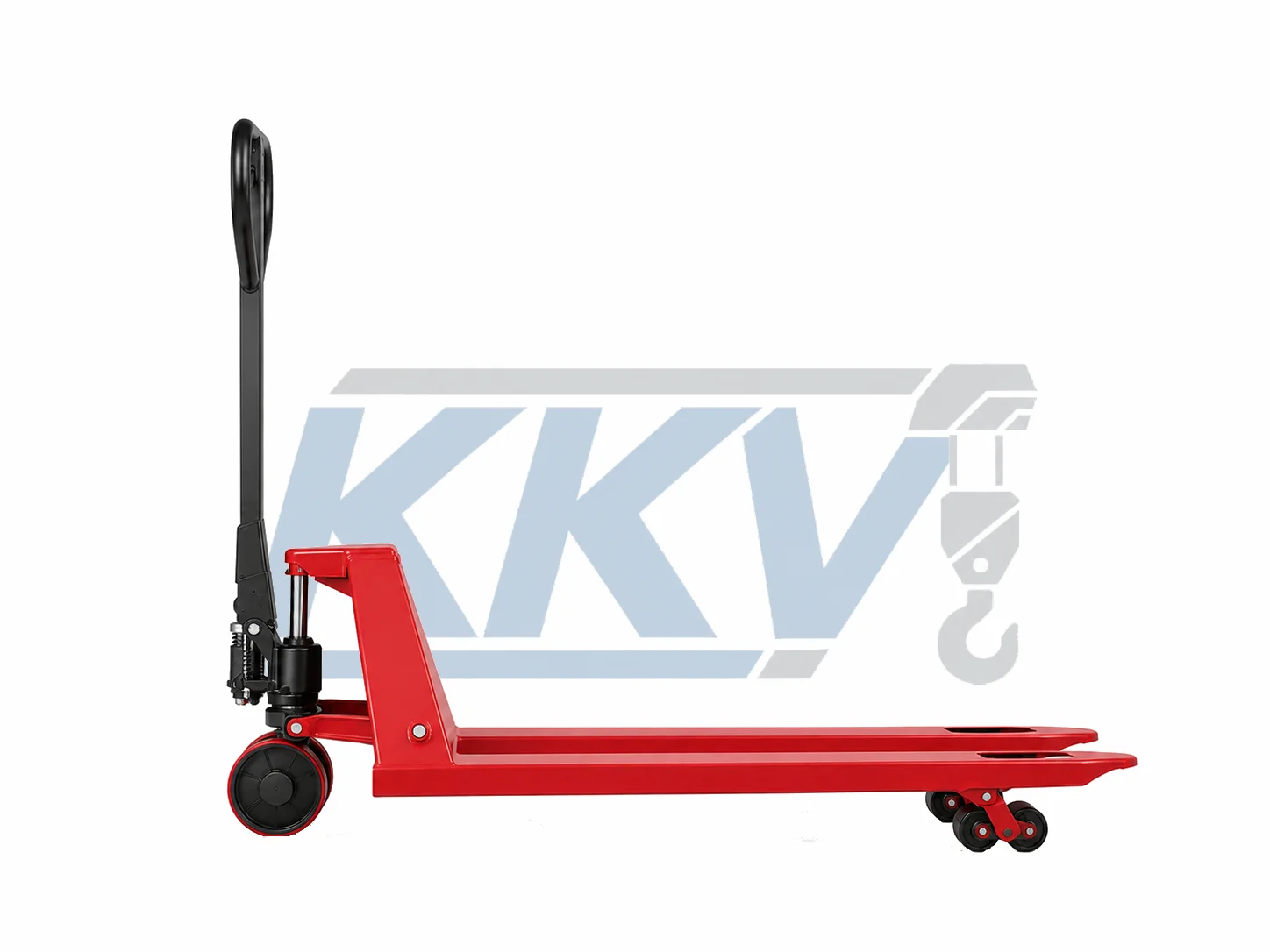
The larger wheels below the handle carry and steer the rear of the truck. Their material affects rolling resistance, noise, grip, floor marking, shock transmission and resistance to wear or contaminants.
Nylon, rubber and polyurethane are common choices, but the exact compound and construction vary. Do not rely only on the material name. Tell the supplier about floor finish, debris, moisture, oil, temperature, hygiene rules and required noise level.
6. Single or tandem load rollers
The smaller rollers near the fork tips pass through the pallet and carry the front of the load. They may be supplied as a single roller per fork or as a tandem pair.
Tandem rollers can spread contact and may cross small joints or transitions more smoothly. Single rollers can suit compatible pallets and straightforward smooth-floor operation. The correct option depends on pallet base-board geometry, entry direction, floor transitions and available fork profile.
More rollers do not automatically make a truck suitable for damaged floors or large thresholds. Avoid routes that shock the load or pallet, and verify any transition with the manufacturer rather than treating the rated capacity as an impact rating.
7. Floor, aisle, turning space and gradients
A hand pallet truck performs best on a firm, level and reasonably smooth surface. Rough concrete, cracked joints, metal thresholds, dock plates and debris increase rolling force and shock. Soft, wet, oily or contaminated surfaces can reduce control.
Measure the complete truck-and-pallet envelope. Turning space depends on fork length, pallet size, handle position and the path the load must follow—not simply the truck’s overall width. Check doorways and lift cars with the pallet loaded.
Treat ramps and gradients as a separate application. A manually moved load can run away or become impossible to stop. Never assume a manual pallet truck is acceptable on a slope. Obtain the equipment manufacturer’s limits, conduct a site risk assessment and use a powered/braked alternative where appropriate.
8. Travel distance, frequency and operator effort
Record the distance per trip, trips per hour, hours per shift, maximum load and number of operators. A manual truck that is reasonable for five short movements may be unsuitable for continuous dispatch work.
Operator effort is influenced by more than mass:
- wheel material and diameter;
- bearing and wheel condition;
- floor hardness, joints and gradient;
- the force needed to start, stop and turn;
- route congestion and visibility;
- ambient temperature and required protective clothing;
- total exposure across the shift.
Where pushing or pulling forces may be high, complete an ergonomic or manual-handling assessment using the rules applicable at the site. The HSE pushing and pulling assessment guidance illustrates why load, route, floor and frequency must be considered together. Do not solve an excessive-force problem by buying a higher-capacity manual truck. A powered pallet truck, route repair or process change may be the appropriate control.
How to Choose Pallet Truck Wheel Material
Wheel selection is an application decision. The table below is a starting point, not a substitute for confirming the exact wheel compound with the supplier.
| Wheel material | Typical reasons to consider it | Points to verify before ordering |
|---|---|---|
| Nylon | Low rolling resistance on smooth hard floors; durable in many clean indoor applications | Can be noisier and transmit more shock; verify floor marking, joints, debris, moisture and chemical exposure |
| Rubber | Quieter running, cushioning and useful grip in some indoor conditions | Usually higher rolling resistance; verify wear, load rating, floor marking and resistance to oils or contaminants |
| Polyurethane (PU) | A common balance of floor protection, noise, wear and rolling performance | Compounds differ; check cuts, embedded debris, heat, moisture, chemicals and the required load rating |
The steering wheels and fork-end load rollers do not always need to use the same construction. Ask the supplier to specify the complete wheel set, including material, dimensions, bearings and single or tandem arrangement.
Smooth sealed floors
On a clean, hard and level warehouse floor, low rolling resistance may be a priority. Nylon or an appropriate polyurethane may be considered, subject to noise and floor-protection requirements.
Noise-sensitive or finished-floor areas
Rubber or an appropriate polyurethane may reduce noise and shock compared with a hard nylon wheel. Confirm that the chosen material will not mark the actual floor coating.
Joints, thresholds and imperfect surfaces
No wheel material converts a pallet truck into rough-terrain equipment. Larger or tandem rollers may improve some small transitions, but damaged floors and abrupt thresholds should be repaired or avoided. Test the proposed wheel configuration under representative conditions before fleet purchase where possible.
Cold, wet, oily or chemical environments
Material names alone are insufficient. Request compatibility data for the exact compound, bearings, grease, seals, paint and hydraulic system. A standard warehouse truck is not automatically suitable for cold stores, washdown areas, corrosive plants, food-production hygiene zones or hazardous atmospheres.
KKV Manual Pallet Truck Configurations
KKV’s current ORM-HP Manual Hydraulic Pallet Truck range lists the following standard selection options. These values describe published KKV configurations; final availability and compatibility should be confirmed in the quotation.
| Selection item | Published KKV options | What the buyer should confirm |
|---|---|---|
| Rated capacity | 2,000 kg, 2,500 kg or 3,000 kg | Maximum complete pallet weight, load distribution and required margin within the manufacturer’s rules |
| Operating type | Manual travel with manual hydraulic lifting | Trip distance, frequency, floor and acceptable operator effort |
| Listed fork-width option | 550 mm or 685 mm | Confirm the supplier’s width definition, then check pallet pockets, blocks, stringers and required entry direction |
| Fork length | 1100 mm or 1200 mm | Pallet length parallel to forks, support and clearance beyond the pallet |
| Lowered fork height | 75 mm or 85 mm | Minimum real pallet opening and base-board geometry |
| Load-roller arrangement | Single or double | Pallet base, floor joints, transitions and entry clearance |
| Wheel materials | Nylon, rubber or polyurethane | Floor, noise, rolling resistance, marking and environmental exposure |
| Supply options | KKV states that applicable configurations are CE-certified; OEM and ODM options are available | Exact model, destination requirements, configuration-specific compliance documents, marking, packaging and agreed customization |
The correct combination cannot be selected from one row in isolation. For example, a 685 mm fork width may fit one pallet family but conflict with another, and a 75 mm low-entry configuration must still be checked against roller and base-board geometry.
For a broader view of the available range, visit the KKV pallet truck category.
Manual vs Electric Pallet Truck
Manual and electric pallet trucks perform the same basic low-lift transport function, but they create very different operating systems.
| Question | Manual hydraulic pallet truck | Electric pallet truck |
|---|---|---|
| Travel and lifting | Manual travel; lifting by hydraulic handle pumping | Powered travel and powered lifting on the KKV EPT range |
| Best starting point | Occasional, short-distance movement on a suitable level floor | Frequent movement, longer routes or duties where powered travel reduces manual effort |
| Infrastructure | No traction battery or charger | Requires battery management, charging arrangements and electrical checks |
| Controls and braking | Pedestrian steering and manual movement; verify site procedure | Powered controls, braking and safety functions require model-specific familiarization and maintenance |
| Selection emphasis | Pallet fit, wheels, floor and acceptable pushing/pulling force | Pallet fit plus battery, motors, speed, turning radius, braking, controls and duty |
| Cost and complexity | Generally simpler equipment | Higher system complexity but potentially better productivity and ergonomics |
KKV currently publishes a 1.5–2.0 tonne EPT lithium electric pallet truck with powered travel and lifting. Standard published features include removable lithium-ion batteries, 1150 mm forks, 560 mm or 685 mm fork-width options, electromagnetic braking, emergency reverse and low-speed operation. Use the product data for model-level comparison rather than assuming an electric version matches every manual-truck dimension.
An electric truck is not automatically suitable for every route. Confirm turning radius, stopping, gradient capability, operator position, pedestrian interaction, battery charging, temperature, fire controls and applicable training requirements.
Worked Hand Pallet Truck Selection Example
Consider a distributor that needs to move palletized cartons from receiving to a staging area. The maximum verified gross pallet weight is 1,750 kg. Most trips are 25 metres on a level sealed-concrete floor, but the route crosses one narrow floor joint. The pallets are entered from the short side and their actual opening, block spacing and entry height have been measured.
The selection should proceed as follows:
- Capacity: A published KKV 2,000 kg configuration is the first capacity class above the stated load, but the supplier must still confirm load distribution and application limits.
- Fork width: Compare the measured clear pallet geometry with the 550 mm and 685 mm outside-width options. Do not choose from the pallet’s outside dimensions alone.
- Fork length: Compare the entry-direction pallet length with the 1100 mm and 1200 mm options, including support and clearance beyond the pallet.
- Entry height: Confirm whether the 75 mm or 85 mm lowered fork option enters every acceptable pallet without contact.
- Rollers and wheels: Discuss tandem load rollers for the floor joint and compare polyurethane, rubber and nylon against noise, rolling resistance and floor requirements.
- Maneuvering: Test the complete loaded pallet through the doorway and staging turn, not only the empty truck.
- Duty: Multiply 25 metres by the expected trips per shift. If the movement is frequent or pushing-force assessment is unfavorable, compare a powered truck before purchase.
This example does not produce a final model number because several essential pallet dimensions and duty values remain application-specific. A useful RFQ makes those variables explicit instead of hiding them behind the phrase “2 tonne pallet truck.”
Seven-Step Hand Pallet Truck Selection Process
Step 1: Record the heaviest complete pallet
Weigh or reliably calculate the goods, pallet, packaging and fixtures. Identify uneven, concentrated, liquid or unstable loads and provide the center-of-gravity information available.
Step 2: Measure every pallet format
Record length, width, entry direction, clear fork openings, block or stringer spacing, entry height and bottom-board arrangement. Photograph the top and underside and identify the pallets used most often.
Step 3: Map the route
Measure distance, aisle width, doorways, turns and lift interiors. Photograph joints, thresholds, dock plates and damaged floor areas. Record slopes, contamination and temperature.
Step 4: Select fork dimensions and entry profile
Compare outside fork width, fork length, lowered fork height, fork thickness and roller position with the measured pallet. Request a dimensional drawing when geometry is close.
Step 5: Choose wheels and load rollers
State the floor type, noise and marking requirements, debris, chemicals and transitions. Agree on steering-wheel material plus single or tandem load rollers; do not write only “PU wheels” without defining the full set.
Step 6: Confirm manual or powered operation
Calculate trips, distance and operator exposure. Consider starting, stopping and turning force. Where manual movement is excessive, compare an electric pallet truck or change the route and process.
Step 7: Confirm the exact supply and documents
Record model, capacity, fork dimensions, lowered and raised height, wheel configuration, finish, labels, manuals, declarations, inspection requirements, spare parts, warranty, packaging and destination standards in the quotation and order confirmation.
Hand Pallet Truck RFQ Checklist
| RFQ field | Example format | Why it matters |
|---|---|---|
| Maximum gross pallet weight | 1,750 kg including pallet and packaging | Screens rated capacity |
| Load description and distribution | Cartons, evenly distributed; drawing attached | Identifies concentrated or unstable loading |
| Pallet type and material | Four-way timber block pallet | Establishes entry and base-board geometry |
| Pallet dimensions | Length × width × height in mm | Supports fork and maneuvering review |
| Entry direction | Short-side entry | Defines dimension parallel to forks |
| Clear fork openings | Dimensioned underside drawing/photos | Confirms outside fork-width compatibility |
| Minimum entry height | Measured in mm, loaded and unloaded | Screens lowered fork height |
| Required fork length/width | Supplier to confirm from pallet drawing | Prevents catalogue assumptions |
| Floor and transitions | Sealed concrete; one 8 mm joint; no ramps | Guides wheel and roller selection |
| Aisle/door/turning space | Dimensions and route sketch | Confirms complete loaded envelope |
| Trip distance and frequency | 25 m each way; 12 trips/hour; 6 hours/day | Supports manual-versus-electric decision |
| Environment | Indoor, 5–35°C, dry; no chemicals | Screens materials and special protection |
| Wheel requirements | Noise-sensitive; non-marking to be confirmed | Defines steering and load-wheel needs |
| Required documents | Manual, declaration, inspection record, parts list | Aligns supply with project and destination |
| Order information | Quantity, destination, OEM branding and packaging | Supports a complete commercial quotation |
Attach a pallet underside photograph and route sketch. These two items often resolve more uncertainty than a long email that states only capacity.
Common Hand Pallet Truck Selection Mistakes
Choosing by tonnage alone
A truck can have sufficient rated capacity and still fail to enter the pallet, clear the base boards, turn in the aisle or roll acceptably on the floor. Capacity is one field in a complete application specification.
Using nominal pallet size instead of measuring openings
Two pallets with the same outside dimensions can have different blocks, stringers, bottom boards and entry clearances. Measure the underside geometry that the forks and rollers actually encounter.
Confusing outside fork width with individual fork width
Catalogue terminology varies. Confirm the dimensional drawing and define whether the quoted width is across both forks, between forks or the width of one fork.
Selecting forks that are too short or unnecessarily long
Short forks can provide inadequate support. Excessively long forks can protrude beyond the pallet and strike nearby goods or structures. Match length to the pallet and route.
Ignoring lowered fork height
Low-entry pallets, sagging decks and bottom boards can prevent entry even when fork width and length appear correct. Check the entire entry profile.
Treating wheel material as a cosmetic option
Wheel choice affects operator force, noise, shock, grip, marking and wear. State floor and environmental conditions rather than choosing only by color or price.
Assuming tandem rollers make every rough route acceptable
Tandem rollers may improve some small transitions but do not justify broken floors, large steps or impact loading. Repair or redesign unsuitable routes.
Buying a larger manual truck to solve an ergonomics problem
Higher capacity does not provide powered travel. If the job requires excessive force or repeated long-distance movement, assess an electric truck or process change.
Assuming “manual” means no environmental restrictions
Hydraulic seals, lubricants, wheels, bearings, paint and steel components still have environmental limits. Confirm cold, heat, moisture, corrosion, washdown and hazardous-area requirements.
Ordering before confirming documentation
The required manual, declaration, test or inspection records, labels, language, spare parts and destination-specific documents should be agreed before production and shipment.
Hand Pallet Truck Inspection and Operation
Selection does not replace inspection, maintenance or operator instruction. Follow the manufacturer’s manual, site procedure and applicable requirements for the exact truck.
Before use, check at least the following:
- capacity and warning markings are present and legible;
- forks, tips, frame and welds show no obvious bending, cracking or damage;
- steering wheels and load rollers rotate freely and are not badly worn, cut or obstructed;
- axles, fasteners and visible retaining parts appear secure;
- the handle, steering and control lever operate correctly;
- the hydraulic system raises, holds and lowers smoothly without visible leakage;
- the pallet is sound, appropriate for the load and free from serious damage;
- the load is stable, centered and restrained where needed;
- the planned route is clear of people, debris and new hazards.
Enter the pallet squarely and make sure the forks are correctly positioned beneath it. Raise only enough to clear the floor, keep feet and hands away from wheels and pinch points, and travel at a speed that allows control. Do not carry passengers, stand on the forks, lift people or use the truck as a scooter.
Avoid sudden turns, stops and impacts. Visibility must be maintained; if the load blocks the view, use an approved site method such as changing the direction of travel or using a spotter. There is no universal push-or-pull rule for every maneuver, so follow the manufacturer’s instructions and the site risk assessment.
At the destination, place the pallet on a stable surface, lower the forks completely and withdraw without catching the base boards. Park the truck in its designated level area with forks lowered and without obstructing walkways, exits or emergency equipment.
Remove the truck from service if it leaks, fails to lift or hold correctly, has damaged forks or wheels, behaves unpredictably or has an unreadable capacity plate. Repairs and adjustments should be performed by authorized personnel using approved parts.
Frequently Asked Questions
What is the difference between a hand pallet truck and a pallet jack?
In most English-language material-handling contexts, the terms describe the same low-lift pallet-moving device. “Pallet truck” is widely used internationally, while “pallet jack” is especially common in North America. “Pump truck” and “pallet trolley” are also used.
What capacity hand pallet truck do I need?
Choose a rated capacity that is not below the heaviest complete pallet, including pallet and packaging. Then confirm load distribution, center of gravity, pallet condition and the manufacturer’s operating assumptions. Do not select from goods weight or average load alone.
Is a 2 tonne pallet truck suitable for every 2 tonne pallet?
No. The exact load may be uneven or concentrated, and pallet entry, fork dimensions, floor, route and operating force may still be unsuitable. The supplier needs the complete application, not only a matching number.
How do I measure pallet truck fork width?
First confirm how the manufacturer defines the dimension. For many trucks it is the total outside width across both forks. Measure the clear pallet openings and block or stringer spacing, then compare them with the supplier’s dimensional drawing.
Should pallet truck forks be the same length as the pallet?
They should provide adequate support without creating harmful projection or interference. HSE guidance gives at least 75% entry along the dimension parallel to the forks as a general handling-device benchmark, but the pallet and truck manufacturer may require more for the application.
What lowered fork height do I need?
Measure the smallest real entry height of every pallet type, including loaded, sagging and worn examples. Select a lowered profile that enters without striking the pallet base, and confirm fork thickness and roller geometry on the drawing.
Are nylon, rubber or polyurethane wheels best?
There is no universal best material. Nylon can offer low rolling resistance on smooth hard floors; rubber may reduce noise and shock; polyurethane often provides a balance. Exact compounds differ, so confirm load, floor, noise, marking and environmental requirements.
Should I choose single or tandem load rollers?
Tandem rollers may cross small joints and transitions more smoothly and spread contact, while single rollers may suit compatible pallets and smooth floors. Check pallet bottom boards, entry height, roller position and the actual route.
Can a manual pallet truck be used on a ramp?
Do not assume so. Heavy manually moved loads can become uncontrollable on gradients. Use only equipment approved for the slope and complete a site risk assessment. A powered truck with suitable braking may be necessary.
Can a pallet truck lift a pallet into racking?
No. A standard hand pallet truck raises a pallet only enough for low-level transport. Use a suitable pallet stacker or forklift when elevated placement or stacking is required.
When should I choose an electric pallet truck?
Compare electric operation when movements are frequent, routes are long, throughput is important or manual starting, stopping and turning forces are excessive. Battery, charger, braking, controls, training and route suitability must then be included in the selection.
How often should a hand pallet truck be inspected?
Carry out the pre-use checks required by the manufacturer and site. Periodic inspection and maintenance intervals should reflect the manual, utilization, environment, condition and applicable local rules. Keep records where required.
Can KKV customize fork sizes and wheels?
KKV publishes 550 mm and 685 mm fork widths, 1100 mm and 1200 mm fork lengths, 75 mm and 85 mm lowered heights, single or double load-roller options, and nylon, rubber or polyurethane wheels for the ORM-HP range. Other OEM or ODM requirements should be confirmed in the quotation.
Specify the Pallet and Route, Not Just the Capacity
The most useful pallet-truck enquiry combines the maximum complete load with a dimensioned pallet drawing, fork-entry measurements, route plan, floor description, trip distance, movement frequency, environmental conditions and required documents.
KKV can compare the published manual hydraulic pallet truck configurations and the EPT electric pallet truck against that information. Final suitability depends on the exact approved configuration and operating conditions, so values should be confirmed in the quotation and dimensional drawing.
For selection support, email sales@kkvhoist.com with the completed RFQ information above.
Safety note: This article is a general product-selection guide, not a substitute for the manufacturer’s instructions, a site-specific risk assessment, operator training, inspection by a competent person or applicable laws and standards. Never exceed rated capacity, lift people, carry passengers, use damaged pallets or equipment, or operate on gradients and surfaces outside the approved conditions.