How to Choose a Crane Fork: Capacity, Load Centre, Pallet Fit and Balancing
Choosing a crane fork starts with the palletized load and its centre of gravity, not simply the largest tonnage in a catalogue. The attachment must support the load in its approved position, fit the pallet openings, provide enough usable height and balance correctly across the intended load range.
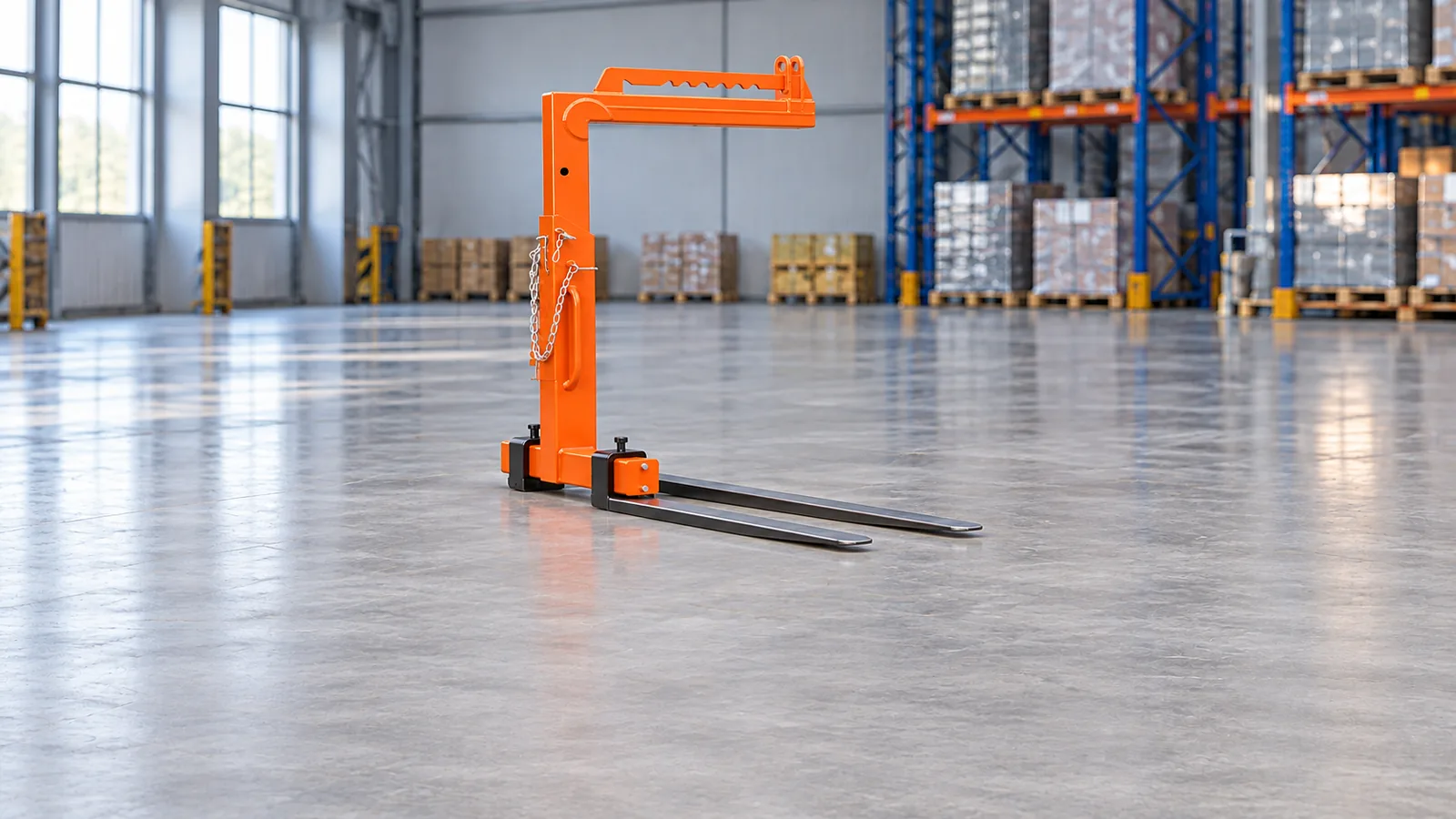
A crane fork, also called a crane pallet fork, is suspended from lifting equipment. It is different from a pallet truck, a pallet stacker or an attachment mounted on forklift tines. This guide focuses on that crane-suspended arrangement and the KKV YLG product range.
Quick answer: Establish maximum and minimum pallet-load mass, centre-of-gravity position, pallet entry geometry and cargo height. Confirm the exact crane fork’s rated load centre, capacity, usable dimensions, balancing mechanism and any minimum operating load. Then verify the complete suspended mass, hook connection, load restraint and lifting route. Self-balancing does not mean that an unsecured load is safe, and a nominal capacity does not approve every load position.
Table of contents
- Identify the correct type of attachment
- Check capacity, load centre and suspended mass
- Measure the pallet and fork interface
- Separate usable height from crane headroom
- Compare manual and automatic balancing
- Compare the KKV YLG models
- Specify restraint, containment and the route
- Work through a pallet-load example
- Prepare a focused specification request
- Frequently asked questions
- Technical references
Identify the Correct Type of Attachment
A crane fork places two tines beneath a compatible pallet or load while an upper suspension point connects the assembly to a crane or other approved lifting equipment. The upright and upper arm provide space around the cargo; the suspension arrangement establishes the attachment’s working attitude.
It does not have the same support conditions as a ground-running pallet truck. The pallet and goods become part of a suspended-load operation, so overhead clearance, load retention and the area beneath the route need separate attention.
If the job is moving pallets along a warehouse floor, the hand pallet truck selection guide addresses a different equipment choice. Do not choose a crane fork merely because a pallet can be lifted by a pallet truck.
Define pickup and landing points before comparing models. State whether the pallet remains in one orientation, whether goods are fully unitized, and whether there are restricted openings or people near the route. These details can determine that another handling method is needed.
Check Capacity, Load Centre and Complete Suspended Mass
Use the gross pallet load
The fork attachment supports more than the saleable contents. Include the pallet, packaging, fixtures and anything else carried on the tines when establishing its applied load. Obtain a verified mass rather than relying on a nominal pallet description.
Use the exact rated units and configuration. A capacity marked for the complete attachment is not a separate allowance for each tine. Proof-load or breaking-load figures, where supplied, do not provide extra working capacity.
Locate the centre of gravity
The longitudinal load centre describes where the load acts along the tines, measured from the datum defined by the manufacturer. A uniform load may have its centre near its geometric midpoint; machinery, partly filled containers and uneven packages may not.
Also identify sideways offset and the height of the centre of gravity. Two pallets with the same total mass can behave differently if one is tall or has most of its weight on one side.
The Star Industries crane-forks manual illustrates that its rating is tied to a specified load centre, balanced loading and tine configuration. Those values belong to that product, not to KKV.
KKV’s public YLG table does not state a rated load-centre distance or load chart. Send the actual loading sketch and obtain the approved limits. Do not assume that the listed 1,000 mm fork length establishes a 500 mm rated centre, or use a homemade capacity-ratio formula to approve a different position.
Account for what the crane carries
The supporting crane carries the fork attachment itself as well as the pallet load and applicable connection equipment. Check the manufacturer’s load-chart method for the actual radius, configuration and suspended equipment. Avoid both omitted items and double-counting items already included in the chart’s definitions.
The Probst PGH instructions distinguish the attachment’s own mass, accessories and carried goods when assessing the lifting equipment. A crane-fork payload rating alone does not establish crane capacity.
Measure the Pallet and Fork Interface
Start with a pallet drawing or measured entry view. “Standard pallet” is not enough: entry direction, underside boards, blocks, fork pockets and pallet condition all affect access and support.
| Dimension or condition | Information to provide | Selection question |
|---|---|---|
| Entry direction | Which face of the pallet the tines enter | Can the approved fork arrangement enter from that side? |
| Clear openings | Width, height and obstructions beneath the pallet | Do both tines fit without contact or forced entry? |
| Tine arrangement | Required support positions and available spacing | Can the tines be placed and locked at suitable locations? |
| Required support length | Pallet depth and load support geometry | Is the usable tine length suitable without prohibited projection? |
| Pallet condition | Material, construction and damage status | Is this pallet suitable for the proposed suspended handling method? |
Distinguish outside-to-outside width, inside gap and centre-to-centre spacing. A supplier’s field called “fork width” may refer to only one of these. Ask for a dimensioned drawing rather than converting it by assumption.
The KKV table labels its adjustable dimension as Fork Width (b). This article preserves that label; it does not redefine it as centre spacing or clear gap. Tine cross-section and locking arrangements also need checking against the actual pallet opening.
Describe the intended support under the pallet, not just whether the fork tips can enter. A damaged pallet or inadequate underside support is not resolved by ordering a stronger attachment. The responsible planner must approve the complete load-support arrangement.
Separate Usable Height from Crane Headroom
The cargo must fit within the attachment’s approved usable envelope. Record total loaded pallet height, including the pallet and any top projections. Check clearance to the upper arm and any moving suspension or balancing parts.
Effective height and hook height are different dimensions. In KKV’s table, h is described as effective height and h1 as hook height. Neither is the crane’s lifting travel. A dimensioned drawing must establish their measurement datums and any required operating clearances.
Do not order from a cargo-height number alone. The hook, connector, upper arm and crane hook block occupy space above the load. The complete arrangement must clear doors, racks, scaffolding or structural members along the route and at the landing point.
When a mast or height adjustment is provided, identify the permitted settings and locking components. Do not assume the largest advertised adjustment can be used while suspended or under load. Obtain the exact setting procedure and approved combination of height, fork width and load.
Compare Manual and Automatic Balancing
Manual balancing
A manual arrangement requires the designated suspension position to be selected as the product’s instructions specify. The correct position depends on the load and approved geometry, not simply a repeated notch number used for yesterday’s pallet.
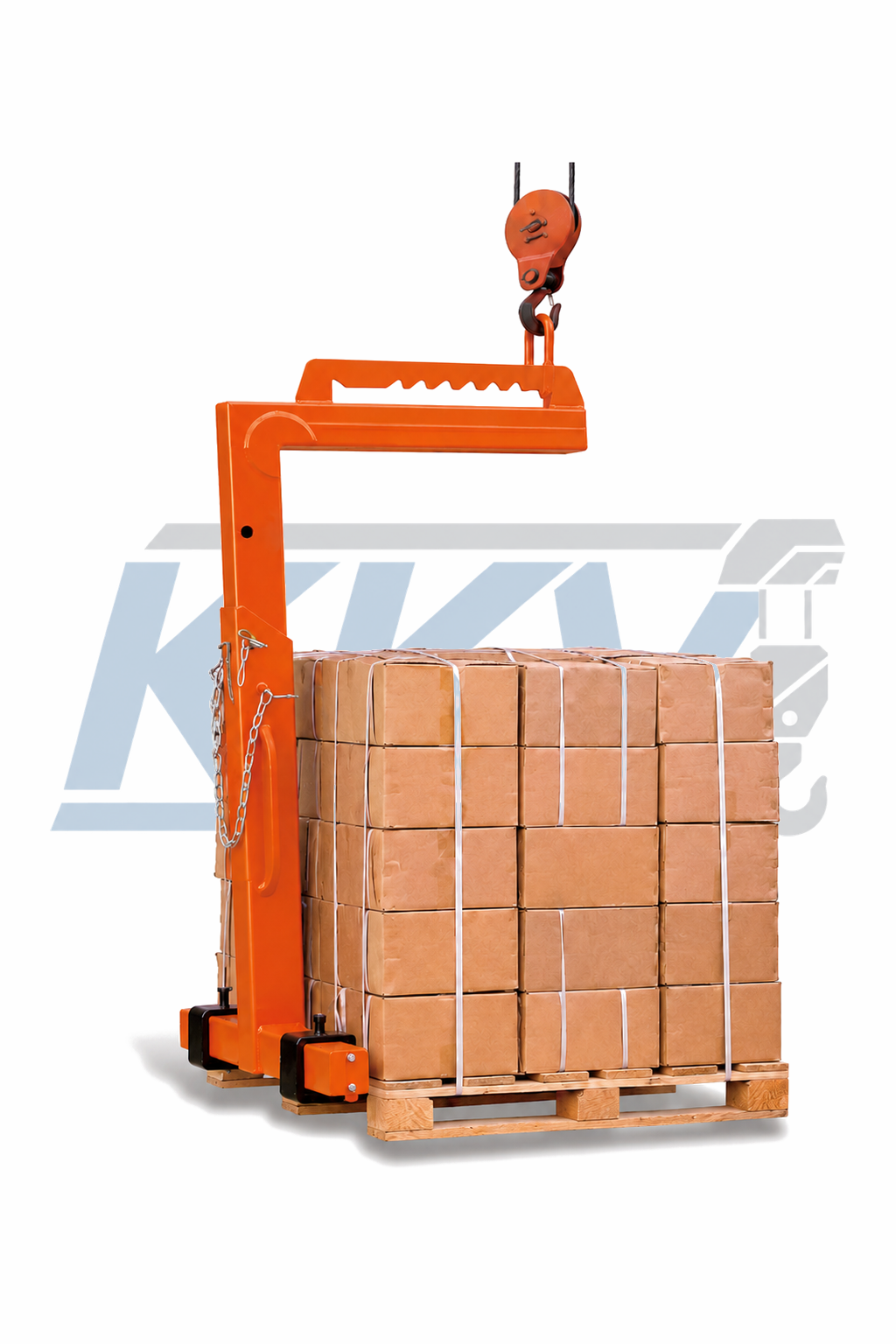
The CMCO Tigrip TKG vh manual describes a manually positioned suspension eye and positively locked dimensional adjustments. Do not transfer its settings or centre-of-gravity limits to another attachment.
For procurement, ask how often load dimensions change and who will perform the permitted adjustments. A manual arrangement may be practical for a controlled repeated task, but the manual configuration still needs approval for the load range.
Automatic balancing
An automatic arrangement changes the suspension relationship through its designed mechanism. Some products need a minimum load before the mechanism operates correctly, making the lightest pallet as important as the heaviest one.
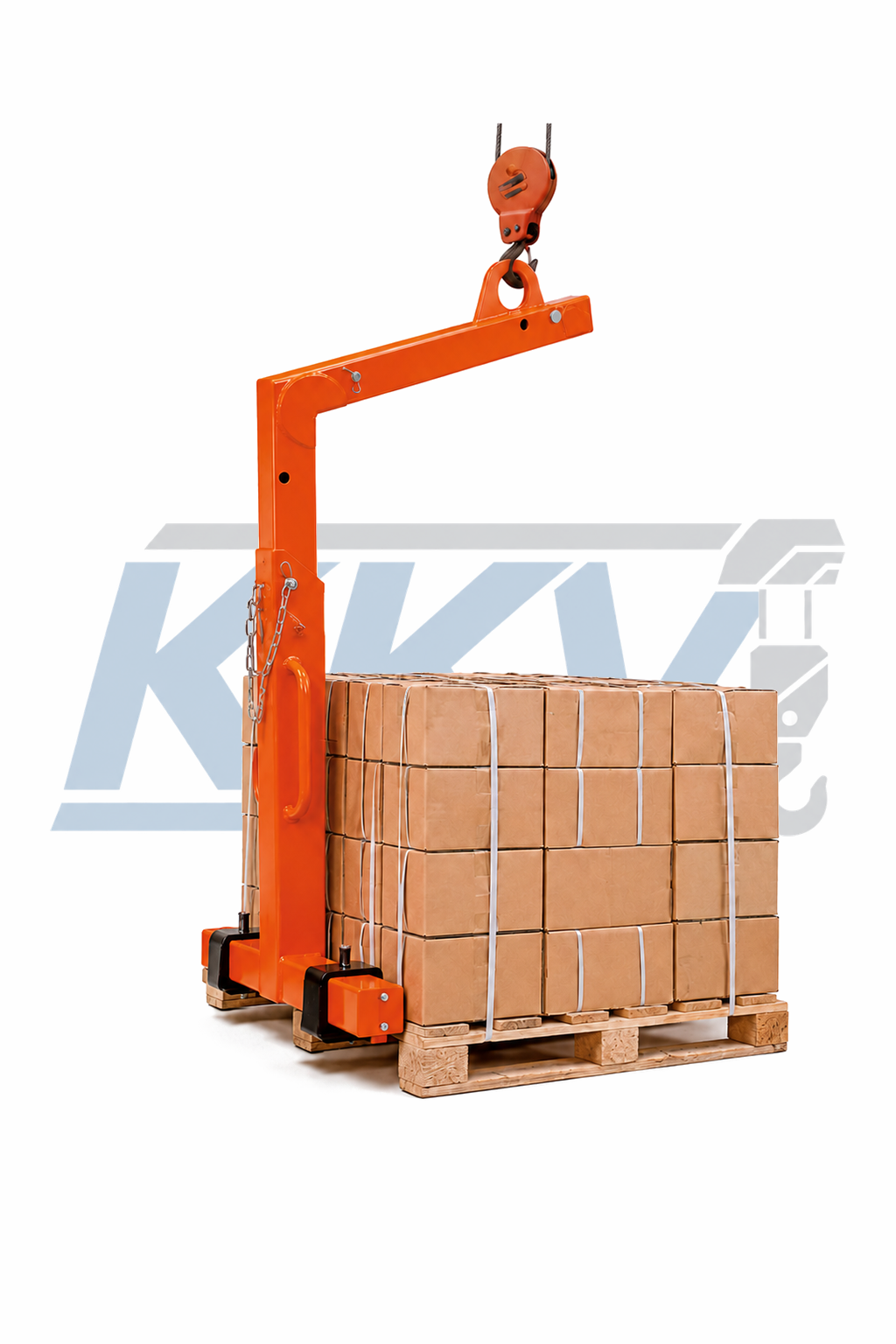
The CMCO TKG vhs manual and Haklift crane-fork manual specify minimum-load requirements for their own families. Their percentages must not be presented as KKV limits.
Request the minimum and maximum load, permissible load-centre range, required starting condition and behavior after set-down for the offered unit. A product being described as self-balancing does not prove it will level every load, compensate for all eccentricity or secure loose cargo.
KKV’s public page contains images labelled manual balancing and self-balancing, but does not explicitly map those mechanisms to every YLG and YLG-T model. Obtain written model-level confirmation rather than assigning the mechanism from a suffix or picture.
Compare the KKV YLG Models
The current KKV crane-fork product page lists the following configurations. All listed fork lengths are 1,000 mm. Dimensions are in millimetres; capacity and net weight are in kilograms.
| Model | Capacity | Fork width b | Effective height h | Hook height h1 | Net weight |
|---|---|---|---|---|---|
| YLG01 | 1,000 | 350–900 | 1,100–1,600 | 1,390–1,890 | 130 |
| YLG02 | 2,000 | 400–900 | 1,300–2,000 | 1,640–2,340 | 200 |
| YLG03 | 3,000 | 450–900 | 1,300–2,000 | 1,670–2,370 | 250 |
| YLG05 | 5,000 | 530–1,000 | 1,300–2,000 | 1,700–2,400 | 370 |
| YLG1T | 1,000 | 350–900 | 1,100–1,600 | 1,420–1,920 | 140 |
| YLG2T | 2,000 | 400–900 | 1,300–2,000 | 1,655–2,355 | 220 |
| YLG3T | 3,000 | 450–900 | 1,300–2,000 | 1,720–2,420 | 280 |
| YLG5T | 5,000 | 530–1,000 | 1,300–2,000 | 1,710–2,410 | 380 |
These figures identify candidates, not a complete lifting approval. Obtain the rated load centre, minimum balancing load where applicable, drawing, exact balancing mechanism and suitable restraint configuration before selecting a unit.
One overall-dimension entry for YLG1T is inconsistent on the public page. This guide therefore does not reproduce that entry or substitute a guessed height. Ask for a corrected drawing and quotation. Also confirm that the quoted unit’s own mass includes the components supplied for your configuration.
Specify Load Restraint, Containment and the Route
Separate balance from load security
The balancing system concerns the attitude of the fork attachment. Load restraint concerns movement or loss of the goods or pallet. Containment concerns items that could escape from the load. These are related but separate purchasing questions.
Ordinary packaging straps or stretch wrap are not automatically a complete overhead-lifting restraint system. Specify whether goods are firmly unitized, whether anything could become loose, and which approved securing components or additional containment the manufacturer requires for the operation.
A catalogue image showing a loaded pallet does not establish that the pictured straps, chain or pallet are sufficient for your workplace. Likewise, a statement that no additional lifting sling is needed for a particular connection must not be read as permission to omit required load securing.
Check the complete route and landing point
Provide travel clearance, pickup and set-down surfaces, planned lifting height and relevant site conditions. Identify any route near occupied areas or edges where falling items would create additional risk. Keep people out of the danger area; never use crane forks to lift people or pass a load over people.
The receiving point must support the load and permit the approved withdrawal of the attachment. Allow space for the fork frame, not just the pallet footprint. Plan communications and handling from the designated safe positions instead of treating operation from a cab as permission to skip inspection or securing.
Before service, confirm the supplied inspection and maintenance instructions for the tines, upright, suspension point, balancing parts, setting pins and retaining devices. Unreadable identification, deformation, suspected cracking or defective locking requires assessment before use. No universal wear percentage or test interval is supplied here.
Work Through a Pallet-Load Example
Assume the following masses have been established for an inquiry. They are an illustration, not a recommendation to lift this arrangement.
| Item | Example mass | Where it belongs in the assessment |
|---|---|---|
| Goods | 1,650 kg | Applied pallet load |
| Pallet | 50 kg | Applied pallet load |
| Packaging carried with the load | 20 kg | Applied pallet load |
| Total on the fork tines | 1,720 kg | Compare with the permitted attachment rating for the actual configuration |
| Candidate YLG02 own mass | 200 kg | Also carried by the crane |
| Subtotal of listed suspended items | 1,920 kg | Crane assessment also needs any additional applicable equipment and its load-chart rules |
A nominal 2,000 kg attachment may be a starting candidate because 1,720 kg is below that number. It is not yet an approved choice: the load centre, balance, pallet support, dimensions and securing arrangements still need verification. The crane’s capacity at the actual configuration must also be sufficient.
Now suppose the lightest routine pallet is only 150 kg including its contents and pallet. That value must also go into the inquiry if automatic balancing is proposed. A configuration acceptable for the maximum load may not meet its minimum operating requirement for the light load.
If the candidate changes from YLG02 to YLG2T, the published net weight changes from 200 to 220 kg. Update the suspended-mass assessment and recheck the offered mechanism and dimensions; equal payload ratings do not make the two configurations identical.
Prepare a Focused Crane-Fork Specification Request
Send information that resolves fit and balancing, rather than a general request for a “2-ton pallet fork.” The following compact checklist is specific to the crane-fork interface.
| Information | What to send |
|---|---|
| Load range | Heaviest and lightest complete pallet loads, with verified mass basis |
| Load geometry | Pallet/load drawing, centre-of-gravity position, height and uneven distribution |
| Entry and support | Entry side, openings, underside construction and required tine support positions |
| Balancing request | Manual/automatic preference; ask for exact mechanism and minimum-load confirmation |
| Suspension and crane | Hook/connector details, available headroom and crane configuration for the planner’s review |
| Load security | Unitized or loose goods; required securing/containment arrangement and site conditions |
| Technical confirmation | Rated load centre, approved operating envelope, drawings and instructions |
| Supply details | Quantity, destination and required identification, language and documents |
Keep uncertain fields marked as questions in the quotation. If the supplier offers a substitution, check it against the same drawing and load range, not only the nominal capacity. Retain the approved configuration with the operating documents.
Frequently Asked Questions
What is the difference between a crane fork and a forklift fork attachment?
A crane fork is suspended from a crane or other approved lifting equipment. A forklift-mounted attachment is supported by the truck’s forks and has different mounting, retention and truck-capacity requirements. Similar names do not make them interchangeable.
Does a 2-ton crane fork lift any pallet weighing less than 2 tons?
No. The permitted load also depends on the stated load centre, configuration, balancing conditions and support geometry. The pallet, goods, securing arrangement and crane must be suitable for the complete operation.
Is fork length the same as rated load centre?
No. Fork length describes a physical dimension; rated load centre defines an approved loading condition from a specified datum. Do not infer one from the other.
Can an automatic crane fork handle very light loads?
That depends on its mechanism and minimum operating load. Give the supplier the lightest intended complete pallet load as well as the maximum. Do not borrow another manufacturer’s minimum percentage.
Does self-balancing eliminate the need to secure the pallet load?
No. Attachment attitude, load restraint and containment are separate checks. Use the securing provisions and any additional containment required for the exact product, goods and operation.
Is the published effective height the maximum cargo height?
Not without checking the drawing and required clearances. Confirm the height datum, loaded pallet height, projections and space for moving components. It is not the crane’s lift height.
Which KKV series is manually balanced and which is automatic?
The public product text does not explicitly identify the mechanism for every listed model. Ask KKV to specify the actual suspension/balancing configuration in the quotation and drawing instead of deciding from the series suffix.
What if a catalogue dimension appears wrong?
Request a corrected drawing and written confirmation before ordering. Do not silently convert or replace a suspicious number. The YLG1T overall-height entry is one field requiring that confirmation.
Technical References
The guide uses current KKV data for model comparison and the following primary references for selection principles. Other manufacturers’ ratings, minimum loads, procedures and inspection schedules are not KKV specifications.
- KKV YLG crane fork: published models, dimensions and weights.
- Star Industries crane-forks manual: load-centre rating basis, securing, the loaded attachment and handling precautions.
- CMCO Tigrip TKG vh manual: manual balancing, geometry and locking arrangements.
- CMCO Tigrip TKG vhs manual: automatic-balancing conditions and separate load securing.
- Haklift crane-fork instructions: model-specific minimum load and load-retention requirements.
- Probst PGH instructions: complete attachment/accessory/load mass for carrier assessment.
Choose the Crane Fork Around the Actual Pallet Load
The useful starting specification combines load range, centre of gravity, pallet entry, tine support, usable height, suspension, balancing and load security. A capacity figure alone leaves too much unresolved.
Review the KKV YLG range with the pallet drawing and intended crane arrangement. Ask for a quotation that identifies the exact model, balancing mechanism, approved load-centre conditions, minimum load where applicable and required securing configuration.
For crane-fork information: Email sales@kkvhoist.com with the load and pallet details, or contact KKV.
Safety note: This is a product-selection guide, not a lift plan or operating authorization. Follow the exact supplied instructions, crane load chart, site procedure and applicable requirements. Have the complete operation assessed by competent personnel. Never lift people, move a load over people or operate with unverified load retention, balancing or capacity.