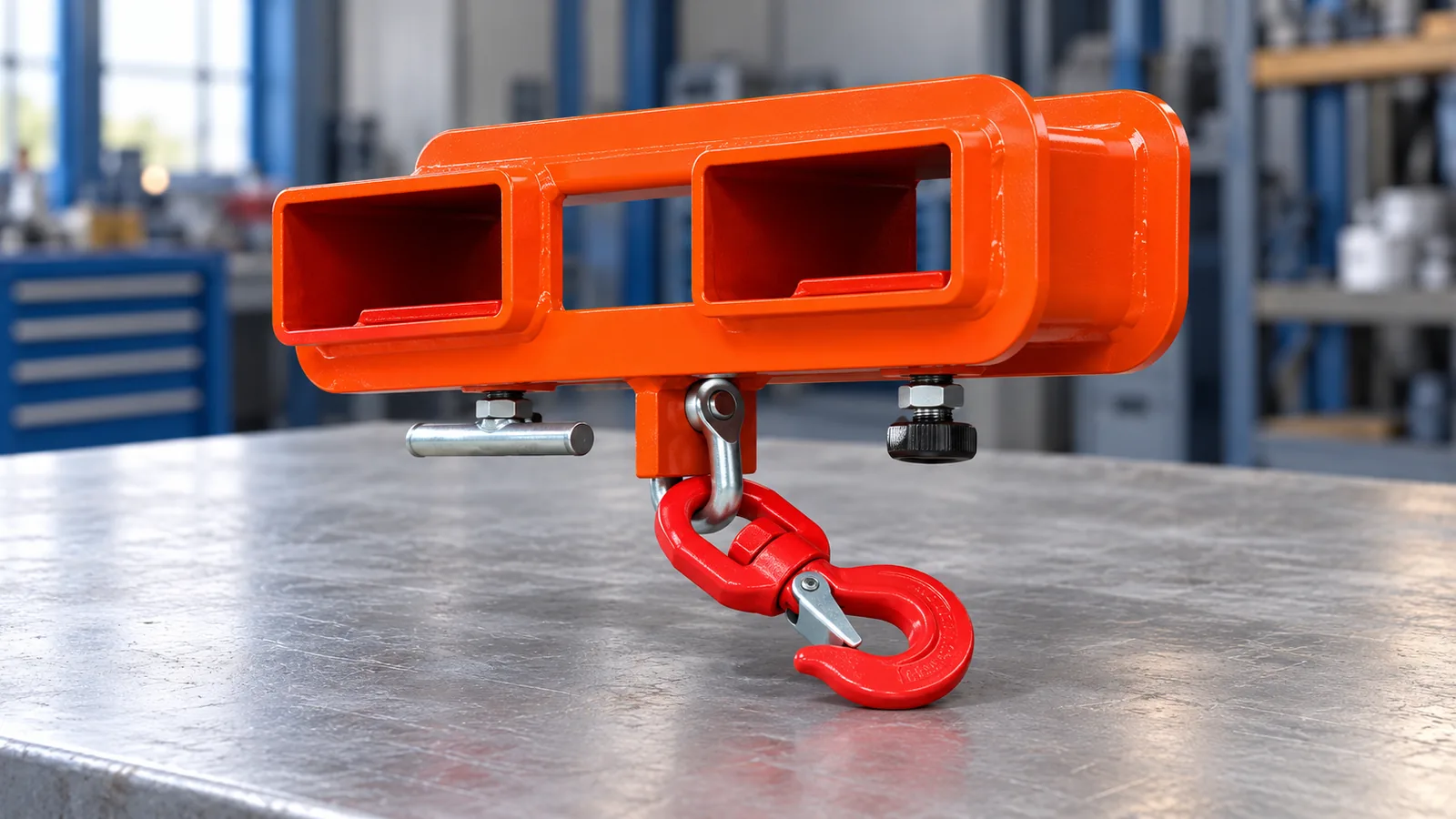
How to Choose a Forklift Lifting Hook: Fork Fit, Capacity, Load Centre and Retention
A forklift lifting hook attachment creates a connection for a suspended load, but choosing one is not simply a matter of matching the number on the hook to the tonnage on the truck. The attachment must fit the actual forks, remain secured in its approved position and work within the forklift’s confirmed capacity for that configuration.
Two attachments with similar advertised capacities can impose different demands on the truck. Their own weights, hook positions, fork engagement and retention arrangements may differ. A unit that slides onto the forks is not automatically approved for lifting with that forklift, and a swivel hook is not automatically approved to rotate under load.
This guide covers fork-mounted lifting hook attachments. It is not a guide to replacing a hook on a chain sling, using an improvised hook over a fork tip, or selecting a pallet fork suspended from a crane.
Quick answer: Choose a forklift lifting hook by the complete attachment’s confirmed capacity and intended use, fork-pocket dimensions, required engagement, approved retention method and actual hook position. Then obtain the truck’s applicable residual-capacity information for the attachment, load centre and lifting height. Include attachment and rigging weight in the appropriate capacity assessment. Do not assume that a high-capacity attachment preserves the forklift’s original nameplate capacity.
Table of contents
- Identify the attachment and the lifting task
- Separate the three capacity checks
- Measure the forks and mounting arrangement
- Confirm the model-specific retention method
- Check hook position, load centre and working space
- Compare the published KKV MK models
- Check the hook connection and swivel limitations
- Work through a preliminary mass example
- Prepare a useful enquiry and handover record
- Frequently asked questions
- Manufacturer references and their limits
Identify the Attachment and the Lifting Task
A fork-mounted hook attachment normally combines a fabricated body, one or more fork pockets, a retention arrangement and a lifting hook with its connecting components. The assembly matters: buying a hook with sufficient capacity does not establish the rating of its supporting frame or its connection to the truck.
Begin with a description of the actual movement. Is the requirement to lift a machine vertically from a stand, place a component into a fixture, or move an approved suspended load along a defined route? Record the pickup and landing positions, load dimensions, centre of gravity and available headroom. Tell the supplier whether the truck must remain stationary or whether travel is proposed.
Do not treat forks, fork extensions or other attachments as interchangeable mounting surfaces. A fit assessment must cover the exact fork set and any proposed accessories. Nor should a single-pocket attachment be assumed suitable for every individual tine: the truck and fork arrangement still require assessment for the applied loading.

Separate the Three Capacity Checks
1. The load carried below the hook
Establish the maximum payload and the mass of all rigging and other items carried below the attachment hook. A lifting beam, sling assembly or other below-hook accessory adds to the load at that hook. Use reliable weights; an estimate based on appearance is not an adequate basis for equipment selection.
2. The complete hook attachment and its components
Confirm the permitted load for the supplied assembly, including its mounting configuration and hook position. A replacement hook’s marking alone does not rate the complete attachment. The hook, connector, frame and retention system must belong to the specified configuration, and the rigging must have adequate capacity for its actual arrangement.
The Star Industries universal lift-hook manual distinguishes the attachment’s rating from the truck’s rating and requires the complete combination to remain within its limiting capacities. Its published dimensions and ratings apply to its own models, not to KKV attachments.
3. The forklift with that attachment installed
The forklift assessment also needs the attachment’s own mass and the position at which forces act. Request the applicable truck manufacturer information for the identified attachment, fork arrangement, load centre, mast configuration and required lifting height. Include other installed equipment where relevant and avoid counting an item twice if the approved chart already includes it.
A truck described as a 2.5-ton forklift is not thereby approved to handle every suspended load below 2.5 tons. Similarly, subtracting attachment weight from nameplate capacity does not account for the full configuration. CAM’s online residual-capacity tool explicitly describes its result as indicative and directs users to the truck producer for an official rating.
Measure the Forks and Mounting Arrangement
Send measurements and photographs of the actual truck rather than only its sales model. Record units clearly, identify where each measurement was taken and ask for a dimensioned attachment drawing. Pocket size and fork size must be considered together with the required engagement and retention geometry.
| Item to identify | What to send or request | Why it matters |
|---|---|---|
| Fork cross-section | Width and thickness at the intended mounting area, including the taper | A pocket that accepts the tip may not fit at the required operating position |
| Fork length and heel | Overall tine length, heel shape and any relevant obstructions | These affect engagement and compatibility with retention features |
| Fork arrangement | Number of forks used, permitted spacing and a front-view photograph | A twin-pocket frame requires the correct relationship between both tines |
| Pocket geometry | Internal width, height, usable depth and required clearance from the attachment drawing | Catalogue photographs cannot establish dimensional compatibility |
| Engagement and position | Required insertion, approved position and its reference point | Physical fit does not establish an approved hook location |
| Retention interfaces | Screw travel and contact area, or specified pin/chain interfaces as applicable | The retaining parts must function with this exact truck and fork set |
Check that the attachment can be mounted and removed using the intended procedure without hands entering trapping points. Confirm that the required positioning does not interfere with the carriage, load backrest or other equipment. Any fit issue should be resolved through the supplier and truck manufacturer, not by grinding a pocket or modifying a tine.
Confirm the Model-Specific Retention Method
Retention prevents unintended movement or disengagement; it is not a detail to improvise after delivery. Obtain the exact attachment’s instructions and identify every required securing component before ordering.
Manufacturer designs differ. Eichinger’s 2084/2085 instructions specify wing-screw retention for certain versions and heel-pin retention for others. Star’s 1370B/1371B manual describes retaining pins and a carriage safety chain for those models. Neither example establishes the required arrangement for a KKV MK unit.
Ask the supplier to identify where the attachment may sit, how it is secured and how security is checked. If screws are specified, obtain the correct method of tightening, contact requirements and rechecking instructions. Do not invent a universal torque or assume an extension bar should be used. If pins or other retaining parts are specified, confirm their identity and full installation method.
A large clamping screw in a photograph is not evidence that every configuration needs only that screw. Conversely, adding an improvised chain or pin does not make an unsuitable arrangement compliant. Do not drill, weld, substitute fasteners or add attachment points without the necessary manufacturer approval.

Check Hook Position, Load Centre and Working Space
The useful lifting point is the actual position of the hook, not the front edge of the attachment body. Ask for a drawing that locates the hook relative to a defined fork or carriage reference and identifies the attachment’s own centre of gravity. Use the same reference conventions as the truck capacity information.
Moving the attachment forward can change the load moment applied to the truck. A position that improves access to the load may therefore reduce the usable lifting capacity or fall outside the approved arrangement. Do not use the ability to slide the attachment along a tine as permission to lift from any position.
Check the complete vertical envelope
Measure the space required by the attachment, hanging connector, hook, rigging and load. The hook must reach the pickup point and the load must clear its support without an unapproved mast position. Compare the required lift with the applicable capacity at that height, not only with a ground-level capacity figure.
Also allow for the load’s width and potential movement. A suspended item can occupy more space than the same item resting on a pallet. Columns, racks, doorways, overhead services and the landing area should be considered in the planned arrangement.
Distinguish stationary lifting from travel
Tell the supplier if travel is required. Obtain explicit confirmation of what the attachment and truck instructions permit, together with the site-specific plan and operator requirements. Do not infer permission from a product’s marketing description. Equally, do not copy a blanket travel prohibition from another attachment: Conquip’s own guide permits controlled short-distance movement under its stated conditions. Those conditions are not a KKV operating procedure.
A fork-mounted hook does not automatically make the truck equivalent to a mobile crane or authorize towing, side pulling or personnel lifting.
Compare the Published KKV MK Models
The current KKV fork-hook product page lists the following values. The heading below preserves its wording, Load Capacity, rather than assuming an unpublished rating condition.
| Model | Published load capacity | Published net weight |
|---|---|---|
| MK5 | 500 kg | 6.5 kg |
| MK10 | 1,000 kg | 14 kg |
| MK25 | 2,500 kg | 20 kg |
| MK40 | 4,000 kg | 30 kg |
| MK50 | 5,000 kg | 45 kg |
The page describes adjustable positioning, thumb-screw fixing and a swivel hook with a latch. It does not provide the pocket dimensions, attachment centre of gravity, approved mounting positions, compatible-truck list or residual-capacity chart needed to complete a truck-specific assessment.
Use this table to shortlist a model, then request the current dimensioned drawing and instructions for that exact configuration. Confirm the supplied assembly’s rated conditions and documentation. Do not infer that choosing a larger model automatically improves the combination: a heavier or differently positioned attachment changes the information needed for the forklift assessment.
Check the Hook Connection and Swivel Limitations
Check that the selected sling master link, shackle or other approved connection can seat correctly in the hook bowl without crowding, wedging or loading the tip or latch. The latch is a closing feature, not an alternative load-bearing surface. Several small connectors forced into one hook may be less suitable than a properly specified single connection.
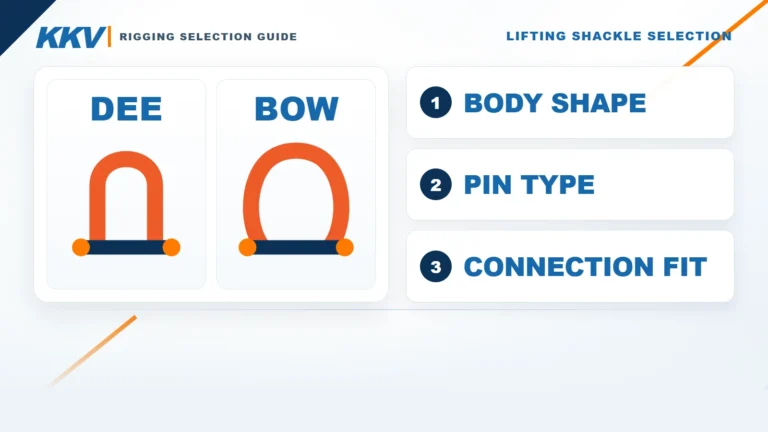
Where a shackle is proposed, review the lifting-shackle selection guide and confirm the exact dimensions, loading arrangement and manufacturer’s limits. Do not substitute a connector simply because its marked tonnage appears sufficient.
Ask separately whether the hook can be oriented before pickup and whether it may rotate while loaded. These are different capabilities. For example, JDT’s GS/GSD forklift swivel-hook instructions explicitly prohibit rotation under load and require positioning before pickup. The presence of a swivel on a KKV product does not establish an under-load rotation capability.
The intended load path should be confirmed with the load’s centre of gravity beneath the hook. Do not plan to drag a load into alignment, pull against a fixed object or use the truck’s movement to create a side load through the hook.
Work Through a Preliminary Mass Example
Suppose a workshop wants to lift a machine using a sling assembly and is considering an MK10 attachment. The following is a purchasing illustration, not approval of a lift.
| Listed item | Mass | Where it enters the assessment |
|---|---|---|
| Machine payload | 900 kg | Below the attachment hook |
| Sling assembly and other below-hook rigging | 60 kg | Below the attachment hook |
| Load applied at the hook from these items | 960 kg | Preliminary attachment-capacity check |
| Candidate MK10 published net weight | 14 kg | Additional mass for the forklift assessment |
| Subtotal of the listed items | 974 kg | Input to the truck assessment, subject to its chart conventions |
The 960 kg hook load is below the MK10’s published 1,000 kg capacity, so this model may enter a preliminary shortlist. That comparison does not verify its rated conditions, retention, fork fit or suitability for the job.
Likewise, a nominal 2,500 kg forklift cannot be accepted solely because 974 kg is a smaller number. The truck producer still needs the attachment geometry, hook location, load centre, fork arrangement and required lifting height. Other applicable masses must be included without double-counting any allowance already incorporated into an approved chart.
If access requires the hook to move farther forward, update the configuration review. Do not reuse the earlier conclusion or create a new rating with a simple capacity-to-distance ratio. If the final rigging is heavier than 60 kg, update the hook-load and truck assessments as well.
Prepare a Useful Enquiry and Handover Record
A useful enquiry pairs the attachment drawing with a real truck and load description. It should let the supplier answer a specific compatibility question rather than merely quote a tonnage.
| Record | Information to provide or obtain |
|---|---|
| Truck identity | Manufacturer, exact model, serial details, mast configuration and current capacity information |
| Fork set | Number used, width, thickness, length, spacing and photographs at the proposed mounting area |
| Maximum load | Payload, below-hook accessories, dimensions, centre of gravity and lifting points |
| Proposed geometry | Hook position, required engagement, pickup height, landing height and clearances |
| Operating scope | Stationary lifting or proposed travel, route, floor condition and relevant environmental exposure |
| Attachment evidence | Model, own mass, centre of gravity, drawing, complete retention instructions and supplied component identities |
| Final acceptance | Applicable truck capacity/approval information, instructions, identification and project-required documents |
At handover, make sure the delivered assembly matches the reviewed model and drawing. Check the legibility of identification, presence of the specified retaining parts and condition of the frame, pockets, welds, screws, pins, hook and latch. Missing parts, damage, a mismatched fork set or uncertain capacity information should be resolved before use.
Set inspection and maintenance arrangements from the applicable instructions, service conditions and local requirements. Do not copy another brand’s wear percentages, test loads or inspection intervals onto an MK attachment. This buying checklist does not replace the operator’s manual, the required training or a competent person’s assessment of the actual lifting task.
Frequently Asked Questions
Can I fit a lifting hook attachment to any forklift?
No. Physical fit is only one check. The fork set, retention interfaces, permitted attachment position and truck capacity for the proposed configuration also need confirmation. Identify the actual truck and obtain the applicable manufacturer information before use.
Is a 2.5-ton hook attachment suitable for a 2.5-ton forklift?
Not necessarily. Those two advertised capacities describe different items. Attachment weight, hook location, load centre, lifting height and other configuration limits affect what the combination may handle. Neither number alone approves the assembly.
Are two-pocket attachments always better than single-pocket attachments?
No universal conclusion follows from pocket count. Choose the manufacturer-approved arrangement for the truck, fork loading and task. A twin-pocket model still needs the correct spacing and engagement; a single-pocket model requires assessment of the loading it introduces.
Can I position the hook near the fork tips for extra reach?
Only if that position is permitted by the exact attachment instructions and the truck’s applicable capacity information. Adjustable positioning is not an unlimited reach allowance. Obtain the approved location and retention details rather than estimating from a photograph.
Is a clamping screw enough to prevent the attachment sliding off?
That depends on the design. Some manufacturers specify screw retention for particular models, while others specify heel pins, chains or a combination. Follow the complete instructions for the supplied attachment. Do not omit specified hardware or improvise an alternative system.
Does a swivel hook allow the load to rotate during lifting?
Not automatically. Some swivels are intended for positioning before loading. Ask for explicit confirmation of any permitted rotation under load, including its conditions. Do not infer that capability from the word swivel or from a freely moving unloaded hook.
Can the forklift travel while carrying a suspended load?
Do not assume permission or apply another model’s procedure. Establish what the exact truck and attachment instructions allow, together with the site plan, route, load-control measures and operator requirements. Where the combination or conditions are not approved, do not proceed.
Which KKV MK model should I request first?
Start with the maximum below-hook load, then provide the truck identity, fork measurements, proposed hook position and required height. The published MK table supports an initial shortlist; the supplier still needs to confirm the assembly and help obtain the necessary truck-specific compatibility information.
Manufacturer References and Their Limits
These primary sources support the selection principles and the model-specific examples in this guide. They are not interchangeable operating instructions.
- KKV MK fork-hook product page: published model capacities, net weights and product description.
- Star Industries universal lift-hook manual: attachment and truck capacity checks and its own retaining arrangement.
- Eichinger 2084/2085 instructions: different securing methods within a product family.
- JDT GS/GSD forklift swivel-hook instructions: connection, load alignment and its specific swivel limitation.
- Conquip FA810 fork-mounted hook guide: model-specific mounting, handling and movement conditions.
- CAM residual-capacity calculator: an indicative tool, not an official forklift rating.
Other manufacturers’ capacities, dimensions, tightening methods, travel conditions and inspection limits must not be assigned to a KKV model. Obtain the current documents for the equipment actually supplied and the forklift actually used.
Specify the Forklift Hook Attachment, Not Just Its Tonnage
The right purchase connects a defined load, a compatible fork-mounted attachment and a forklift configuration with confirmed capacity. A nominal tonnage match is only a starting point. Resolve pocket fit, retention, hook location and documentation before the attachment arrives on site.
For a forklift lifting hook enquiry: send your truck model, fork measurements, maximum payload and rigging weight, proposed hook position and required lifting height to sales@kkvhoist.com, or contact KKV. Include photographs and a drawing where available so the exact MK configuration can be reviewed.
Safety note: This is a general purchasing guide, not an installation procedure, lifting plan, capacity certificate or permission to operate. Follow the supplied attachment and truck instructions, applicable requirements and site assessment. Do not lift with uncertain capacity, incomplete retention or damaged equipment; never use this attachment to lift people or allow anyone beneath a suspended load.