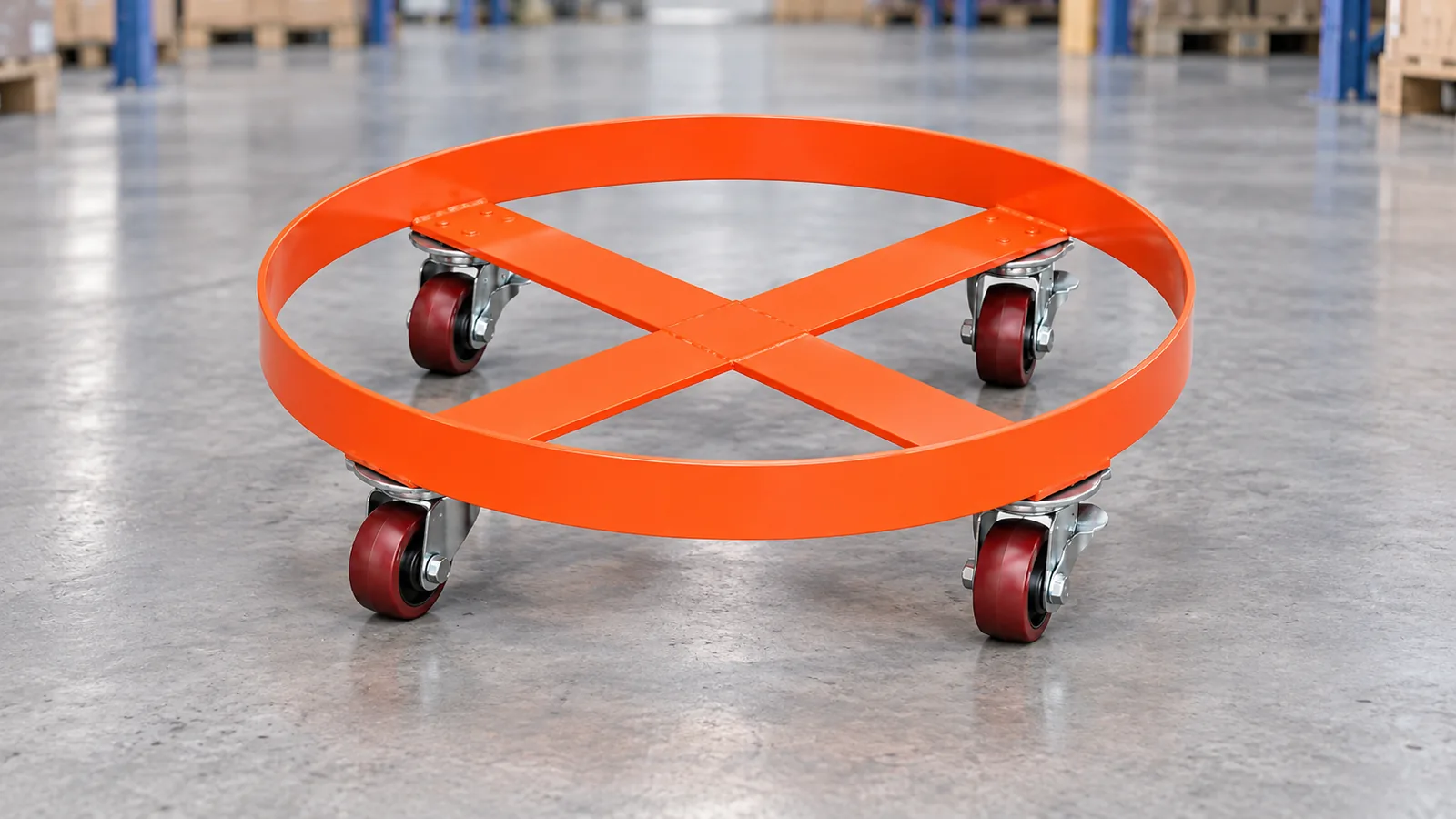
How to Choose a Drum Dolly: Drum Fit, Capacity, Wheels and Floor Conditions
A drum dolly can make an upright drum easier to reposition, but a suitable purchase requires more than a matching gallon size and a high load rating. The drum bottom must sit on the intended supports, the complete loaded drum must remain within the dolly’s capacity, and the wheels must suit the actual route.
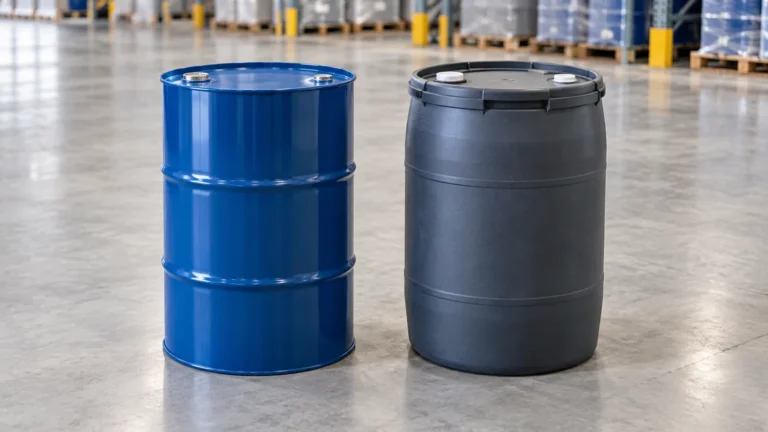
Two dollies advertised for 55-gallon drums may have different support geometry, frame materials, caster arrangements and handling characteristics. Likewise, two drums with the same nominal volume do not necessarily have identical bottom dimensions. A dolly that fits one steel drum should not automatically be accepted for every plastic drum of the same stated capacity.
This guide covers floor-supported drum transport dollies, including the KKV SD55 range. It is not a guide to suspending drums from a crane, turning them for dispensing or using a drum dolly as spill containment.
Quick answer: Choose a drum dolly by the actual drum-bottom geometry, maximum gross drum weight, approved support arrangement, wheel specification and floor conditions. Confirm the exact model’s materials, dimensions, loading method and parking provisions. Use nominal gallon size only as an initial filter, and do not assume stainless or plastic construction guarantees chemical compatibility, hygienic suitability or containment performance.
Table of contents
- Decide whether a drum dolly fits the task
- Check the drum bottom, not only its gallon size
- Calculate the maximum gross drum weight
- Compare the published KKV SD55 models
- Match wheels and casters to the real route
- Check materials and environmental requirements
- Plan loading, unloading and parking
- Work through a preliminary selection example
- Prepare the enquiry and acceptance checks
- Frequently asked questions
- Primary references and their limits
Decide Whether a Drum Dolly Fits the Task
A simple drum dolly supports an upright drum close to floor level and provides wheels for movement and positioning. It does not inherently lift a drum onto its own support, grip the drum for overhead handling or rotate it for pouring.
Start by describing the complete job. Record where the drum starts, how it will be placed on the dolly, the route, where it will stop and how it will be removed. Include the most demanding loaded condition, not only the empty-drum demonstration.
If the requirement includes raising the drum from the floor or controlled rotation, review a purpose-designed drum carrier and tilter as a different equipment category. Do not assume a round transport base provides those functions.
For a basic dolly, focus the enquiry on upright floor movement within the manufacturer’s stated conditions. Towing, ramps, lifting the loaded dolly and use as a dispensing or storage installation are separate requirements to confirm, not automatic consequences of a load rating.

Check the Drum Bottom, Not Only Its Gallon Size
Nominal volume describes the container’s capacity, not all of its external dimensions. Identify the exact drum manufacturer and design, then compare its bottom with a dimensioned drawing of the proposed dolly.
The relevant fit is at the support and locating surfaces. A drum may have a rolled bottom rim, a recessed base, moulded feet or another bottom profile. Its largest body diameter may not describe the surface that will actually bear on the dolly.
| Feature to check | Information to obtain | Question it resolves |
|---|---|---|
| Actual bottom diameter | Drum drawing and measurement at the intended support location | Will the bottom fit the locating rim or support arrangement? |
| Bottom profile | Rim/chime shape, recesses, moulded details and bearing surfaces | Will the drum be supported where its design permits? |
| Dolly support geometry | Clear internal dimensions, crossbar/deck layout and locating features | Is the load carried by the intended supports rather than an unsuitable edge? |
| Overall envelope | Drum height, maximum width, dolly footprint and loaded height | Is there sufficient working and route clearance? |
| Container condition | Damage, distortion and any restrictions from the drum supplier | Is this particular container suitable for handling? |
Morse’s Model 14 specification, for example, states an actual maximum outside drum diameter as well as the nominal drum volume. Its dimensions apply to that Morse model, not to the KKV SD55 series. The useful lesson is to ask for a measurable fit requirement.
Do not accept a loose or partially supported drum because the load is below the dolly’s rating. Conversely, a tight fit that traps the drum or loads an unsuitable part of its base is not an adequate match. Confirm the support arrangement with the dolly and drum suppliers rather than making spacers or modifying a frame to fit.
Calculate the Maximum Gross Drum Weight
Use the mass carried on the dolly: contents, the drum itself, closure and any other items that move with it. Do not select from contents weight alone or assume a nominal volume contains a known mass regardless of the material inside.
If the drum is weighed as a complete closed unit, its reading may already include the container and closure. Avoid adding those items twice. If the mass is calculated from separate records, identify what each value includes and confirm the maximum intended fill condition.
The Vestil DRUM-X manual explicitly compares its rating with the barrel plus all contents. That is a useful gross-load distinction, but its dimensions and operating conditions do not establish an SD55 rating.
The dolly’s own net weight has a different role. It is not additional drum-carrying capacity, but it contributes to the total mass moving across the floor. For caster engineering, floor assessment and handling-effort review, keep payload and equipment mass clearly identified.
Do not calculate a new complete-dolly capacity by adding individual caster ratings. Blickle’s load-capacity guidance accounts for equipment weight, load, supporting casters and application conditions, and notes that load sharing may be unequal. Replacement wheels do not automatically re-rate the frame or complete dolly.
Compare the Published KKV SD55 Models
The current KKV Round Drum Dolly page publishes the following figures. The capacity column retains the catalogue wording, Loading Weight.
| Model | Published loading weight | Net weight | Published wheel dimension |
|---|---|---|---|
| SD55A | 300 kg | 7.5 kg | Ø75 × 35 mm |
| SD55B | 400 kg | 8.5 kg | Ø75 × 35 mm |
| SD55C | 300 kg | 5.4 kg | Ø75 × 35 mm |
| SD55D | 400 kg | 6 kg | Ø75 × 35 mm |
| SD55E | 400 kg | 7.2 kg | Ø75 × 35 mm |
| SD55F | 400 kg | 9 kg | Ø75 × 35 mm |
| SD55G | 400 kg | 10 kg | Ø75 × 35 mm |
| SD55H | 400 kg | 9.5 kg | Ø75 × 35 mm |
The live product introduction identifies SD55C, SD55D and SD55H as stainless steel, and SD55E as plastic construction. It describes the series generally for 30- and 55-gallon steel or plastic drums. It does not provide a model-by-model drum-fit matrix.
The public table also does not specify the internal support dimensions, deck height, tread material, bearing type, brake provision or stainless/plastic grade. Obtain the exact model drawing and supplied caster details before treating two models with the same capacity as equivalent.
Match Wheels and Casters to the Real Route
The wheel size is only the beginning
The SD55 table lists the same wheel dimension across all eight models, but this does not prove identical rolling performance. Ask for the tread material, bearing arrangement, caster mounting and any parking feature supplied with the selected model.
Blickle’s wheel-series engineering guide identifies wheel diameter, tread properties, bearing and floor surface among the factors affecting starting and rolling resistance. Its published comparisons use controlled conditions; they are not a measurement of effort on your route.
Avoid universal recommendations such as nylon for every warehouse or rubber for every rough floor. The right choice must balance the approved load, floor protection, rolling effort, environmental exposure and required manoeuvring. A wheel’s colour is not reliable evidence of its material.
Walk and document the route
Include floor joints, cracks, thresholds, drain covers, gaps, debris, tight turns and changes of level in the enquiry. Record where the loaded drum must start, turn and stop. Do not describe a route as smooth merely because most of it is polished concrete.
The Morse 14 Series manual warns that uneven floors, obstructions, holes and slopes can create control or tipping problems. The Vestil DRUM-X instructions limit those models to even, level ground. These are reasons to verify the SD55’s permitted route, not to copy another brand’s limit or prescribe a threshold height.
Do not assume a brake, if fitted, authorizes ramp use. Nor should a user substitute larger casters without manufacturer review: changing them can alter support height, clearances, mounting loads and the handling configuration.
Distinguish load rating from handling effort
A load may be below the published capacity yet require unsuitable effort to start or steer. Ask how the proposed loaded arrangement will be assessed for the operators, frequency and actual route. No universal one-person pushing limit is established by the SD55 table.
Check Materials and Environmental Requirements
The frame, supports, fasteners, caster brackets, bearings and wheel treads are different parts of the assembly. Identifying one material does not describe them all.
For example, the Morse manual distinguishes stainless-frame versions with steel casters from a version with stainless casters. That is not an SD55 construction claim; it illustrates why a buyer should request the complete material specification rather than rely on a stainless label.
Likewise, plastic does not automatically mean compatible with every chemical, and stainless steel does not automatically mean suitable for a hygienic production environment. Provide the cleaning agents, contact conditions, relevant temperatures and workplace requirements for review.
Blickle’s environmental guide treats chemical resistance as dependent on the substance, concentration, exposure and temperature. Use that principle to ask a specific compatibility question, not to assume a generic wheel or frame material is chemical-proof.
If the process requires spill retention, drainage control, static-control properties or a specific cleanability standard, state that explicitly. A shallow rim or tray-like appearance is not a declared containment volume, and a plastic or stainless frame is not evidence of an approved static-control assembly.

Plan Loading, Unloading and Parking
Decide how the drum will enter and leave the dolly before placing the order. A low-profile base is not necessarily a self-loading device, and the lifting method must suit the actual container and transfer height.
Provide the supplier with the drum’s starting position, the dolly’s support height and the proposed loading equipment. Ask for the permitted loading procedure and required precautions. Do not assume a heavy drum should be manually tipped onto the rim or dragged over it.
For parking, confirm whether the supplied model has wheel brakes, swivel locks or neither, what any mechanism actually restrains, and how the loaded unit is to be kept secure under the site plan. Do not infer a brake from an unclear catalogue photo.
Also confirm how the drum is located or retained during the approved movement. A surrounding ring is not automatically a restraint for every drum, and extra straps or improvised handles do not establish an approved configuration. Towability, overhead lifting and dispensing should be reviewed as separate uses, not assumed features.
Work Through a Preliminary Selection Example
Suppose a workshop needs to reposition a closed drum and has the following maximum planned masses. These are hypothetical values, not standard drum weights.
| Listed item | Mass | Meaning |
|---|---|---|
| Contents | 285 kg | Maximum planned contents mass |
| Empty drum | 22 kg | Container tare |
| Closure and carried accessories | 8 kg | Items not already included above |
| Gross carried load | 315 kg | Preliminary comparison with dolly loading weight |
| Candidate SD55B net weight | 8.5 kg | Additional equipment mass |
| Listed moving mass | 323.5 kg | Input to route, floor and handling assessment |
A 315 kg gross carried load exceeds the published 300 kg loading weight of SD55A and SD55C. A 400 kg model may therefore enter the capacity shortlist. This comparison alone does not approve SD55B or any other model.
The buyer must still verify bottom dimensions, support geometry, drum material, caster specification, loading method and route. If there is a raised doorway threshold, record its geometry and obtain a route decision rather than assuming the 75 mm wheels can cross it safely.
The 323.5 kg moving subtotal is not a new payload rating. If different accessories or another dolly model are selected, update the relevant masses and assessment. Do not copy the example as permission to handle another drum.
Prepare the Enquiry and Acceptance Checks
A useful enquiry describes the actual drum and movement rather than simply requesting a 55-gallon trolley.
| Enquiry field | Information to provide or obtain |
|---|---|
| Drum identification | Manufacturer/model, material, nominal volume and drawing |
| Fit dimensions | Actual bottom profile/diameter, overall size and approved support surfaces |
| Maximum load | Gross drum mass with contents, closure and accessories identified |
| Transfer method | How the drum will be loaded, unloaded and positioned |
| Route | Floor type, joints, thresholds, level changes, turns and available space |
| Working environment | Cleaning agents, relevant exposure, temperature and any special requirements |
| Supplied configuration | Exact SD55 model, drawing, material specification, caster details, parking provisions and instructions |
On receipt, compare the supplied unit with the reviewed offer. Inspect the support structure, rim/deck, caster attachments, wheels and visible fasteners for damage or looseness, and confirm that rolling and swivelling function as specified. Obtain the manufacturer’s inspection and maintenance requirements rather than inventing a universal service interval.
Do not begin loaded use with uncertain fit, missing instructions, a damaged container or a defective dolly. Do not re-rate the unit after changing casters or repairing the frame without the necessary manufacturer review.
Frequently Asked Questions
Will any 55-gallon drum fit a 55-gallon drum dolly?
Not automatically. Check actual bottom dimensions, profile and permitted support arrangement against the exact dolly drawing. Nominal volume is an initial description, not a complete fit specification.
Should I select capacity using only the contents weight?
No. Include the drum, closure and other carried items not already included in a complete weighing. Keep the dolly’s own mass separate for the total moving-mass assessment, and avoid double-counting items.
Are all SD55 models rated at 400 kg?
No. KKV lists SD55A and SD55C at 300 kg; the other six listed models are 400 kg. Check the exact model, and remember that capacity does not establish drum fit or route suitability.
Does the same wheel dimension mean the models roll identically?
No. Wheel material, bearings, caster condition, load and floor all affect handling. The SD55 table’s Ø75 × 35 mm value does not identify those other characteristics. Obtain the supplied caster specification.
Is a stainless drum dolly automatically suitable for washdown or food production?
No. Confirm the complete construction, weld finish, casters, bearings and cleaning compatibility against the process requirements. The frame description alone does not establish hygienic or chemical suitability.
Can a drum dolly be used on a ramp if it has brakes?
Do not assume so. Confirm the exact equipment instructions and site assessment. A parking feature does not by itself establish slope, stopping or load-control capability, and the KKV public table gives no ramp approval.
Is a plastic tray-style dolly also a spill pallet?
Not without explicit manufacturer confirmation of that function. Appearance alone does not establish containment volume, chemical compatibility or the requirements of the particular process.
Can I tow the dolly or lift it while loaded?
Do not treat either as an ordinary feature of a floor-transport dolly. Obtain explicit approval of the exact configuration for the proposed function, or select equipment designed for it. The SD55 public data does not establish those approvals.
Primary References and Their Limits
These manufacturer sources support the attributed examples and selection distinctions. Their ratings and procedures are not KKV specifications.
- KKV SD55 Round Drum Dolly: current model table and series-level description.
- Morse Model 14: an example of specifying actual drum fit dimensions.
- Morse 14 Series manual: route hazards and distinctions between frame and caster materials in its own models.
- Vestil DRUM-X manual: its gross-load and level-ground requirements.
- Blickle load-capacity guide: equipment mass, supporting casters and application conditions.
- Blickle wheel-series guide: factors affecting rolling and starting resistance.
- Blickle environmental factors: material and exposure-specific compatibility considerations.
Use the instructions and current drawing for the actual unit supplied. Do not apply another manufacturer’s drum diameter, wheel specification, brake arrangement or operating limits to an SD55 model.
Match the Drum, the Dolly and the Route
The right drum dolly combines suitable bottom support, adequate capacity and a caster arrangement that works under the intended conditions. Resolve those three interfaces together, then confirm loading and parking before the unit enters service.
For a drum-dolly enquiry: send your drum drawing and bottom dimensions, maximum gross load, loading method, route details and material requirements to sales@kkvhoist.com, or contact KKV. Include the proposed SD55 model and quantity so the exact configuration and documentation can be confirmed.
Safety note: This is a general purchasing guide, not a loading procedure, handling assessment or approval for a particular drum. Follow the actual equipment instructions and applicable site requirements. Do not exceed capacity, use damaged equipment, improvise loading methods or assume approval for slopes, towing, lifting, personnel movement or containment.